

6 Calorimetry
221
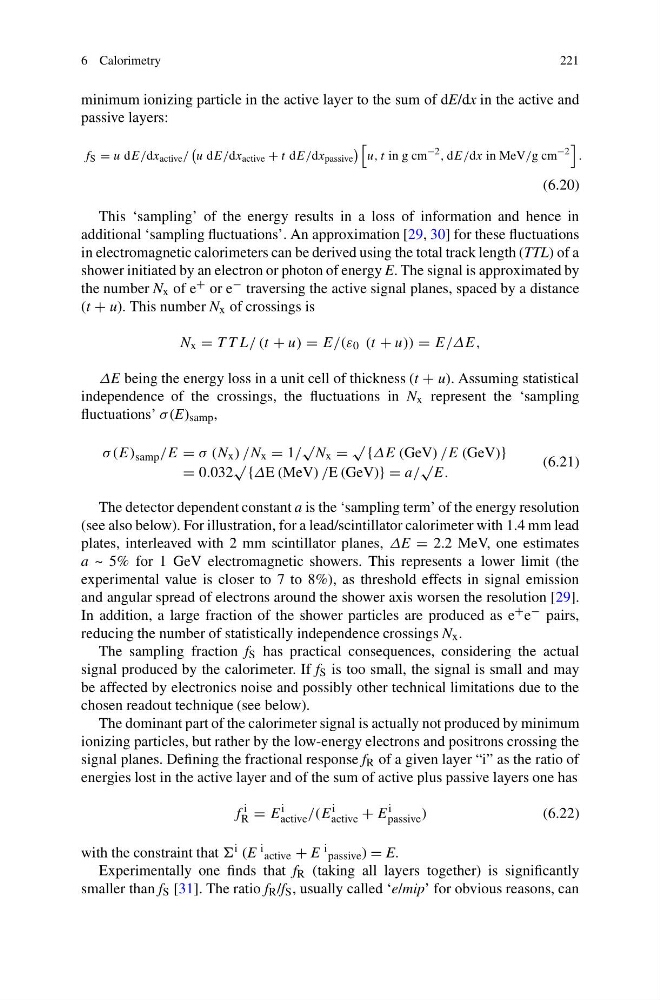
minimum ionizing particle in the active layer to the sum of dE/dx in the active and
passive layers:
f S = u dE/dx active /
u dE/dx active + t dE/dx passive
u, t in g cm
−2 , dE/dx in MeV/g cm
−2
.
(6.20)
This ‘sampling’ of the energy results in a loss of information and hence in
additional ‘sampling fluctuations’. An approximation [29, 30] for these fluctuations
in electromagnetic calorimeters can be derived using the total track length (TTL) of a
shower initiated by an electron or photon of energy E. The signal is approximated by
the number N x of e + or e − traversing the active signal planes, spaced by a distance
(t + u). This number N x of crossings is
N x = T T L/ (t + u) = E/(ε 0 (t + u)) = E/ΔE,
ΔE being the energy loss in a unit cell of thickness (t + u). Assuming statistical
independence of the crossings, the fluctuations in N x represent the ‘sampling
fluctuations’ σ (E) samp ,
σ (E) samp /E = σ (N x ) /N x = 1/
√
N x =
√ {ΔE (GeV) /E (GeV)}
= 0.032
√ {ΔE (MeV) /E (GeV)} = a/
√
E.
(6.21)
The detector dependent constant a is the ‘sampling term’ of the energy resolution
(see also below). For illustration, for a lead/scintillator calorimeter with 1.4 mm lead
plates, interleaved with 2 mm scintillator planes, ΔE = 2.2 MeV, one estimates
a ~ 5% for 1 GeV electromagnetic showers. This represents a lower limit (the
experimental value is closer to 7 to 8%), as threshold effects in signal emission
and angular spread of electrons around the shower axis worsen the resolution [29].
In addition, a large fraction of the shower particles are produced as e + e − pairs,
reducing the number of statistically independence crossings N x .
The sampling fraction f S has practical consequences, considering the actual
signal produced by the calorimeter. If f S is too small, the signal is small and may
be affected by electronics noise and possibly other technical limitations due to the
chosen readout technique (see below).
The dominant part of the calorimeter signal is actually not produced by minimum
ionizing particles, but rather by the low-energy electrons and positrons crossing the
signal planes. Defining the fractional response f R of a given layer “i” as the ratio of
energies lost in the active layer and of the sum of active plus passive layers one has
f
i
R = E
i
active /(E
i
active + E
i
passive )
(6.22)
with the constraint that i (E i active + E i passive ) = E.
Experimentally one finds that f R (taking all layers together) is significantly
smaller than f S [31]. The ratio f R /f S , usually called ‘e/mip’ for obvious reasons, can
221
minimum ionizing particle in the active layer to the sum of dE/dx in the active and
passive layers:
f S = u dE/dx active /
u dE/dx active + t dE/dx passive
u, t in g cm
−2 , dE/dx in MeV/g cm
−2
.
(6.20)
This ‘sampling’ of the energy results in a loss of information and hence in
additional ‘sampling fluctuations’. An approximation [29, 30] for these fluctuations
in electromagnetic calorimeters can be derived using the total track length (TTL) of a
shower initiated by an electron or photon of energy E. The signal is approximated by
the number N x of e + or e − traversing the active signal planes, spaced by a distance
(t + u). This number N x of crossings is
N x = T T L/ (t + u) = E/(ε 0 (t + u)) = E/ΔE,
ΔE being the energy loss in a unit cell of thickness (t + u). Assuming statistical
independence of the crossings, the fluctuations in N x represent the ‘sampling
fluctuations’ σ (E) samp ,
σ (E) samp /E = σ (N x ) /N x = 1/
√
N x =
√ {ΔE (GeV) /E (GeV)}
= 0.032
√ {ΔE (MeV) /E (GeV)} = a/
√
E.
(6.21)
The detector dependent constant a is the ‘sampling term’ of the energy resolution
(see also below). For illustration, for a lead/scintillator calorimeter with 1.4 mm lead
plates, interleaved with 2 mm scintillator planes, ΔE = 2.2 MeV, one estimates
a ~ 5% for 1 GeV electromagnetic showers. This represents a lower limit (the
experimental value is closer to 7 to 8%), as threshold effects in signal emission
and angular spread of electrons around the shower axis worsen the resolution [29].
In addition, a large fraction of the shower particles are produced as e + e − pairs,
reducing the number of statistically independence crossings N x .
The sampling fraction f S has practical consequences, considering the actual
signal produced by the calorimeter. If f S is too small, the signal is small and may
be affected by electronics noise and possibly other technical limitations due to the
chosen readout technique (see below).
The dominant part of the calorimeter signal is actually not produced by minimum
ionizing particles, but rather by the low-energy electrons and positrons crossing the
signal planes. Defining the fractional response f R of a given layer “i” as the ratio of
energies lost in the active layer and of the sum of active plus passive layers one has
f
i
R = E
i
active /(E
i
active + E
i
passive )
(6.22)
with the constraint that i (E i active + E i passive ) = E.
Experimentally one finds that f R (taking all layers together) is significantly
smaller than f S [31]. The ratio f R /f S , usually called ‘e/mip’ for obvious reasons, can