

6 Calorimetry
219
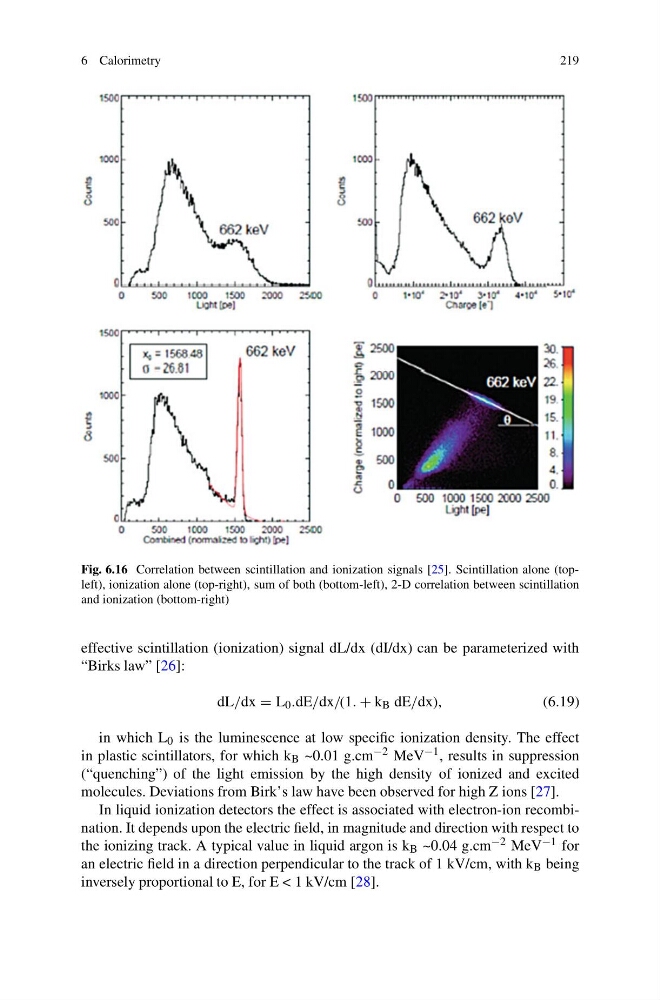
Fig. 6.16 Correlation between scintillation and ionization signals [25]. Scintillation alone (topleft), ionization alone (top-right), sum of both (bottom-left), 2-D correlation between scintillation
and ionization (bottom-right)
effective scintillation (ionization) signal dL/dx (dI/dx) can be parameterized with
“Birks law” [26]:
dL/dx = L 0 .dE/dx/(1. + k B dE/dx),
(6.19)
in which L 0 is the luminescence at low specific ionization density. The effect
in plastic scintillators, for which k B ~0.01 g.cm −2 MeV −1 , results in suppression
(“quenching”) of the light emission by the high density of ionized and excited
molecules. Deviations from Birk’s law have been observed for high Z ions [27].
In liquid ionization detectors the effect is associated with electron-ion recombination. It depends upon the electric field, in magnitude and direction with respect to
the ionizing track. A typical value in liquid argon is k B ~0.04 g.cm −2 MeV −1 for
an electric field in a direction perpendicular to the track of 1 kV/cm, with k B being
inversely proportional to E, for E < 1 kV/cm [28].
219
Fig. 6.16 Correlation between scintillation and ionization signals [25]. Scintillation alone (topleft), ionization alone (top-right), sum of both (bottom-left), 2-D correlation between scintillation
and ionization (bottom-right)
effective scintillation (ionization) signal dL/dx (dI/dx) can be parameterized with
“Birks law” [26]:
dL/dx = L 0 .dE/dx/(1. + k B dE/dx),
(6.19)
in which L 0 is the luminescence at low specific ionization density. The effect
in plastic scintillators, for which k B ~0.01 g.cm −2 MeV −1 , results in suppression
(“quenching”) of the light emission by the high density of ionized and excited
molecules. Deviations from Birk’s law have been observed for high Z ions [27].
In liquid ionization detectors the effect is associated with electron-ion recombination. It depends upon the electric field, in magnitude and direction with respect to
the ionizing track. A typical value in liquid argon is k B ~0.04 g.cm −2 MeV −1 for
an electric field in a direction perpendicular to the track of 1 kV/cm, with k B being
inversely proportional to E, for E < 1 kV/cm [28].