

6 Calorimetry
217
no dependence of shower transverse profiles (integrated over depth) as a function of
initial electron energy.
6.2.3 Homogeneous Calorimeters
For reasons explained later, large calorimeter systems are often ‘sampling’ calorimeters. These calorimeters are built as a stack of passive layers, in general of high
Z material for electromagnetic calorimeters, alternating with layers of a sensitive
medium responding to (‘sampling’ the) electrons/positrons of the shower, produced
mostly in the passive layers.
A homogeneous calorimeter is built only from the sensitive medium. Provided all
other conditions are satisfied (full containment of the shower, efficient collection and
processing of the signal) homogeneous calorimeters give the best energy resolution,
because sampling calorimeters are limited by ‘sampling fluctuations’ (see Sect.
6.2.4). It is instructive to study first the limitations in the “ideal” conditions of
homogeneous calorimeters.
We first discuss low-energy applications, where the absorption does not involve
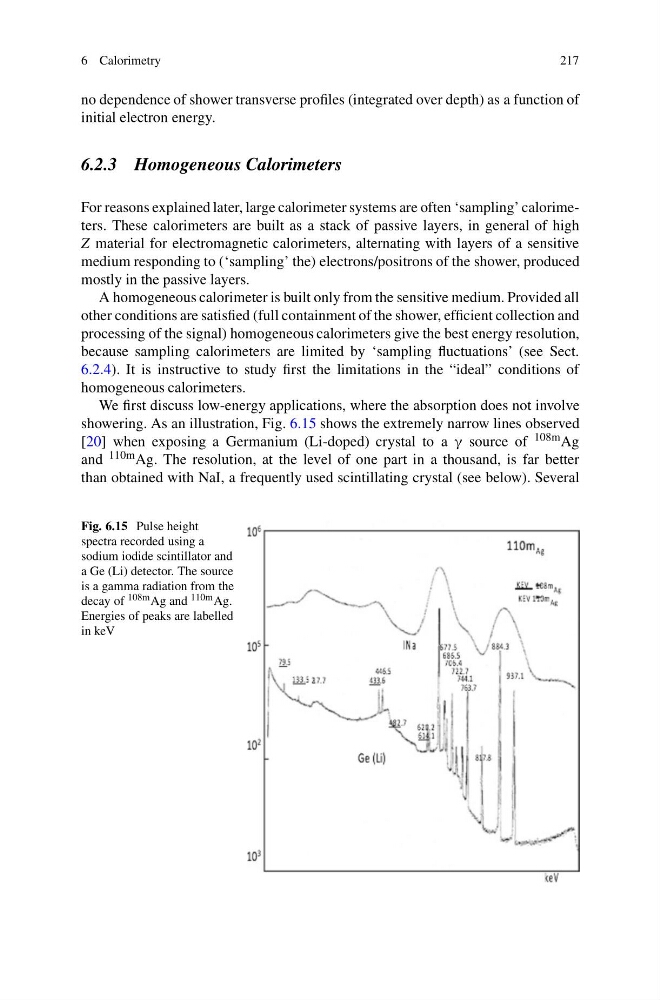
showering. As an illustration, Fig. 6.15 shows the extremely narrow lines observed
[20] when exposing a Germanium (Li-doped) crystal to a γ source of 108m Ag
and 110m Ag. The resolution, at the level of one part in a thousand, is far better
than obtained with NaI, a frequently used scintillating crystal (see below). Several
Fig. 6.15 Pulse height
spectra recorded using a
sodium iodide scintillator and
a Ge (Li) detector. The source
is a gamma radiation from the
decay of 108m Ag and 110m Ag.
Energies of peaks are labelled
in keV
217
no dependence of shower transverse profiles (integrated over depth) as a function of
initial electron energy.
6.2.3 Homogeneous Calorimeters
For reasons explained later, large calorimeter systems are often ‘sampling’ calorimeters. These calorimeters are built as a stack of passive layers, in general of high
Z material for electromagnetic calorimeters, alternating with layers of a sensitive
medium responding to (‘sampling’ the) electrons/positrons of the shower, produced
mostly in the passive layers.
A homogeneous calorimeter is built only from the sensitive medium. Provided all
other conditions are satisfied (full containment of the shower, efficient collection and
processing of the signal) homogeneous calorimeters give the best energy resolution,
because sampling calorimeters are limited by ‘sampling fluctuations’ (see Sect.
6.2.4). It is instructive to study first the limitations in the “ideal” conditions of
homogeneous calorimeters.
We first discuss low-energy applications, where the absorption does not involve
showering. As an illustration, Fig. 6.15 shows the extremely narrow lines observed
[20] when exposing a Germanium (Li-doped) crystal to a γ source of 108m Ag
and 110m Ag. The resolution, at the level of one part in a thousand, is far better
than obtained with NaI, a frequently used scintillating crystal (see below). Several
Fig. 6.15 Pulse height
spectra recorded using a
sodium iodide scintillator and
a Ge (Li) detector. The source
is a gamma radiation from the
decay of 108m Ag and 110m Ag.
Energies of peaks are labelled
in keV