

6 Calorimetry
209
1.2
0.8
0.4
0
0
0 . 2 5
0 . 5
0 . 7 5
1
y = k / E
1 PeV
10 PeV
100TeV
10TeV
Bremsstrahlung
10 GeV
100 GeV
1 TeV
(X
0 NA/A)ydσ
LPM /dy
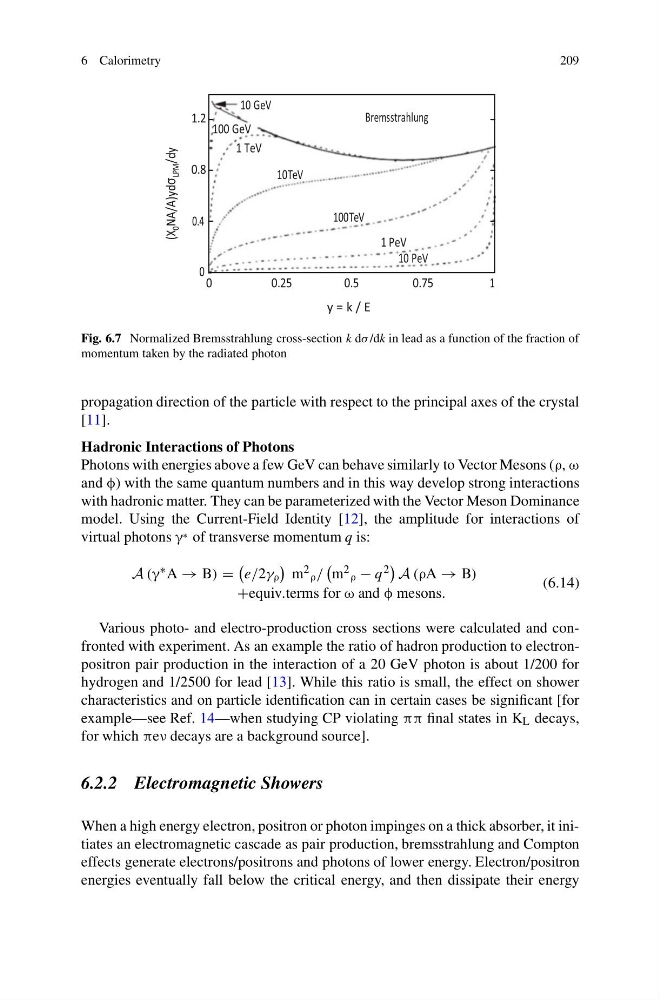
Fig. 6.7 Normalized Bremsstrahlung cross-section k dσ /dk in lead as a function of the fraction of
momentum taken by the radiated photon
propagation direction of the particle with respect to the principal axes of the crystal
[11].
Hadronic Interactions of Photons
Photons with energies above a few GeV can behave similarly to Vector Mesons (ρ, ω
and φ) with the same quantum numbers and in this way develop strong interactions
with hadronic matter. They can be parameterized with the Vector Meson Dominance
model. Using the Current-Field Identity [12], the amplitude for interactions of
virtual photons γ ∗ of transverse momentum q is:
A (γ ∗ A → B) =
e/2γ ρ
m 2 ρ /
m 2 ρ − q 2 A (ρA → B)
+equiv.terms for ω and φ mesons.
(6.14)
Various photo- and electro-production cross sections were calculated and confronted with experiment. As an example the ratio of hadron production to electronpositron pair production in the interaction of a 20 GeV photon is about 1/200 for
hydrogen and 1/2500 for lead [13]. While this ratio is small, the effect on shower
characteristics and on particle identification can in certain cases be significant [for
example—see Ref. 14—when studying CP violating ππ final states in K L decays,
for which πeν decays are a background source].
6.2.2 Electromagnetic Showers
When a high energy electron, positron or photon impinges on a thick absorber, it initiates an electromagnetic cascade as pair production, bremsstrahlung and Compton
effects generate electrons/positrons and photons of lower energy. Electron/positron
energies eventually fall below the critical energy, and then dissipate their energy
209
1.2
0.8
0.4
0
0
0 . 2 5
0 . 5
0 . 7 5
1
y = k / E
1 PeV
10 PeV
100TeV
10TeV
Bremsstrahlung
10 GeV
100 GeV
1 TeV
(X
0 NA/A)ydσ
LPM /dy
Fig. 6.7 Normalized Bremsstrahlung cross-section k dσ /dk in lead as a function of the fraction of
momentum taken by the radiated photon
propagation direction of the particle with respect to the principal axes of the crystal
[11].
Hadronic Interactions of Photons
Photons with energies above a few GeV can behave similarly to Vector Mesons (ρ, ω
and φ) with the same quantum numbers and in this way develop strong interactions
with hadronic matter. They can be parameterized with the Vector Meson Dominance
model. Using the Current-Field Identity [12], the amplitude for interactions of
virtual photons γ ∗ of transverse momentum q is:
A (γ ∗ A → B) =
e/2γ ρ
m 2 ρ /
m 2 ρ − q 2 A (ρA → B)
+equiv.terms for ω and φ mesons.
(6.14)
Various photo- and electro-production cross sections were calculated and confronted with experiment. As an example the ratio of hadron production to electronpositron pair production in the interaction of a 20 GeV photon is about 1/200 for
hydrogen and 1/2500 for lead [13]. While this ratio is small, the effect on shower
characteristics and on particle identification can in certain cases be significant [for
example—see Ref. 14—when studying CP violating ππ final states in K L decays,
for which πeν decays are a background source].
6.2.2 Electromagnetic Showers
When a high energy electron, positron or photon impinges on a thick absorber, it initiates an electromagnetic cascade as pair production, bremsstrahlung and Compton
effects generate electrons/positrons and photons of lower energy. Electron/positron
energies eventually fall below the critical energy, and then dissipate their energy