

5 Solid State Detectors
195
study of different annealing scenarios, which allows to optimise the temperature
cycling for operating SiPMs in high radiation fields, as available for silicon tracking
detectors without gain [7, 10], is so far not available. In [54] it is demonstrated
that SiPMs produced by Hamamatsu and SENSL, after irradiation to a fluence of
10 14 cm –2 and annealed at 175 ◦ C can achieve single photon detection at 77 K with
a DCR below 1 kHz/cm 2 .
The values of V bd and V off have a temperature dependence of order 20 mV/ ◦ C,
which results in a temperature-dependent gain. However this is not a real problem
and several feedback systems for gain stabilisations have been designed and are
used.
Due to the vast application potential, which spans from research, over industrial
applications to medicine, several firms develop and manufacture SiPMs. In close
collaboration with research institutions, in particular working in particle physics, a
rapid development and major improvements of SiPMs are presently under way.
5.11.4 Ultrafast Tracking Detectors: LGADs
At the HL-LHC (High-Luminosity Large Hadron Collider at CERN planned to start
operation in 2026) in the large collider experiments ATLAS and CMS there will
be on average ≈ 200 interactions with vertices distributed over ≈ 10 cm along the
beam direction for every bunch crossing. For the complete kinematic reconstruction
of the most interesting interactions in a bunch crossing, the information of the
individual detector components has to be assigned to the correct interaction vertices.
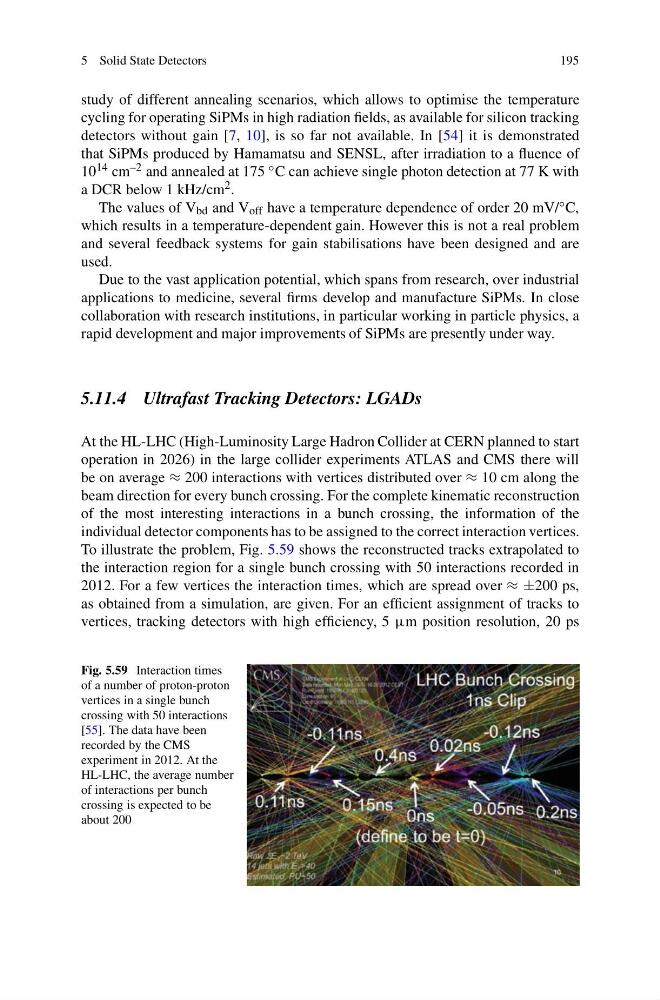
To illustrate the problem, Fig. 5.59 shows the reconstructed tracks extrapolated to
the interaction region for a single bunch crossing with 50 interactions recorded in
2012. For a few vertices the interaction times, which are spread over ≈ ±200 ps,
as obtained from a simulation, are given. For an efficient assignment of tracks to
vertices, tracking detectors with high efficiency, 5 μm position resolution, 20 ps
Fig. 5.59 Interaction times
of a number of proton-proton
vertices in a single bunch
crossing with 50 interactions
[55]. The data have been
recorded by the CMS
experiment in 2012. At the
HL-LHC, the average number
of interactions per bunch
crossing is expected to be
about 200
195
study of different annealing scenarios, which allows to optimise the temperature
cycling for operating SiPMs in high radiation fields, as available for silicon tracking
detectors without gain [7, 10], is so far not available. In [54] it is demonstrated
that SiPMs produced by Hamamatsu and SENSL, after irradiation to a fluence of
10 14 cm –2 and annealed at 175 ◦ C can achieve single photon detection at 77 K with
a DCR below 1 kHz/cm 2 .
The values of V bd and V off have a temperature dependence of order 20 mV/ ◦ C,
which results in a temperature-dependent gain. However this is not a real problem
and several feedback systems for gain stabilisations have been designed and are
used.
Due to the vast application potential, which spans from research, over industrial
applications to medicine, several firms develop and manufacture SiPMs. In close
collaboration with research institutions, in particular working in particle physics, a
rapid development and major improvements of SiPMs are presently under way.
5.11.4 Ultrafast Tracking Detectors: LGADs
At the HL-LHC (High-Luminosity Large Hadron Collider at CERN planned to start
operation in 2026) in the large collider experiments ATLAS and CMS there will
be on average ≈ 200 interactions with vertices distributed over ≈ 10 cm along the
beam direction for every bunch crossing. For the complete kinematic reconstruction
of the most interesting interactions in a bunch crossing, the information of the
individual detector components has to be assigned to the correct interaction vertices.
To illustrate the problem, Fig. 5.59 shows the reconstructed tracks extrapolated to
the interaction region for a single bunch crossing with 50 interactions recorded in
2012. For a few vertices the interaction times, which are spread over ≈ ±200 ps,
as obtained from a simulation, are given. For an efficient assignment of tracks to
vertices, tracking detectors with high efficiency, 5 μm position resolution, 20 ps
Fig. 5.59 Interaction times
of a number of proton-proton
vertices in a single bunch
crossing with 50 interactions
[55]. The data have been
recorded by the CMS
experiment in 2012. At the
HL-LHC, the average number
of interactions per bunch
crossing is expected to be
about 200