

2 The Interaction of Radiation with Matter
11
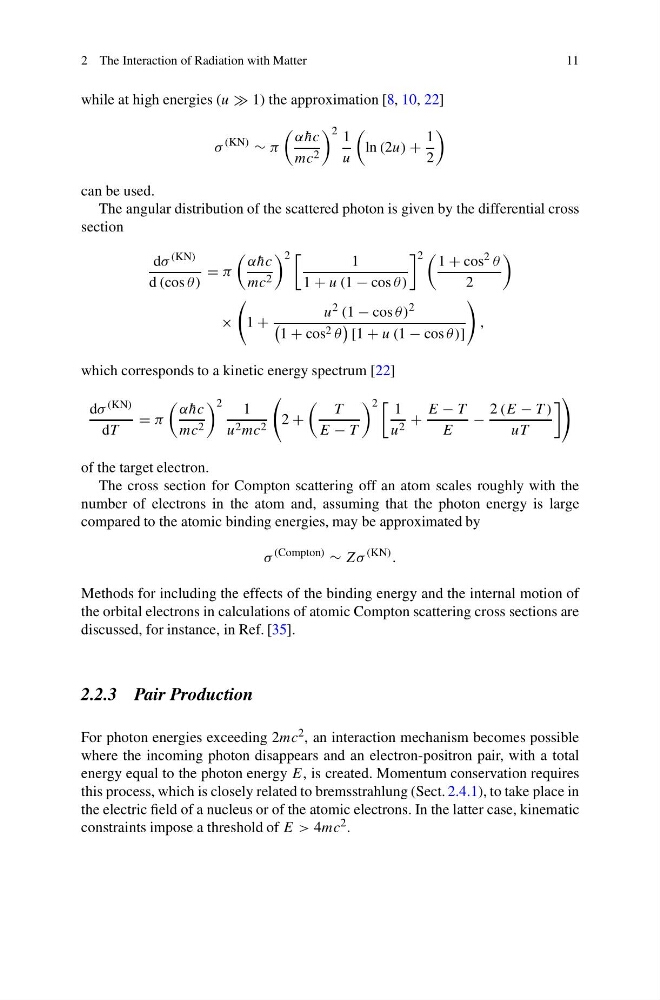
while at high energies (u 1) the approximation [8, 10, 22]
σ
(KN)
∼ π
α ¯
hc
mc 2
2 1
u
ln (2u) +
1
2
can be used.
The angular distribution of the scattered photon is given by the differential cross
section
dσ (KN)
d (cos θ )
= π
α ¯
hc
mc 2
2
1
1 + u (1 − cos θ )
2
1 + cos 2 θ
2
×
1 +
u 2 (1 − cos θ )
2
1 + cos 2 θ
[1 + u (1 − cos θ )]
,
which corresponds to a kinetic energy spectrum [22]
dσ (KN)
dT
= π
α ¯
hc
mc 2
2 1
u 2 mc 2
2 +
T
E − T
2
1
u 2 +
E − T
E
−
2 (E − T )
uT
of the target electron.
The cross section for Compton scattering off an atom scales roughly with the
number of electrons in the atom and, assuming that the photon energy is large
compared to the atomic binding energies, may be approximated by
σ
(Compton)
∼ Zσ
(KN) .
Methods for including the effects of the binding energy and the internal motion of
the orbital electrons in calculations of atomic Compton scattering cross sections are
discussed, for instance, in Ref. [35].
2.2.3 Pair Production
For photon energies exceeding 2mc 2 , an interaction mechanism becomes possible
where the incoming photon disappears and an electron-positron pair, with a total
energy equal to the photon energy E, is created. Momentum conservation requires
this process, which is closely related to bremsstrahlung (Sect. 2.4.1), to take place in
the electric field of a nucleus or of the atomic electrons. In the latter case, kinematic
constraints impose a threshold of E > 4mc 2 .
11
while at high energies (u 1) the approximation [8, 10, 22]
σ
(KN)
∼ π
α ¯
hc
mc 2
2 1
u
ln (2u) +
1
2
can be used.
The angular distribution of the scattered photon is given by the differential cross
section
dσ (KN)
d (cos θ )
= π
α ¯
hc
mc 2
2
1
1 + u (1 − cos θ )
2
1 + cos 2 θ
2
×
1 +
u 2 (1 − cos θ )
2
1 + cos 2 θ
[1 + u (1 − cos θ )]
,
which corresponds to a kinetic energy spectrum [22]
dσ (KN)
dT
= π
α ¯
hc
mc 2
2 1
u 2 mc 2
2 +
T
E − T
2
1
u 2 +
E − T
E
−
2 (E − T )
uT
of the target electron.
The cross section for Compton scattering off an atom scales roughly with the
number of electrons in the atom and, assuming that the photon energy is large
compared to the atomic binding energies, may be approximated by
σ
(Compton)
∼ Zσ
(KN) .
Methods for including the effects of the binding energy and the internal motion of
the orbital electrons in calculations of atomic Compton scattering cross sections are
discussed, for instance, in Ref. [35].
2.2.3 Pair Production
For photon energies exceeding 2mc 2 , an interaction mechanism becomes possible
where the incoming photon disappears and an electron-positron pair, with a total
energy equal to the photon energy E, is created. Momentum conservation requires
this process, which is closely related to bremsstrahlung (Sect. 2.4.1), to take place in
the electric field of a nucleus or of the atomic electrons. In the latter case, kinematic
constraints impose a threshold of E > 4mc 2 .