

156
G. Lutz and R. Klanner
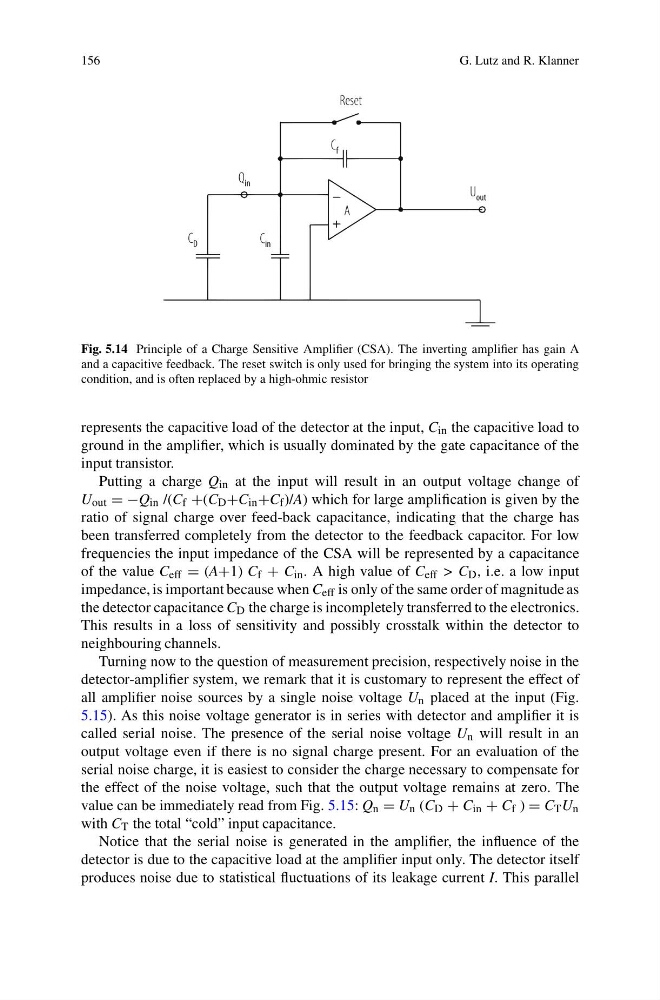
Fig. 5.14 Principle of a Charge Sensitive Amplifier (CSA). The inverting amplifier has gain A
and a capacitive feedback. The reset switch is only used for bringing the system into its operating
condition, and is often replaced by a high-ohmic resistor
represents the capacitive load of the detector at the input, C in the capacitive load to
ground in the amplifier, which is usually dominated by the gate capacitance of the
input transistor.
Putting a charge Q in at the input will result in an output voltage change of
U out = −Q in /(C f +(C D +C in +C f )/A) which for large amplification is given by the
ratio of signal charge over feed-back capacitance, indicating that the charge has
been transferred completely from the detector to the feedback capacitor. For low
frequencies the input impedance of the CSA will be represented by a capacitance
of the value C eff = (A+1) C f + C in . A high value of C eff > C D , i.e. a low input
impedance, is important because when C eff is only of the same order of magnitude as
the detector capacitance C D the charge is incompletely transferred to the electronics.
This results in a loss of sensitivity and possibly crosstalk within the detector to
neighbouring channels.
Turning now to the question of measurement precision, respectively noise in the
detector-amplifier system, we remark that it is customary to represent the effect of
all amplifier noise sources by a single noise voltage U n placed at the input (Fig.
5.15). As this noise voltage generator is in series with detector and amplifier it is
called serial noise. The presence of the serial noise voltage U n will result in an
output voltage even if there is no signal charge present. For an evaluation of the
serial noise charge, it is easiest to consider the charge necessary to compensate for
the effect of the noise voltage, such that the output voltage remains at zero. The
value can be immediately read from Fig. 5.15: Q n = U n (C D + C in + C f ) = C T U n
with C T the total “cold” input capacitance.
Notice that the serial noise is generated in the amplifier, the influence of the
detector is due to the capacitive load at the amplifier input only. The detector itself
produces noise due to statistical fluctuations of its leakage current I. This parallel
G. Lutz and R. Klanner
Fig. 5.14 Principle of a Charge Sensitive Amplifier (CSA). The inverting amplifier has gain A
and a capacitive feedback. The reset switch is only used for bringing the system into its operating
condition, and is often replaced by a high-ohmic resistor
represents the capacitive load of the detector at the input, C in the capacitive load to
ground in the amplifier, which is usually dominated by the gate capacitance of the
input transistor.
Putting a charge Q in at the input will result in an output voltage change of
U out = −Q in /(C f +(C D +C in +C f )/A) which for large amplification is given by the
ratio of signal charge over feed-back capacitance, indicating that the charge has
been transferred completely from the detector to the feedback capacitor. For low
frequencies the input impedance of the CSA will be represented by a capacitance
of the value C eff = (A+1) C f + C in . A high value of C eff > C D , i.e. a low input
impedance, is important because when C eff is only of the same order of magnitude as
the detector capacitance C D the charge is incompletely transferred to the electronics.
This results in a loss of sensitivity and possibly crosstalk within the detector to
neighbouring channels.
Turning now to the question of measurement precision, respectively noise in the
detector-amplifier system, we remark that it is customary to represent the effect of
all amplifier noise sources by a single noise voltage U n placed at the input (Fig.
5.15). As this noise voltage generator is in series with detector and amplifier it is
called serial noise. The presence of the serial noise voltage U n will result in an
output voltage even if there is no signal charge present. For an evaluation of the
serial noise charge, it is easiest to consider the charge necessary to compensate for
the effect of the noise voltage, such that the output voltage remains at zero. The
value can be immediately read from Fig. 5.15: Q n = U n (C D + C in + C f ) = C T U n
with C T the total “cold” input capacitance.
Notice that the serial noise is generated in the amplifier, the influence of the
detector is due to the capacitive load at the amplifier input only. The detector itself
produces noise due to statistical fluctuations of its leakage current I. This parallel