

5 Solid State Detectors
141
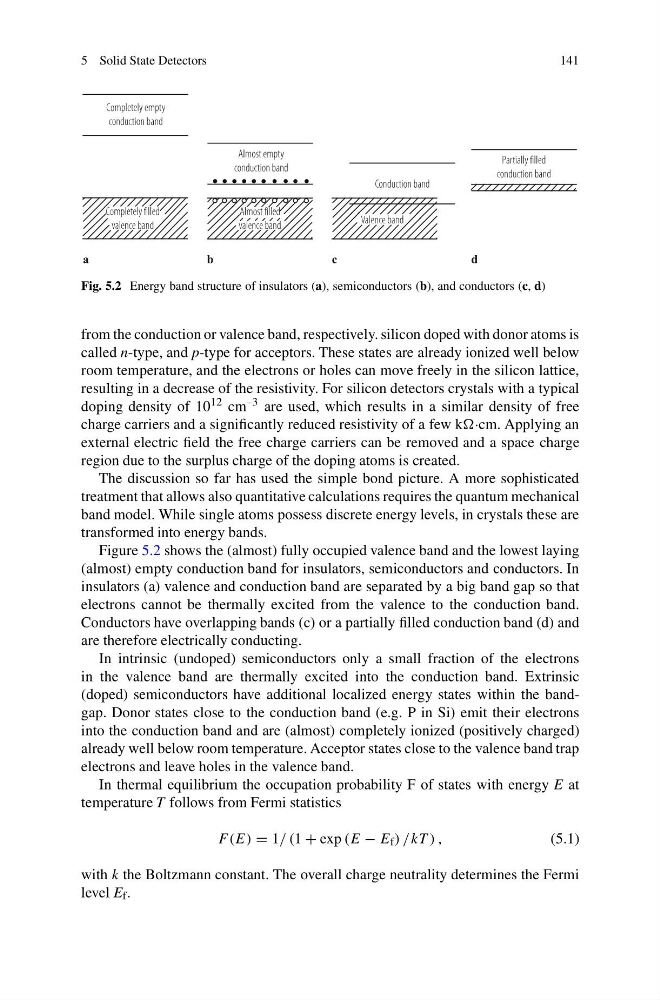
Fig. 5.2 Energy band structure of insulators (a), semiconductors (b), and conductors (c, d)
from the conduction or valence band, respectively. silicon doped with donor atoms is
called n-type, and p-type for acceptors. These states are already ionized well below
room temperature, and the electrons or holes can move freely in the silicon lattice,
resulting in a decrease of the resistivity. For silicon detectors crystals with a typical
doping density of 10 12 cm –3 are used, which results in a similar density of free
charge carriers and a significantly reduced resistivity of a few k·cm. Applying an
external electric field the free charge carriers can be removed and a space charge
region due to the surplus charge of the doping atoms is created.
The discussion so far has used the simple bond picture. A more sophisticated
treatment that allows also quantitative calculations requires the quantum mechanical
band model. While single atoms possess discrete energy levels, in crystals these are
transformed into energy bands.
Figure 5.2 shows the (almost) fully occupied valence band and the lowest laying
(almost) empty conduction band for insulators, semiconductors and conductors. In
insulators (a) valence and conduction band are separated by a big band gap so that
electrons cannot be thermally excited from the valence to the conduction band.
Conductors have overlapping bands (c) or a partially filled conduction band (d) and
are therefore electrically conducting.
In intrinsic (undoped) semiconductors only a small fraction of the electrons
in the valence band are thermally excited into the conduction band. Extrinsic
(doped) semiconductors have additional localized energy states within the bandgap. Donor states close to the conduction band (e.g. P in Si) emit their electrons
into the conduction band and are (almost) completely ionized (positively charged)
already well below room temperature. Acceptor states close to the valence band trap
electrons and leave holes in the valence band.
In thermal equilibrium the occupation probability F of states with energy E at
temperature T follows from Fermi statistics
F (E) = 1/ (1 + exp (E − E f ) /kT ) ,
(5.1)
with k the Boltzmann constant. The overall charge neutrality determines the Fermi
level E f .
141
Fig. 5.2 Energy band structure of insulators (a), semiconductors (b), and conductors (c, d)
from the conduction or valence band, respectively. silicon doped with donor atoms is
called n-type, and p-type for acceptors. These states are already ionized well below
room temperature, and the electrons or holes can move freely in the silicon lattice,
resulting in a decrease of the resistivity. For silicon detectors crystals with a typical
doping density of 10 12 cm –3 are used, which results in a similar density of free
charge carriers and a significantly reduced resistivity of a few k·cm. Applying an
external electric field the free charge carriers can be removed and a space charge
region due to the surplus charge of the doping atoms is created.
The discussion so far has used the simple bond picture. A more sophisticated
treatment that allows also quantitative calculations requires the quantum mechanical
band model. While single atoms possess discrete energy levels, in crystals these are
transformed into energy bands.
Figure 5.2 shows the (almost) fully occupied valence band and the lowest laying
(almost) empty conduction band for insulators, semiconductors and conductors. In
insulators (a) valence and conduction band are separated by a big band gap so that
electrons cannot be thermally excited from the valence to the conduction band.
Conductors have overlapping bands (c) or a partially filled conduction band (d) and
are therefore electrically conducting.
In intrinsic (undoped) semiconductors only a small fraction of the electrons
in the valence band are thermally excited into the conduction band. Extrinsic
(doped) semiconductors have additional localized energy states within the bandgap. Donor states close to the conduction band (e.g. P in Si) emit their electrons
into the conduction band and are (almost) completely ionized (positively charged)
already well below room temperature. Acceptor states close to the valence band trap
electrons and leave holes in the valence band.
In thermal equilibrium the occupation probability F of states with energy E at
temperature T follows from Fermi statistics
F (E) = 1/ (1 + exp (E − E f ) /kT ) ,
(5.1)
with k the Boltzmann constant. The overall charge neutrality determines the Fermi
level E f .