

4 Gaseous Detectors
97
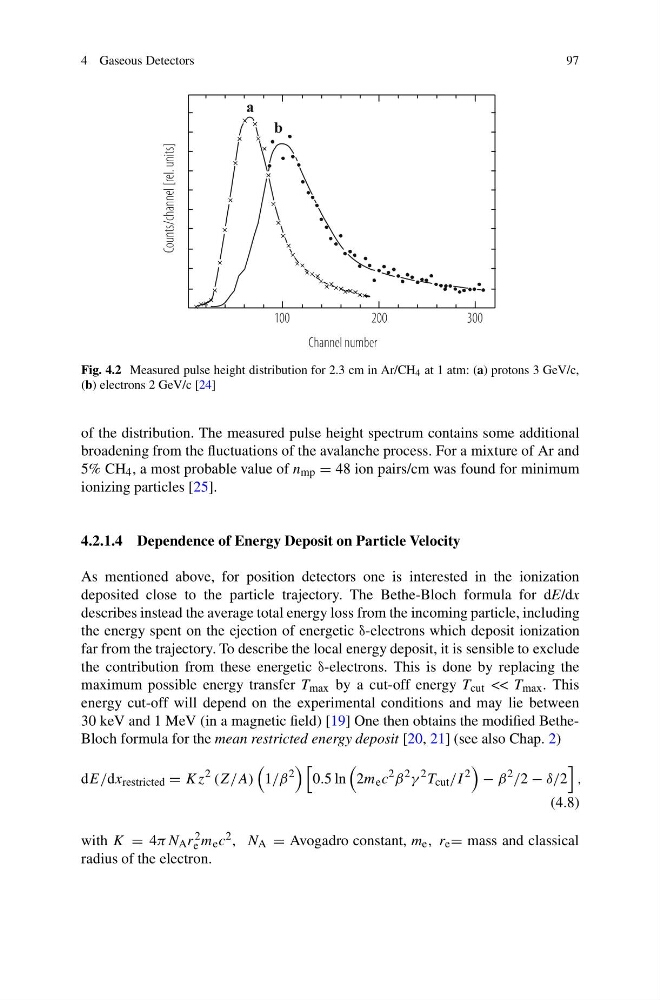
Fig. 4.2 Measured pulse height distribution for 2.3 cm in Ar/CH 4 at 1 atm: (a) protons 3 GeV/c,
(b) electrons 2 GeV/c [24]
of the distribution. The measured pulse height spectrum contains some additional
broadening from the fluctuations of the avalanche process. For a mixture of Ar and
5% CH 4 , a most probable value of n mp = 48 ion pairs/cm was found for minimum
ionizing particles [25].
4.2.1.4 Dependence of Energy Deposit on Particle Velocity
As mentioned above, for position detectors one is interested in the ionization
deposited close to the particle trajectory. The Bethe-Bloch formula for dE/dx
describes instead the average total energy loss from the incoming particle, including
the energy spent on the ejection of energetic δ-electrons which deposit ionization
far from the trajectory. To describe the local energy deposit, it is sensible to exclude
the contribution from these energetic δ-electrons. This is done by replacing the
maximum possible energy transfer T max by a cut-off energy T cut << T max . This
energy cut-off will depend on the experimental conditions and may lie between
30 keV and 1 MeV (in a magnetic field) [19] One then obtains the modified BetheBloch formula for the mean restricted energy deposit [20, 21] (see also Chap. 2)
dE/dx restricted = Kz
2 (Z/A)
1/β
2
0.5 ln
2m e c
2 β
2 γ
2 T cut /I
2
− β
2 /2 − δ/2
,
(4.8)
with K = 4πN A r 2
e m e c 2 , N A = Avogadro constant, m e , r e = mass and classical
radius of the electron.
97
Fig. 4.2 Measured pulse height distribution for 2.3 cm in Ar/CH 4 at 1 atm: (a) protons 3 GeV/c,
(b) electrons 2 GeV/c [24]
of the distribution. The measured pulse height spectrum contains some additional
broadening from the fluctuations of the avalanche process. For a mixture of Ar and
5% CH 4 , a most probable value of n mp = 48 ion pairs/cm was found for minimum
ionizing particles [25].
4.2.1.4 Dependence of Energy Deposit on Particle Velocity
As mentioned above, for position detectors one is interested in the ionization
deposited close to the particle trajectory. The Bethe-Bloch formula for dE/dx
describes instead the average total energy loss from the incoming particle, including
the energy spent on the ejection of energetic δ-electrons which deposit ionization
far from the trajectory. To describe the local energy deposit, it is sensible to exclude
the contribution from these energetic δ-electrons. This is done by replacing the
maximum possible energy transfer T max by a cut-off energy T cut << T max . This
energy cut-off will depend on the experimental conditions and may lie between
30 keV and 1 MeV (in a magnetic field) [19] One then obtains the modified BetheBloch formula for the mean restricted energy deposit [20, 21] (see also Chap. 2)
dE/dx restricted = Kz
2 (Z/A)
1/β
2
0.5 ln
2m e c
2 β
2 γ
2 T cut /I
2
− β
2 /2 − δ/2
,
(4.8)
with K = 4πN A r 2
e m e c 2 , N A = Avogadro constant, m e , r e = mass and classical
radius of the electron.