

4 Gaseous Detectors
95
4.2.1.2 Cluster Size Distribution
The space resolution in gaseous detectors is influenced not only by the Poisson
distribution of the primary clusters along the track but also by the cluster size
distribution, i.e., by the number of electrons in each cluster and their spatial
extent. Little was known experimentally (except for some measurements in cloud
chambers) until the first detailed theoretical study [22] for Ar at 1 atm and
20
◦ C. Based on the experimental cross-sections for photo absorption, the oscillator
strengths and the complex dielectric constants are calculated and from this the
distribution of energy transfers larger than the ionization energy (15.7 eV). Finally, a
detailed list is obtained for the distribution of cluster sizes for γ = 4 and γ = 1000,
to estimate the relativistic rise. A cut of 15 keV was applied to the maximum energy
transfer, thus concentrating on the local energy deposition. The mean number of
clusters is found to be n p = 26.6/cm at γ = 4, and 35/cm at γ = 1000. For a MIP,
80.2% of the clusters are found to contain 1 electron, 7.7% two electrons, 2% three
electrons, and 1.4% more than 20 electrons.
Several years later, a detailed experimental study of several gases is reported
in [23]. For Ar, 66/15/6 and 1.1% of the clusters are found to contain 1/2/3 and
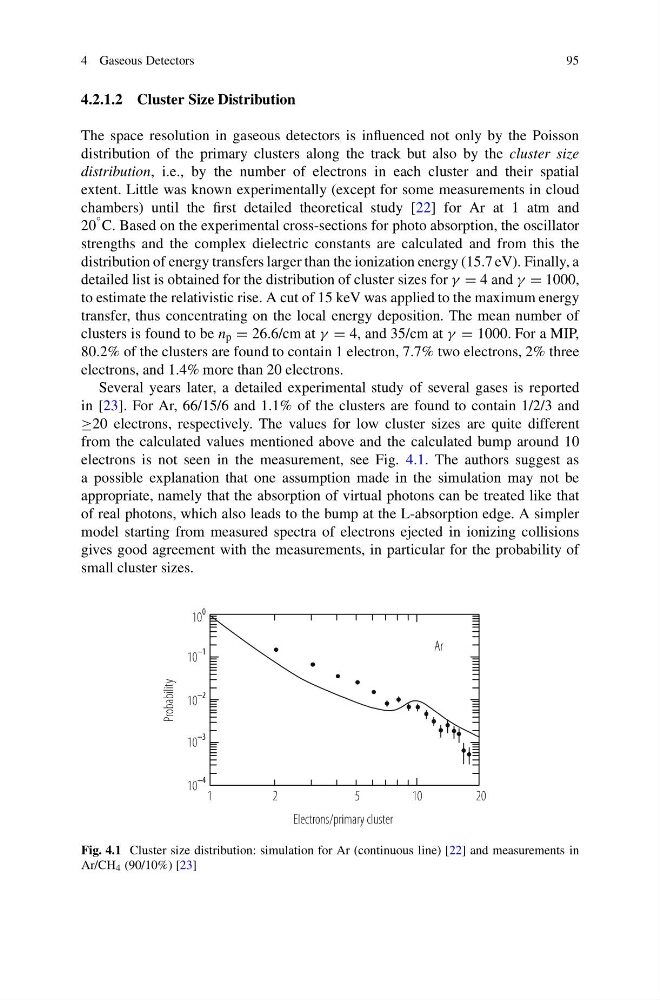
≥20 electrons, respectively. The values for low cluster sizes are quite different
from the calculated values mentioned above and the calculated bump around 10
electrons is not seen in the measurement, see Fig. 4.1. The authors suggest as
a possible explanation that one assumption made in the simulation may not be
appropriate, namely that the absorption of virtual photons can be treated like that
of real photons, which also leads to the bump at the L-absorption edge. A simpler
model starting from measured spectra of electrons ejected in ionizing collisions
gives good agreement with the measurements, in particular for the probability of
small cluster sizes.
Fig. 4.1 Cluster size distribution: simulation for Ar (continuous line) [22] and measurements in
Ar/CH 4 (90/10%) [23]
95
4.2.1.2 Cluster Size Distribution
The space resolution in gaseous detectors is influenced not only by the Poisson
distribution of the primary clusters along the track but also by the cluster size
distribution, i.e., by the number of electrons in each cluster and their spatial
extent. Little was known experimentally (except for some measurements in cloud
chambers) until the first detailed theoretical study [22] for Ar at 1 atm and
20
◦ C. Based on the experimental cross-sections for photo absorption, the oscillator
strengths and the complex dielectric constants are calculated and from this the
distribution of energy transfers larger than the ionization energy (15.7 eV). Finally, a
detailed list is obtained for the distribution of cluster sizes for γ = 4 and γ = 1000,
to estimate the relativistic rise. A cut of 15 keV was applied to the maximum energy
transfer, thus concentrating on the local energy deposition. The mean number of
clusters is found to be n p = 26.6/cm at γ = 4, and 35/cm at γ = 1000. For a MIP,
80.2% of the clusters are found to contain 1 electron, 7.7% two electrons, 2% three
electrons, and 1.4% more than 20 electrons.
Several years later, a detailed experimental study of several gases is reported
in [23]. For Ar, 66/15/6 and 1.1% of the clusters are found to contain 1/2/3 and
≥20 electrons, respectively. The values for low cluster sizes are quite different
from the calculated values mentioned above and the calculated bump around 10
electrons is not seen in the measurement, see Fig. 4.1. The authors suggest as
a possible explanation that one assumption made in the simulation may not be
appropriate, namely that the absorption of virtual photons can be treated like that
of real photons, which also leads to the bump at the L-absorption edge. A simpler
model starting from measured spectra of electrons ejected in ionizing collisions
gives good agreement with the measurements, in particular for the probability of
small cluster sizes.
Fig. 4.1 Cluster size distribution: simulation for Ar (continuous line) [22] and measurements in
Ar/CH 4 (90/10%) [23]