

52
D. L. Magembe-Mushi and A. Namangaya
2 Background
Capacity gaps and institutional conflicts in small towns are increasingly contributing
to unsustainable utilization of resources as well as the control of growth and management of small towns. This is manifested by expanding informality, land use conflicts,
degradation of resources and increased spatial and population growth. Following the
COVID-19 pandemic, these small towns have not slowed down their activities which
involve movement and interaction of people from different areas within and outside
the region and even the country. Considering high informality and scarcity of basic
facilities such as health centres, chances are these small towns can fuel the spread of
the virus. This is because it is very difficult to practise the recommended measures
for slowing down cases as well as containing the affected population. Due to lack
of planning, it is difficult to trace, isolate and contain the sick or practising social
distancing.
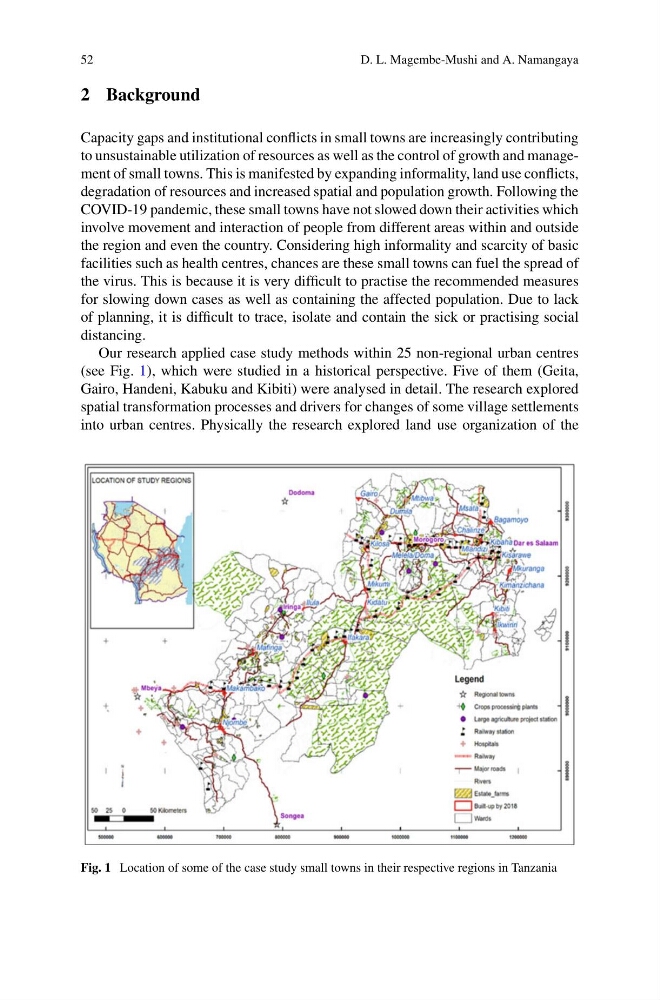
Our research applied case study methods within 25 non-regional urban centres
(see Fig. 1), which were studied in a historical perspective. Five of them (Geita,
Gairo, Handeni, Kabuku and Kibiti) were analysed in detail. The research explored
spatial transformation processes and drivers for changes of some village settlements
into urban centres. Physically the research explored land use organization of the
Fig. 1 Location of some of the case study small towns in their respective regions in Tanzania
D. L. Magembe-Mushi and A. Namangaya
2 Background
Capacity gaps and institutional conflicts in small towns are increasingly contributing
to unsustainable utilization of resources as well as the control of growth and management of small towns. This is manifested by expanding informality, land use conflicts,
degradation of resources and increased spatial and population growth. Following the
COVID-19 pandemic, these small towns have not slowed down their activities which
involve movement and interaction of people from different areas within and outside
the region and even the country. Considering high informality and scarcity of basic
facilities such as health centres, chances are these small towns can fuel the spread of
the virus. This is because it is very difficult to practise the recommended measures
for slowing down cases as well as containing the affected population. Due to lack
of planning, it is difficult to trace, isolate and contain the sick or practising social
distancing.
Our research applied case study methods within 25 non-regional urban centres
(see Fig. 1), which were studied in a historical perspective. Five of them (Geita,
Gairo, Handeni, Kabuku and Kibiti) were analysed in detail. The research explored
spatial transformation processes and drivers for changes of some village settlements
into urban centres. Physically the research explored land use organization of the
Fig. 1 Location of some of the case study small towns in their respective regions in Tanzania