

24
A. Bakhtawar
in 2014 as an innovative step to drive economic growth and improve the quality of
life of people by focusing on development and technology to create better outcomes
for citizens. Health and education are included in the core infrastructural elements
of the Smart City Mission. However, in most of the instances, these two elements
have not received the desired attention by the city planners and administrators, and
there have been limited cross-sectoral activities across these two departments.
Young people are a precious resource of India. In a phase characterized by growth
and development, youth are vulnerable to influence by factors that affect their health
and safety. As urban populations expand, so will the numbers of young people.
As cities consider how best to reach them, interest in schools has increased. First
advocated by the World Health Organisation, Health-Promoting Schools (HPS) is
a concept of a school as a healthy setting for living, learning and working (World
Health Organization, n.d.). In 1946, the Bhore Committee identified school health as
an important health intervention (Kaur et al. 2015) to promote the maximum physical,
social, emotional, mental and educational growth of the students by adopting healthpromoting policies and practices.
Bearing this in mind, the USAID-funded Building Healthy Cities (BHC) project is
providing technical assistance to Indore Smart City Development Limited (ISCDL)
to implement a comprehensive HPS programme. This programme will promote the
physical, social, emotional, mental and educational growth of the students by facilitating health-promoting policies and practices. The programme is being implemented
by BHC with support from MP Voluntary Health Association (MPVHA), a leading
NGO.
Implementation began in October 2019 in 148 government (aka public) middle,
high and higher secondary schools of Indore selected by the Education Department.
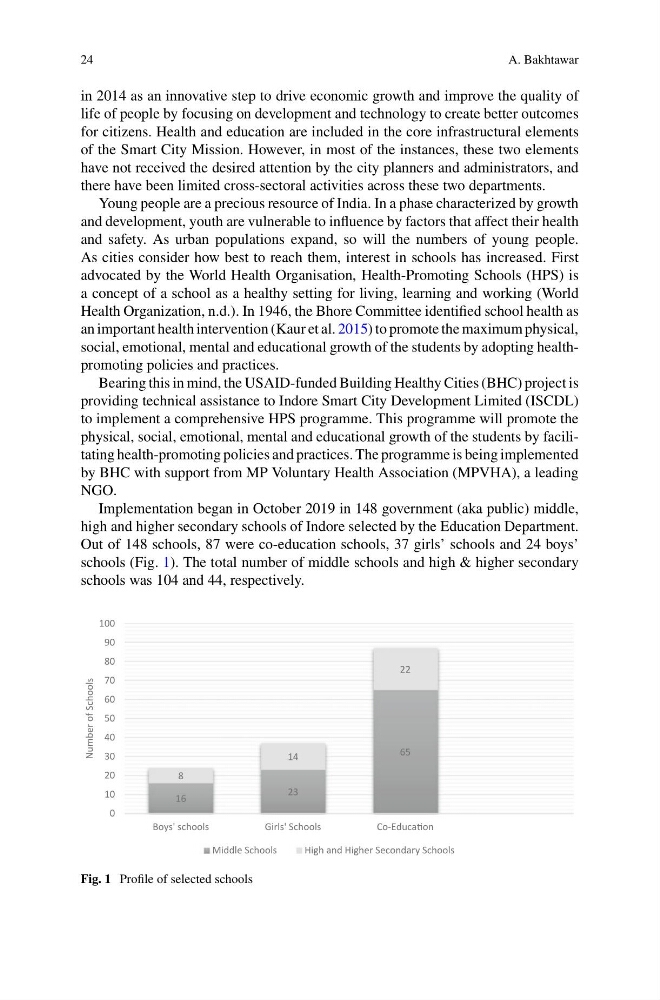
Out of 148 schools, 87 were co-education schools, 37 girls’ schools and 24 boys’
schools (Fig. 1). The total number of middle schools and high & higher secondary
schools was 104 and 44, respectively.
16
23
65
8
14
22
0
10
20
30
40
50
60
70
80
90
100
Boys' schools
Girls' Schools
Co-EducaƟon
Number of Schools
Middle Schools
High and Higher Secondary Schools
Fig. 1 Profile of selected schools
A. Bakhtawar
in 2014 as an innovative step to drive economic growth and improve the quality of
life of people by focusing on development and technology to create better outcomes
for citizens. Health and education are included in the core infrastructural elements
of the Smart City Mission. However, in most of the instances, these two elements
have not received the desired attention by the city planners and administrators, and
there have been limited cross-sectoral activities across these two departments.
Young people are a precious resource of India. In a phase characterized by growth
and development, youth are vulnerable to influence by factors that affect their health
and safety. As urban populations expand, so will the numbers of young people.
As cities consider how best to reach them, interest in schools has increased. First
advocated by the World Health Organisation, Health-Promoting Schools (HPS) is
a concept of a school as a healthy setting for living, learning and working (World
Health Organization, n.d.). In 1946, the Bhore Committee identified school health as
an important health intervention (Kaur et al. 2015) to promote the maximum physical,
social, emotional, mental and educational growth of the students by adopting healthpromoting policies and practices.
Bearing this in mind, the USAID-funded Building Healthy Cities (BHC) project is
providing technical assistance to Indore Smart City Development Limited (ISCDL)
to implement a comprehensive HPS programme. This programme will promote the
physical, social, emotional, mental and educational growth of the students by facilitating health-promoting policies and practices. The programme is being implemented
by BHC with support from MP Voluntary Health Association (MPVHA), a leading
NGO.
Implementation began in October 2019 in 148 government (aka public) middle,
high and higher secondary schools of Indore selected by the Education Department.
Out of 148 schools, 87 were co-education schools, 37 girls’ schools and 24 boys’
schools (Fig. 1). The total number of middle schools and high & higher secondary
schools was 104 and 44, respectively.
16
23
65
8
14
22
0
10
20
30
40
50
60
70
80
90
100
Boys' schools
Girls' Schools
Co-EducaƟon
Number of Schools
Middle Schools
High and Higher Secondary Schools
Fig. 1 Profile of selected schools