

12 Outlook for the Future
799
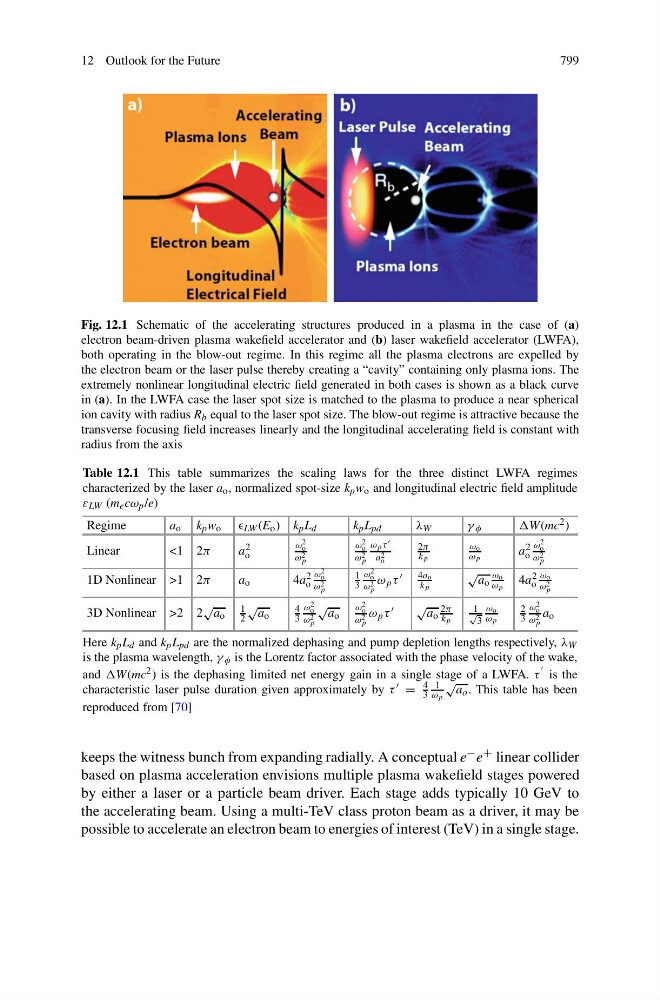
Fig. 12.1 Schematic of the accelerating structures produced in a plasma in the case of (a)
electron beam-driven plasma wakefield accelerator and (b) laser wakefield accelerator (LWFA),
both operating in the blow-out regime. In this regime all the plasma electrons are expelled by
the electron beam or the laser pulse thereby creating a “cavity” containing only plasma ions. The
extremely nonlinear longitudinal electric field generated in both cases is shown as a black curve
in (a). In the LWFA case the laser spot size is matched to the plasma to produce a near spherical
ion cavity with radius R b equal to the laser spot size. The blow-out regime is attractive because the
transverse focusing field increases linearly and the longitudinal accelerating field is constant with
radius from the axis
Table 12.1 This table summarizes the scaling laws for the three distinct LWFA regimes
characterized by the laser a o , normalized spot-size k p w o and longitudinal electric field amplitude
ε LW (m e cω p /e)
Regime
a o k p w o LW (E o ) k p L d
k p L pd
λ W
γ φ
2 )
Linear
<1 2π
a 2
o
ω 2
o
ω 2
p
ω 2
o
ω 2
p
ωp τ
a 2
o
2π
kp
ωo
ωp
a 2
o
ω 2
o
ω 2
p
1D Nonlinear >1 2π
a o
4a 2
o
ω 2
o
ω 2
p
1
3
ω 2
o
ω 2
p
ω p τ 4ao
kp
√ a o
ωo
ωp
4a 2
o
ωo
ω 2
p
3D Nonlinear >2 2
√ a o
1
2
√ a o
4
3
ω 2
o
ω 2
p
√ a o
ω 2
o
ω 2
p
ω p τ
√ a o
2π
kp
1
√
3
ωo
ωp
2
3
ω 2
o
ω 2
p
a o
Here k p L d and k p L pd are the normalized dephasing and pump depletion lengths respectively, λ W
is the plasma wavelength, γ φ is the Lorentz factor associated with the phase velocity of the wake,
and 2 ) is the dephasing limited net energy gain in a single stage of a LWFA. τ
is the
characteristic laser pulse duration given approximately by τ =
4
3
1
ωp
√ a o . This table has been
reproduced from [70]
keeps the witness bunch from expanding radially. A conceptual e − e + linear collider
based on plasma acceleration envisions multiple plasma wakefield stages powered
by either a laser or a particle beam driver. Each stage adds typically 10 GeV to
the accelerating beam. Using a multi-TeV class proton beam as a driver, it may be
possible to accelerate an electron beam to energies of interest (TeV) in a single stage.