

768
M. Dohlus et al.
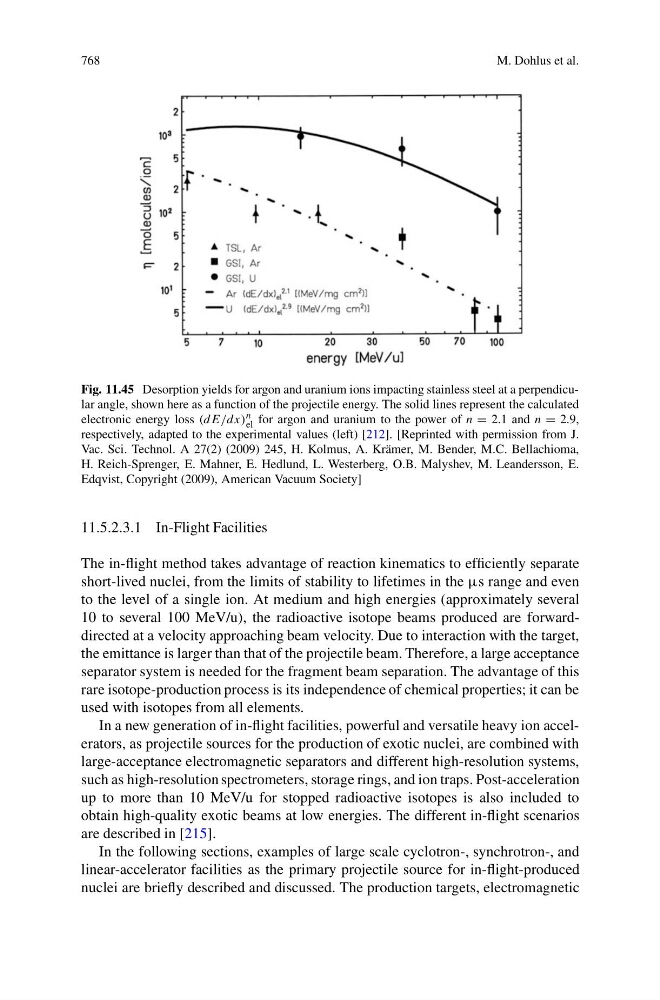
Fig. 11.45 Desorption yields for argon and uranium ions impacting stainless steel at a perpendicular angle, shown here as a function of the projectile energy. The solid lines represent the calculated
electronic energy loss (dE/dx)
n
el for argon and uranium to the power of n = 2.1 and n = 2.9,
respectively, adapted to the experimental values (left) [212]. [Reprinted with permission from J.
Vac. Sci. Technol. A 27(2) (2009) 245, H. Kolmus, A. Krämer, M. Bender, M.C. Bellachioma,
H. Reich-Sprenger, E. Mahner, E. Hedlund, L. Westerberg, O.B. Malyshev, M. Leandersson, E.
Edqvist, Copyright (2009), American Vacuum Society]
11.5.2.3.1 In-Flight Facilities
The in-flight method takes advantage of reaction kinematics to efficiently separate
short-lived nuclei, from the limits of stability to lifetimes in the μs range and even
to the level of a single ion. At medium and high energies (approximately several
10 to several 100 MeV/u), the radioactive isotope beams produced are forwarddirected at a velocity approaching beam velocity. Due to interaction with the target,
the emittance is larger than that of the projectile beam. Therefore, a large acceptance
separator system is needed for the fragment beam separation. The advantage of this
rare isotope-production process is its independence of chemical properties; it can be
used with isotopes from all elements.
In a new generation of in-flight facilities, powerful and versatile heavy ion accelerators, as projectile sources for the production of exotic nuclei, are combined with
large-acceptance electromagnetic separators and different high-resolution systems,
such as high-resolution spectrometers, storage rings, and ion traps. Post-acceleration
up to more than 10 MeV/u for stopped radioactive isotopes is also included to
obtain high-quality exotic beams at low energies. The different in-flight scenarios
are described in [215].
In the following sections, examples of large scale cyclotron-, synchrotron-, and
linear-accelerator facilities as the primary projectile source for in-flight-produced
nuclei are briefly described and discussed. The production targets, electromagnetic