

3 Non-linear Dynamics in Accelerators
67
K L
L
K L
L/2
L/2
Fig. 3.1 Schematic representation of a symplectic kick of first order (left) and second order (right)
.
a L
.
a L
b L
. b L
.
β
α
α
K L
.
.
.
K L
K L
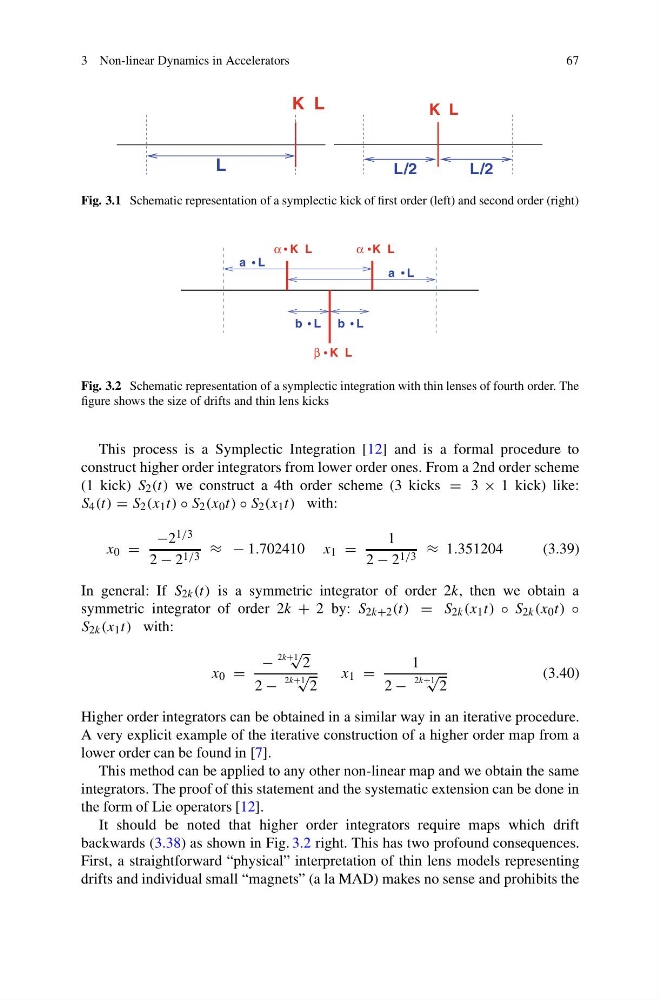
Fig. 3.2 Schematic representation of a symplectic integration with thin lenses of fourth order. The
figure shows the size of drifts and thin lens kicks
This process is a Symplectic Integration [12] and is a formal procedure to
construct higher order integrators from lower order ones. From a 2nd order scheme
(1 kick) S 2 (t) we construct a 4th order scheme (3 kicks = 3 × 1 kick) like:
S 4 (t) = S 2 (x 1 t) ◦ S 2 (x 0 t) ◦ S 2 (x 1 t) with:
x 0 =
−2 1/3
2 − 2 1/3 ≈ − 1.702410 x 1 =
1
2 − 2 1/3 ≈ 1.351204
(3.39)
In general: If S 2k (t) is a symmetric integrator of order 2k, then we obtain a
symmetric integrator of order 2k + 2 by: S 2k+2 (t) = S 2k (x 1 t) ◦ S 2k (x 0 t) ◦
S 2k (x 1 t) with:
x 0 =
−
2k+1
√
2
2 −
2k+1
√
2
x 1 =
1
2 −
2k+1
√
2
(3.40)
Higher order integrators can be obtained in a similar way in an iterative procedure.
A very explicit example of the iterative construction of a higher order map from a
lower order can be found in [7].
This method can be applied to any other non-linear map and we obtain the same
integrators. The proof of this statement and the systematic extension can be done in
the form of Lie operators [12].
It should be noted that higher order integrators require maps which drift
backwards (3.38) as shown in Fig. 3.2 right. This has two profound consequences.
First, a straightforward “physical” interpretation of thin lens models representing
drifts and individual small “magnets” (a la MAD) makes no sense and prohibits the
67
K L
L
K L
L/2
L/2
Fig. 3.1 Schematic representation of a symplectic kick of first order (left) and second order (right)
.
a L
.
a L
b L
. b L
.
β
α
α
K L
.
.
.
K L
K L
Fig. 3.2 Schematic representation of a symplectic integration with thin lenses of fourth order. The
figure shows the size of drifts and thin lens kicks
This process is a Symplectic Integration [12] and is a formal procedure to
construct higher order integrators from lower order ones. From a 2nd order scheme
(1 kick) S 2 (t) we construct a 4th order scheme (3 kicks = 3 × 1 kick) like:
S 4 (t) = S 2 (x 1 t) ◦ S 2 (x 0 t) ◦ S 2 (x 1 t) with:
x 0 =
−2 1/3
2 − 2 1/3 ≈ − 1.702410 x 1 =
1
2 − 2 1/3 ≈ 1.351204
(3.39)
In general: If S 2k (t) is a symmetric integrator of order 2k, then we obtain a
symmetric integrator of order 2k + 2 by: S 2k+2 (t) = S 2k (x 1 t) ◦ S 2k (x 0 t) ◦
S 2k (x 1 t) with:
x 0 =
−
2k+1
√
2
2 −
2k+1
√
2
x 1 =
1
2 −
2k+1
√
2
(3.40)
Higher order integrators can be obtained in a similar way in an iterative procedure.
A very explicit example of the iterative construction of a higher order map from a
lower order can be found in [7].
This method can be applied to any other non-linear map and we obtain the same
integrators. The proof of this statement and the systematic extension can be done in
the form of Lie operators [12].
It should be noted that higher order integrators require maps which drift
backwards (3.38) as shown in Fig. 3.2 right. This has two profound consequences.
First, a straightforward “physical” interpretation of thin lens models representing
drifts and individual small “magnets” (a la MAD) makes no sense and prohibits the