

748
M. Dohlus et al.
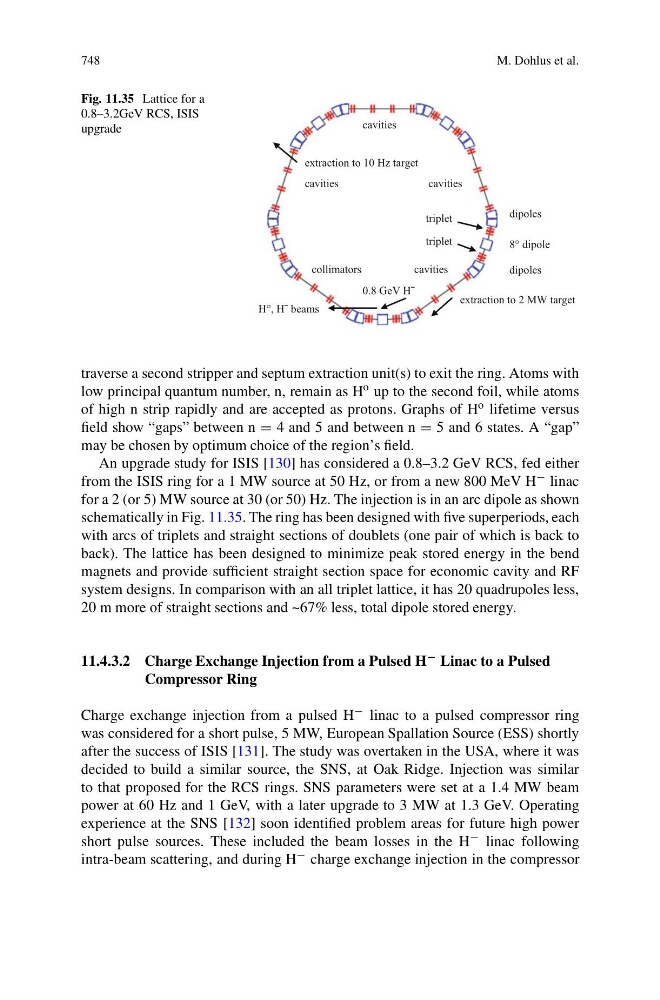
Fig. 11.35 Lattice for a
0.8–3.2GeV RCS, ISIS
upgrade
0.8 GeV Hˉ
H°, Hˉ beams
triplet
triplet
extraction to 2 MW target
dipoles
8° dipole
dipoles
collimators
cavities
extraction to 10 Hz target
cavities
cavities
cavities
traverse a second stripper and septum extraction unit(s) to exit the ring. Atoms with
low principal quantum number, n, remain as H o up to the second foil, while atoms
of high n strip rapidly and are accepted as protons. Graphs of H o lifetime versus
field show “gaps” between n = 4 and 5 and between n = 5 and 6 states. A “gap”
may be chosen by optimum choice of the region’s field.
An upgrade study for ISIS [130] has considered a 0.8–3.2 GeV RCS, fed either
from the ISIS ring for a 1 MW source at 50 Hz, or from a new 800 MeV H − linac
for a 2 (or 5) MW source at 30 (or 50) Hz. The injection is in an arc dipole as shown
schematically in Fig. 11.35. The ring has been designed with five superperiods, each
with arcs of triplets and straight sections of doublets (one pair of which is back to
back). The lattice has been designed to minimize peak stored energy in the bend
magnets and provide sufficient straight section space for economic cavity and RF
system designs. In comparison with an all triplet lattice, it has 20 quadrupoles less,
20 m more of straight sections and ~67% less, total dipole stored energy.
11.4.3.2 Charge Exchange Injection from a Pulsed H − Linac to a Pulsed
Compressor Ring
Charge exchange injection from a pulsed H − linac to a pulsed compressor ring
was considered for a short pulse, 5 MW, European Spallation Source (ESS) shortly
after the success of ISIS [131]. The study was overtaken in the USA, where it was
decided to build a similar source, the SNS, at Oak Ridge. Injection was similar
to that proposed for the RCS rings. SNS parameters were set at a 1.4 MW beam
power at 60 Hz and 1 GeV, with a later upgrade to 3 MW at 1.3 GeV. Operating
experience at the SNS [132] soon identified problem areas for future high power
short pulse sources. These included the beam losses in the H − linac following
intra-beam scattering, and during H − charge exchange injection in the compressor