

11 Application of Accelerators and Storage Rings
745
These linacs tend to favour the alternatives mentioned in the previous section—
separated DTL’s, Side-Coupled DTL’s, and Cavity-Coupled DTL’s.
Superconducting Structures
In the high-energy part of the linac, superconducting technology tends to dominate,
however care must be taken to set the energy at which the linac transitions to
superconducting cavities at a point that properly balances costs and benefits.
Due to several decades of R&D by the ILC community, elliptical cavities are
a very good choice for these structures. The complex manufacturing processes are
very well understood, and the design is very robust to mechanical disturbances.
High-energy efficiency requires that each RF structure is designed to have an
accelerating mode with a very high Quality Factor (Q). Consequently, each Higher
Order Mode (HOM) also tends to have long damping time, with a significant risk
that its amplitude will still be at a high level when the subsequent pulses arrives.
Thus, it is necessary to consider a scheme to damp HOMs. In general two solutions
are available to the accelerator designer.
One solution is to mount one or more HOM couplers in locations where it is
expected that the more destructive parasitic fields will have large amplitudes. These
ports couple HOM power into an external load, dramatically shortening the decay
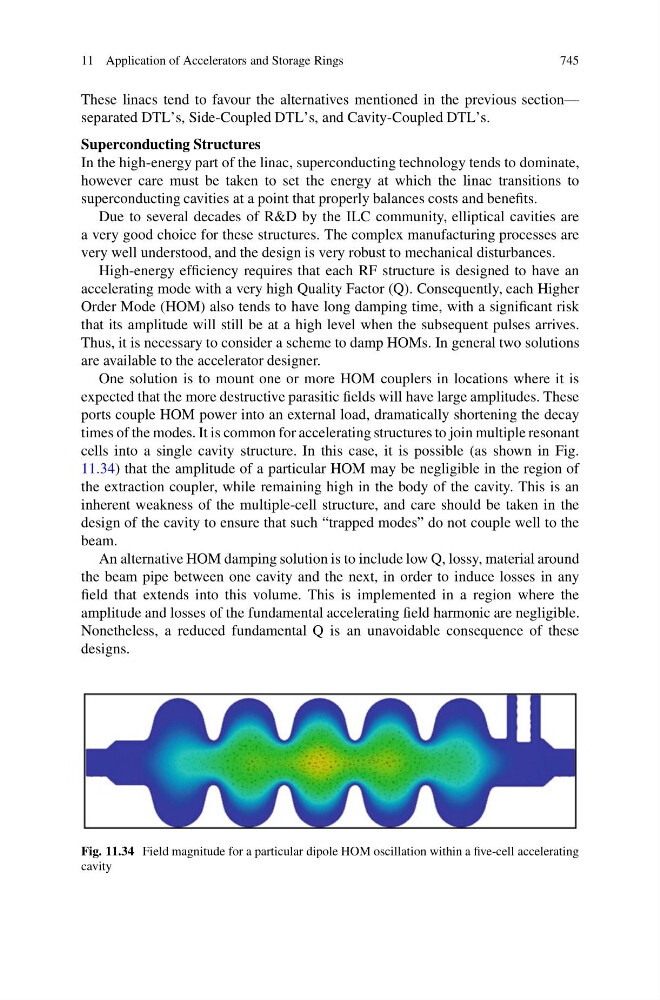
times of the modes. It is common for accelerating structures to join multiple resonant
cells into a single cavity structure. In this case, it is possible (as shown in Fig.
11.34) that the amplitude of a particular HOM may be negligible in the region of
the extraction coupler, while remaining high in the body of the cavity. This is an
inherent weakness of the multiple-cell structure, and care should be taken in the
design of the cavity to ensure that such “trapped modes” do not couple well to the
beam.
An alternative HOM damping solution is to include low Q, lossy, material around
the beam pipe between one cavity and the next, in order to induce losses in any
field that extends into this volume. This is implemented in a region where the
amplitude and losses of the fundamental accelerating field harmonic are negligible.
Nonetheless, a reduced fundamental Q is an unavoidable consequence of these
designs.
Fig. 11.34 Field magnitude for a particular dipole HOM oscillation within a five-cell accelerating
cavity