

11 Application of Accelerators and Storage Rings
737
A 150 MeV FFAG has been built in Japan for high-current applications [102]
and low-current uses of non-scaling FFAGs in proton therapy have been proposed
[103, 104].
In the case of carbon ions, due to the high magnetic rigidity of the beam, a
solution with three concentric non-scaling FFAG machines has been studied [105].
In this case there is the added complication of the many injection and extraction
systems which are needed in multi-ring facilities. This and other arguments are
discussed in a recently published comparison between linacs and FFAGs for hadron
therapy [106].
Compact Accelerators and ‘Single Room’ Facilities
An important line of development concerns what are now known as ‘single room’
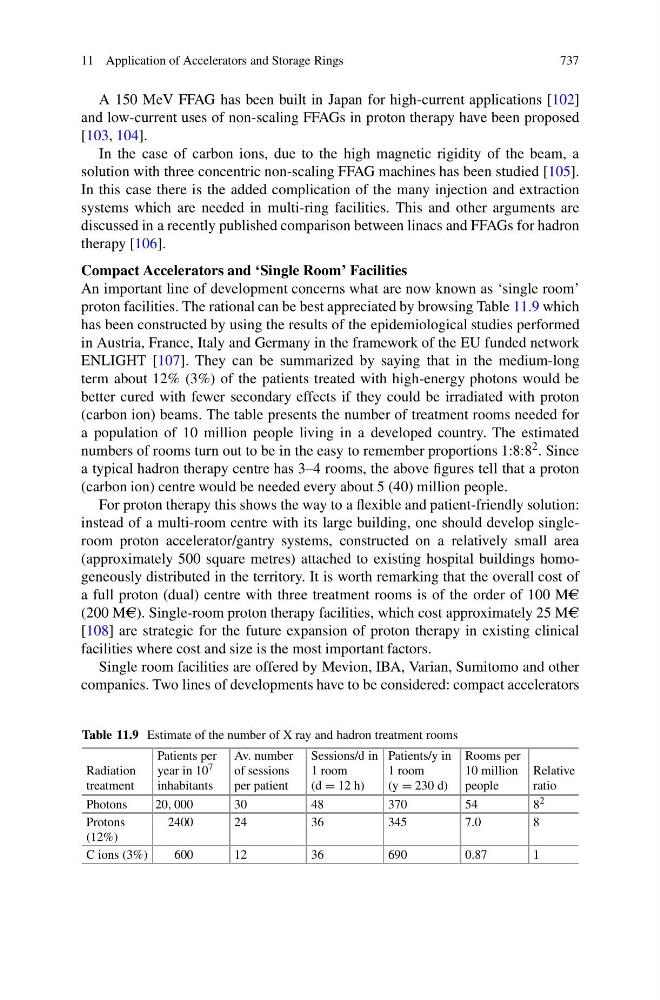
proton facilities. The rational can be best appreciated by browsing Table 11.9 which
has been constructed by using the results of the epidemiological studies performed
in Austria, France, Italy and Germany in the framework of the EU funded network
ENLIGHT [107]. They can be summarized by saying that in the medium-long
term about 12% (3%) of the patients treated with high-energy photons would be
better cured with fewer secondary effects if they could be irradiated with proton
(carbon ion) beams. The table presents the number of treatment rooms needed for
a population of 10 million people living in a developed country. The estimated
numbers of rooms turn out to be in the easy to remember proportions 1:8:8 2 . Since
a typical hadron therapy centre has 3–4 rooms, the above figures tell that a proton
(carbon ion) centre would be needed every about 5 (40) million people.
For proton therapy this shows the way to a flexible and patient-friendly solution:
instead of a multi-room centre with its large building, one should develop singleroom proton accelerator/gantry systems, constructed on a relatively small area
(approximately 500 square metres) attached to existing hospital buildings homogeneously distributed in the territory. It is worth remarking that the overall cost of
a full proton (dual) centre with three treatment rooms is of the order of 100 MA C
(200 MA C). Single-room proton therapy facilities, which cost approximately 25 MA C
[108] are strategic for the future expansion of proton therapy in existing clinical
facilities where cost and size is the most important factors.
Single room facilities are offered by Mevion, IBA, Varian, Sumitomo and other
companies. Two lines of developments have to be considered: compact accelerators
Table 11.9 Estimate of the number of X ray and hadron treatment rooms
Radiation
treatment
Patients per
year in 10 7
inhabitants
Av. number
of sessions
per patient
Sessions/d in
1 room
(d = 12 h)
Patients/y in
1 room
(y = 230 d)
Rooms per
10 million
people
Relative
ratio
Photons
20, 000
30
48
370
54
8 2
Protons
(12%)
2400
24
36
345
7.0
8
C ions (3%)
600
12
36
690
0.87
1