

718
M. Dohlus et al.
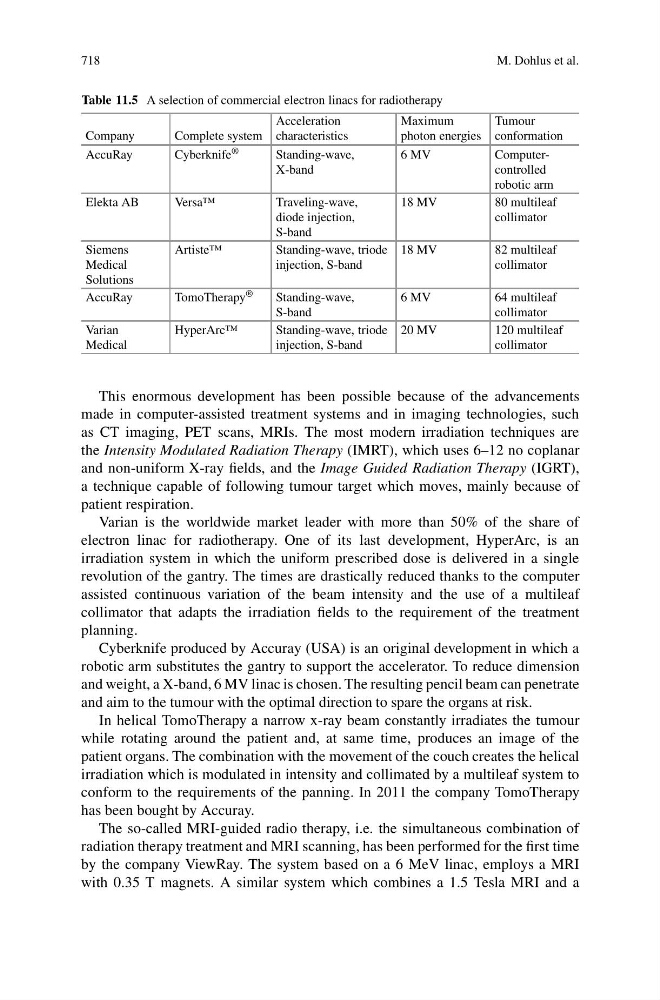
Table 11.5 A selection of commercial electron linacs for radiotherapy
Company
Complete system
Acceleration
characteristics
Maximum
photon energies
Tumour
conformation
AccuRay
Cyberknife ®
Standing-wave,
X-band
6 MV
Computercontrolled
robotic arm
Elekta AB
Versa™
Traveling-wave,
diode injection,
S-band
18 MV
80 multileaf
collimator
Siemens
Medical
Solutions
Artiste™
Standing-wave, triode
injection, S-band
18 MV
82 multileaf
collimator
AccuRay
TomoTherapy ®
Standing-wave,
S-band
6 MV
64 multileaf
collimator
Varian
Medical
HyperArc™
Standing-wave, triode
injection, S-band
20 MV
120 multileaf
collimator
This enormous development has been possible because of the advancements
made in computer-assisted treatment systems and in imaging technologies, such
as CT imaging, PET scans, MRIs. The most modern irradiation techniques are
the Intensity Modulated Radiation Therapy (IMRT), which uses 6–12 no coplanar
and non-uniform X-ray fields, and the Image Guided Radiation Therapy (IGRT),
a technique capable of following tumour target which moves, mainly because of
patient respiration.
Varian is the worldwide market leader with more than 50% of the share of
electron linac for radiotherapy. One of its last development, HyperArc, is an
irradiation system in which the uniform prescribed dose is delivered in a single
revolution of the gantry. The times are drastically reduced thanks to the computer
assisted continuous variation of the beam intensity and the use of a multileaf
collimator that adapts the irradiation fields to the requirement of the treatment
planning.
Cyberknife produced by Accuray (USA) is an original development in which a
robotic arm substitutes the gantry to support the accelerator. To reduce dimension
and weight, a X-band, 6 MV linac is chosen. The resulting pencil beam can penetrate
and aim to the tumour with the optimal direction to spare the organs at risk.
In helical TomoTherapy a narrow x-ray beam constantly irradiates the tumour
while rotating around the patient and, at same time, produces an image of the
patient organs. The combination with the movement of the couch creates the helical
irradiation which is modulated in intensity and collimated by a multileaf system to
conform to the requirements of the panning. In 2011 the company TomoTherapy
has been bought by Accuray.
The so-called MRI-guided radio therapy, i.e. the simultaneous combination of
radiation therapy treatment and MRI scanning, has been performed for the first time
by the company ViewRay. The system based on a 6 MeV linac, employs a MRI
with 0.35 T magnets. A similar system which combines a 1.5 Tesla MRI and a