

11 Application of Accelerators and Storage Rings
701
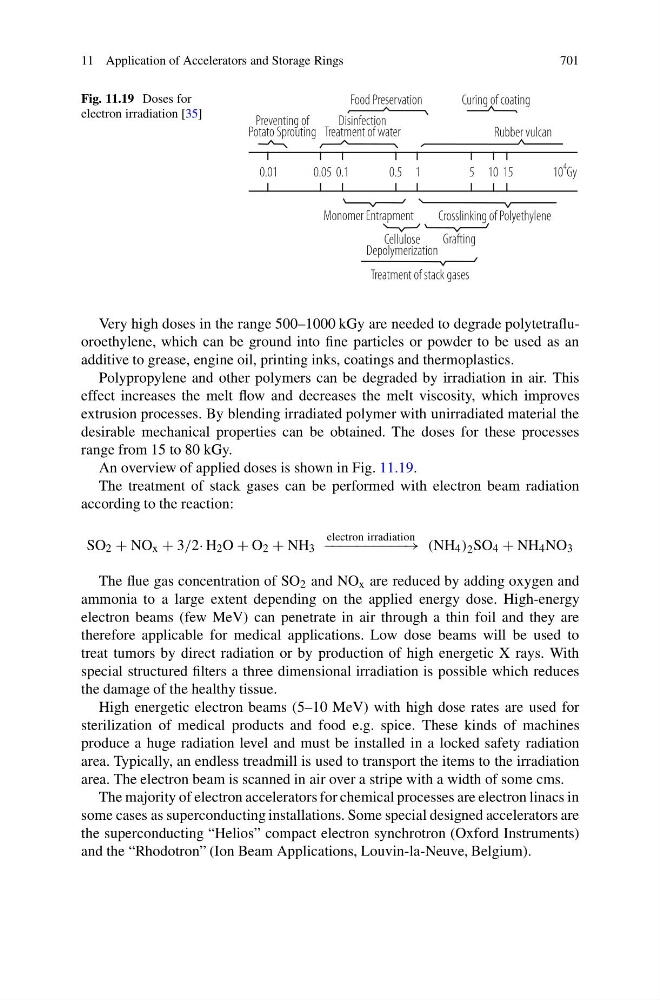
Fig. 11.19 Doses for
electron irradiation [35]
Very high doses in the range 500–1000 kGy are needed to degrade polytetrafluoroethylene, which can be ground into fine particles or powder to be used as an
additive to grease, engine oil, printing inks, coatings and thermoplastics.
Polypropylene and other polymers can be degraded by irradiation in air. This
effect increases the melt flow and decreases the melt viscosity, which improves
extrusion processes. By blending irradiated polymer with unirradiated material the
desirable mechanical properties can be obtained. The doses for these processes
range from 15 to 80 kGy.
An overview of applied doses is shown in Fig. 11.19.
The treatment of stack gases can be performed with electron beam radiation
according to the reaction:
SO 2 + NO x + 3/2· H 2 O + O 2 + NH 3
electron irradiation
− −−−−−−−−− → (NH 4 ) 2 SO 4 + NH 4 NO 3
The flue gas concentration of SO 2 and NO x are reduced by adding oxygen and
ammonia to a large extent depending on the applied energy dose. High-energy
electron beams (few MeV) can penetrate in air through a thin foil and they are
therefore applicable for medical applications. Low dose beams will be used to
treat tumors by direct radiation or by production of high energetic X rays. With
special structured filters a three dimensional irradiation is possible which reduces
the damage of the healthy tissue.
High energetic electron beams (5–10 MeV) with high dose rates are used for
sterilization of medical products and food e.g. spice. These kinds of machines
produce a huge radiation level and must be installed in a locked safety radiation
area. Typically, an endless treadmill is used to transport the items to the irradiation
area. The electron beam is scanned in air over a stripe with a width of some cms.
The majority of electron accelerators for chemical processes are electron linacs in
some cases as superconducting installations. Some special designed accelerators are
the superconducting “Helios” compact electron synchrotron (Oxford Instruments)
and the “Rhodotron” (Ion Beam Applications, Louvin-la-Neuve, Belgium).