

3 Non-linear Dynamics in Accelerators
59
3.5.2 Analysis of the One Turn Map
The key for the analysis is that matrices can be transformed into Normal Forms.
Starting with the One-Turn-Matrix, and try to find a (invertible) transformation A
such that:
AMA
−1
= R
(or :
A
−1 RA = M)
• The matrix R is:
– A “Normal Form”, (or at least a very simplified form of the matrix)
– For example (most important case): R becomes a pure rotation
• The matrix R describes the same dynamics as M, but:
– All coordinates are transformed by A
– This transformation A “analyses” the complexity of the motion, it contains the
structure of the phase space
M = A ◦ R ◦ A
−1 or : R = A
−1
◦ M ◦ A
The motion on an ellipse becomes a motion on a circle (i.e. a rotation): R is the
simple part of the map and its shape is dumped into the matrix A. R can be obtained
by the evaluation of the Eigenvectors and Eigenvalues.
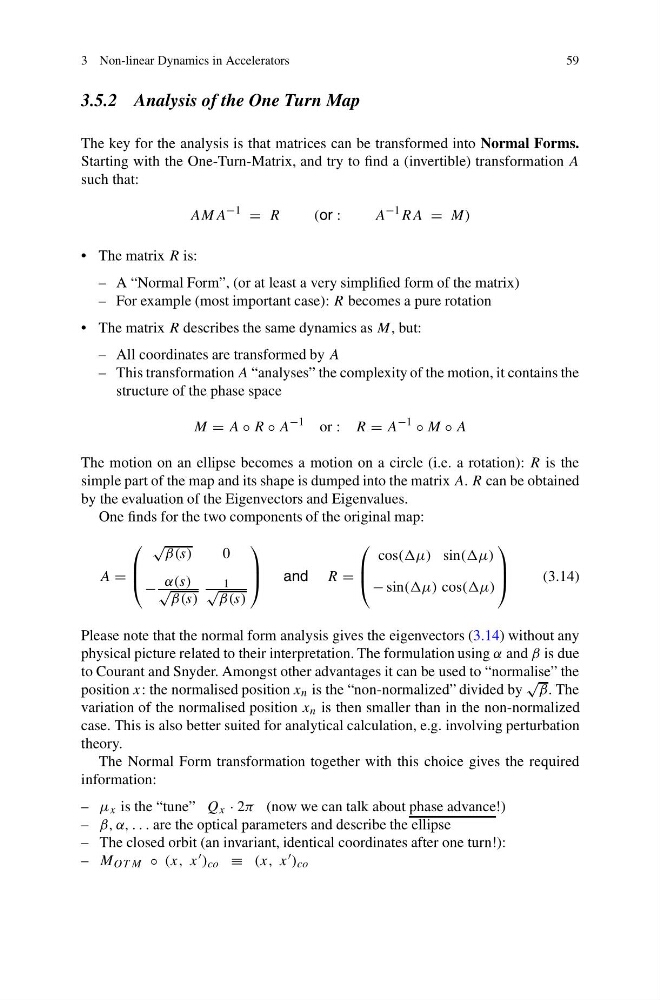
One finds for the two components of the original map:
A =
⎛
⎜
⎝
√
β(s)
0
− α(s)
√
β(s)
1
√
β(s)
⎞
⎟
⎠ and R =
⎛
⎜
⎝
cos((μ) sin((μ)
− sin((μ) cos((μ)
⎞
⎟
⎠
(3.14)
Please note that the normal form analysis gives the eigenvectors (3.14) without any
physical picture related to their interpretation. The formulation using α and β is due
to Courant and Snyder. Amongst other advantages it can be used to “normalise” the
position x: the normalised position x n is the “non-normalized” divided by
√
β. The
variation of the normalised position x n is then smaller than in the non-normalized
case. This is also better suited for analytical calculation, e.g. involving perturbation
theory.
The Normal Form transformation together with this choice gives the required
information:
– μ x is the “tune” Q x · 2π (now we can talk about phase advance!)
– β, α, . . . are the optical parameters and describe the ellipse
– The closed orbit (an invariant, identical coordinates after one turn!):
– M OT M ◦ (x, x ) co ≡ (x, x ) co
59
3.5.2 Analysis of the One Turn Map
The key for the analysis is that matrices can be transformed into Normal Forms.
Starting with the One-Turn-Matrix, and try to find a (invertible) transformation A
such that:
AMA
−1
= R
(or :
A
−1 RA = M)
• The matrix R is:
– A “Normal Form”, (or at least a very simplified form of the matrix)
– For example (most important case): R becomes a pure rotation
• The matrix R describes the same dynamics as M, but:
– All coordinates are transformed by A
– This transformation A “analyses” the complexity of the motion, it contains the
structure of the phase space
M = A ◦ R ◦ A
−1 or : R = A
−1
◦ M ◦ A
The motion on an ellipse becomes a motion on a circle (i.e. a rotation): R is the
simple part of the map and its shape is dumped into the matrix A. R can be obtained
by the evaluation of the Eigenvectors and Eigenvalues.
One finds for the two components of the original map:
A =
⎛
⎜
⎝
√
β(s)
0
− α(s)
√
β(s)
1
√
β(s)
⎞
⎟
⎠ and R =
⎛
⎜
⎝
cos((μ) sin((μ)
− sin((μ) cos((μ)
⎞
⎟
⎠
(3.14)
Please note that the normal form analysis gives the eigenvectors (3.14) without any
physical picture related to their interpretation. The formulation using α and β is due
to Courant and Snyder. Amongst other advantages it can be used to “normalise” the
position x: the normalised position x n is the “non-normalized” divided by
√
β. The
variation of the normalised position x n is then smaller than in the non-normalized
case. This is also better suited for analytical calculation, e.g. involving perturbation
theory.
The Normal Form transformation together with this choice gives the required
information:
– μ x is the “tune” Q x · 2π (now we can talk about phase advance!)
– β, α, . . . are the optical parameters and describe the ellipse
– The closed orbit (an invariant, identical coordinates after one turn!):
– M OT M ◦ (x, x ) co ≡ (x, x ) co