

682
M. Dohlus et al.
experiments is the brilliance B:
B = (dn/dt) /
4π
2 x y x y dω/ω
.
(11.53)
This quantity is also called brightness by some authors. dn/dt is the number of
photons per unit time, and Σ x , etc., are the rms photon beam extensions in x,y
dimensions, convoluted in the spirit of Eq. (11.52).
In RF accelerators, electrons are arranged within bunches such that the peak
beam current is much larger than the average current. Thus, the instantaneous value
of brilliance during the very moment of bunch passage is much larger that its time
average.
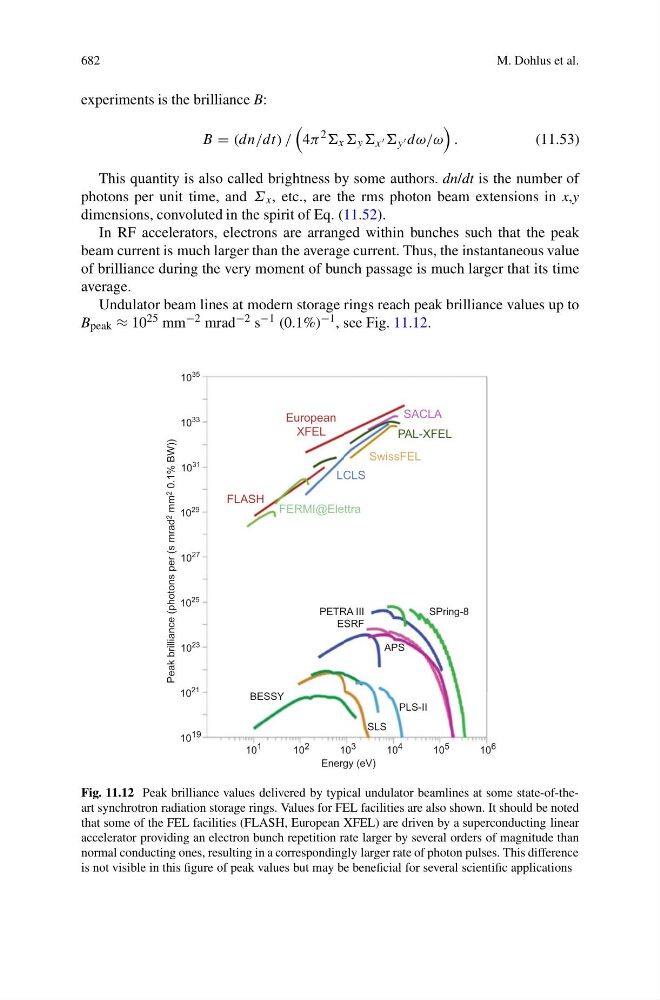
Undulator beam lines at modern storage rings reach peak brilliance values up to
B peak ≈ 10 25 mm −2 mrad −2 s −1 (0.1%) −1 , see Fig. 11.12.
European
XFEL
SACLA
PAL-XFEL
SwissFEL
LCLS
FERMI@Elettra
FLASH
PETRA III
ESRF
BESSY
SPring-8
APS
PLS-II
SLS
10
35
10
33
10
31
10
29
10
27
10
25
10
23
10
21
10 19
10 1
10 2
10 3
Energy (eV)
10
4
10 5
10 6
Peak brilliance (photons per (s mrad 2
mm 2
0.1% BW))
Fig. 11.12 Peak brilliance values delivered by typical undulator beamlines at some state-of-theart synchrotron radiation storage rings. Values for FEL facilities are also shown. It should be noted
that some of the FEL facilities (FLASH, European XFEL) are driven by a superconducting linear
accelerator providing an electron bunch repetition rate larger by several orders of magnitude than
normal conducting ones, resulting in a correspondingly larger rate of photon pulses. This difference
is not visible in this figure of peak values but may be beneficial for several scientific applications