

680
M. Dohlus et al.
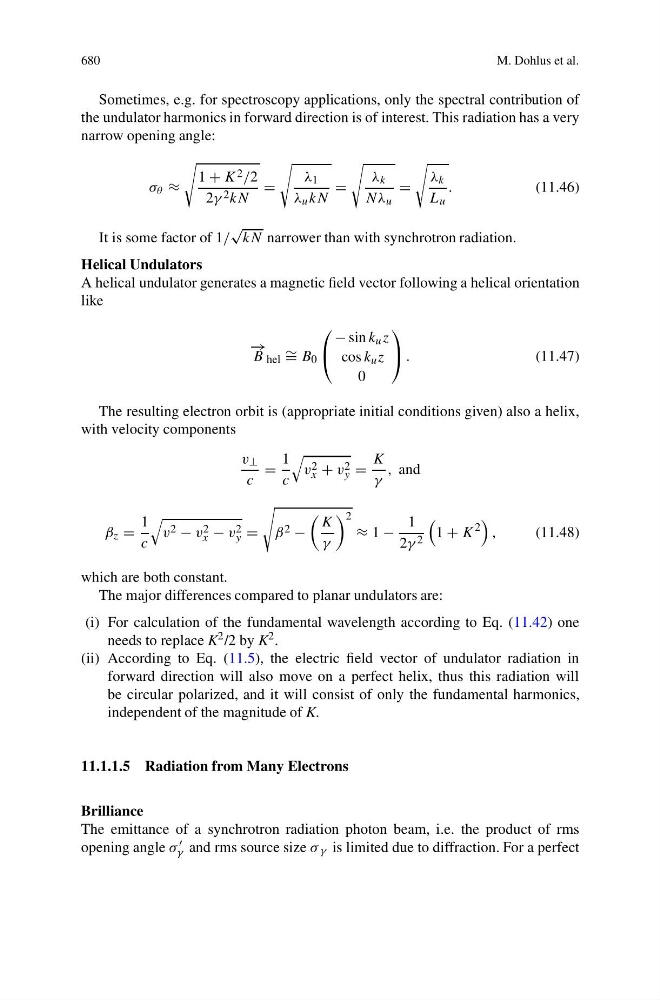
Sometimes, e.g. for spectroscopy applications, only the spectral contribution of
the undulator harmonics in forward direction is of interest. This radiation has a very
narrow opening angle:
σ θ ≈
1 + K 2 /2
2γ 2 kN
=
λ 1
λ u kN
=
λ k
Nλ u
=
λ k
L u
.
(11.46)
It is some factor of 1/
√
kN narrower than with synchrotron radiation.
Helical Undulators
A helical undulator generates a magnetic field vector following a helical orientation
like
− →
B hel ∼ = B 0
⎛
⎝
− sin k u z
cos k u z
0
⎞
⎠ .
(11.47)
The resulting electron orbit is (appropriate initial conditions given) also a helix,
with velocity components
v ⊥
c
=
1
c
v 2
x + v 2
y =
K
γ
, and
β z =
1
c
v 2 − v 2
x − v 2
y =
β 2 −
K
γ
2
≈ 1 −
1
2γ 2
1 + K
2
,
(11.48)
which are both constant.
The major differences compared to planar undulators are:
(i) For calculation of the fundamental wavelength according to Eq. (11.42) one
needs to replace K 2 /2 by K 2 .
(ii) According to Eq. (11.5), the electric field vector of undulator radiation in
forward direction will also move on a perfect helix, thus this radiation will
be circular polarized, and it will consist of only the fundamental harmonics,
independent of the magnitude of K.
11.1.1.5 Radiation from Many Electrons
Brilliance
The emittance of a synchrotron radiation photon beam, i.e. the product of rms
opening angle σ
γ and rms source size σ γ is limited due to diffraction. For a perfect