

678
M. Dohlus et al.
Fig. 11.9 Emission of radiation cones along the oscillatory trajectory in an undulator or wiggler.
In this schematic, the wiggler case K > 1 is illustrated, where the deflection angles ϑ = K/γ are
larger than 1/γ
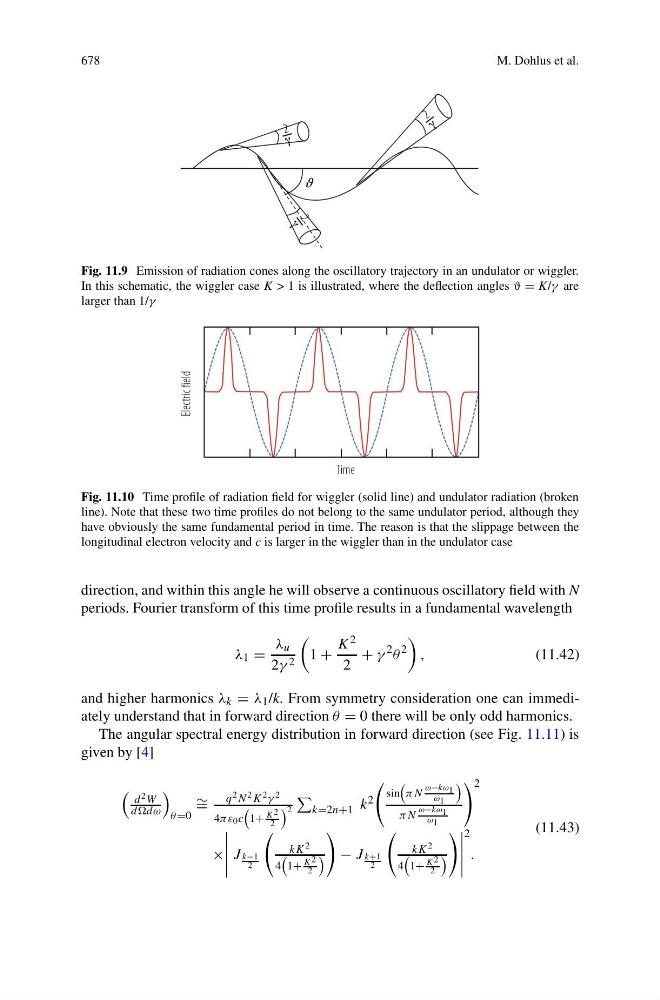
Fig. 11.10 Time profile of radiation field for wiggler (solid line) and undulator radiation (broken
line). Note that these two time profiles do not belong to the same undulator period, although they
have obviously the same fundamental period in time. The reason is that the slippage between the
longitudinal electron velocity and c is larger in the wiggler than in the undulator case
direction, and within this angle he will observe a continuous oscillatory field with N
periods. Fourier transform of this time profile results in a fundamental wavelength
λ 1 =
λ u
2γ 2
1 +
K 2
2
+ γ
2 θ
2
,
(11.42)
and higher harmonics λ k = λ 1 /k. From symmetry consideration one can immediately understand that in forward direction θ = 0 there will be only odd harmonics.
The angular spectral energy distribution in forward direction (see Fig. 11.11) is
given by [4]
d 2 W
dddω
θ=0
∼ =
q 2 N 2 K 2 γ 2
4πε 0 c
1+
K 2
2
2
k=2n+1 k 2
sin
πN
ω−kω 1
ω 1
πN
ω−kω 1
ω 1
2
×
J k−1
2
kK 2
4
1+
K 2
2
− J k+1
2
kK 2
4
1+
K 2
2
2
.
(11.43)