

676
M. Dohlus et al.
A key parameter is the undulator parameter
K =
eB 0 λ u
2πm 0 c
≈ (0.934B 0 /T) · (λ u /cm) .
(11.35)
As this quantity refers to electrons (or positrons), we have assumed m 0 to be the
electron rest mass m e in the last part of the equation. A device with K ≤ 1 is called
undulator, while wigglers exhibit values K > 1. Sometimes devices with K > 1 are
also called undulators if they are used in terms of radiation properties typical of
undulators, e.g. when observing the line spectrum in forward direction (see below).
Undulators and wigglers are realized in basically three varieties of technology:
iron-based electromagnets, permanent magnets and superconducting magnets. For
details, see e.g. [6].
Particle Trajectory
The equation of motion of an electron (with elementary charge −e) moving in
presence of the field of Eq. (11.33) reads in Cartesian components
¨
x =
e
γ m e
B y (z)· ˙
z, and
¨
z = −
e
γ m e
B y (z)· ˙
x.
(11.36)
To first-order approximation, the periodic solution reads
x(t) ∼ =
K
βγ k u
sin (k u βct) , or x(z) ∼ =
K
βγ k u
sin (k u z) , and
z(t) ∼ = βct.
(11.37)
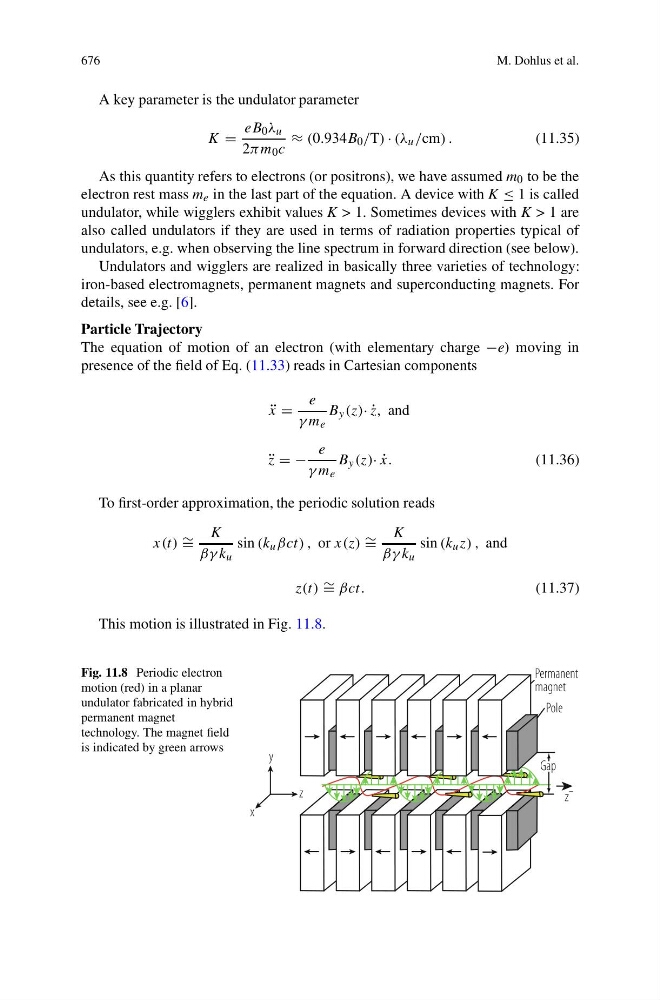
This motion is illustrated in Fig. 11.8.
Fig. 11.8 Periodic electron
motion (red) in a planar
undulator fabricated in hybrid
permanent magnet
technology. The magnet field
is indicated by green arrows