

634
K. Hübner et al.
0
2000
4000
6000 A
current
1000 K
800 K
600 K
400 K
200 K
l i o c n i e
r
u
t
a
r
e
p
m
e
t
m
u
m
i
x
a
m
warm-iron
cold-iron
cold-iron
with cold diode
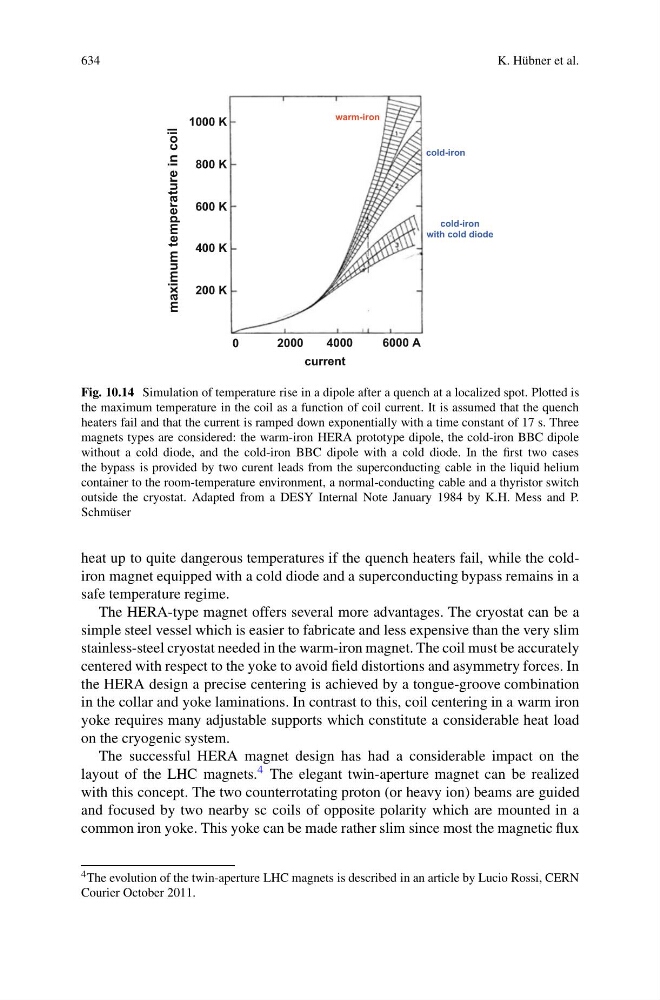
Fig. 10.14 Simulation of temperature rise in a dipole after a quench at a localized spot. Plotted is
the maximum temperature in the coil as a function of coil current. It is assumed that the quench
heaters fail and that the current is ramped down exponentially with a time constant of 17 s. Three
magnets types are considered: the warm-iron HERA prototype dipole, the cold-iron BBC dipole
without a cold diode, and the cold-iron BBC dipole with a cold diode. In the first two cases
the bypass is provided by two curent leads from the superconducting cable in the liquid helium
container to the room-temperature environment, a normal-conducting cable and a thyristor switch
outside the cryostat. Adapted from a DESY Internal Note January 1984 by K.H. Mess and P.
Schmüser
heat up to quite dangerous temperatures if the quench heaters fail, while the coldiron magnet equipped with a cold diode and a superconducting bypass remains in a
safe temperature regime.
The HERA-type magnet offers several more advantages. The cryostat can be a
simple steel vessel which is easier to fabricate and less expensive than the very slim
stainless-steel cryostat needed in the warm-iron magnet. The coil must be accurately
centered with respect to the yoke to avoid field distortions and asymmetry forces. In
the HERA design a precise centering is achieved by a tongue-groove combination
in the collar and yoke laminations. In contrast to this, coil centering in a warm iron
yoke requires many adjustable supports which constitute a considerable heat load
on the cryogenic system.
The successful HERA magnet design has had a considerable impact on the
layout of the LHC magnets. 4 The elegant twin-aperture magnet can be realized
with this concept. The two counterrotating proton (or heavy ion) beams are guided
and focused by two nearby sc coils of opposite polarity which are mounted in a
common iron yoke. This yoke can be made rather slim since most the magnetic flux
4 The evolution of the twin-aperture LHC magnets is described in an article by Lucio Rossi, CERN
Courier October 2011.