

630
K. Hübner et al.
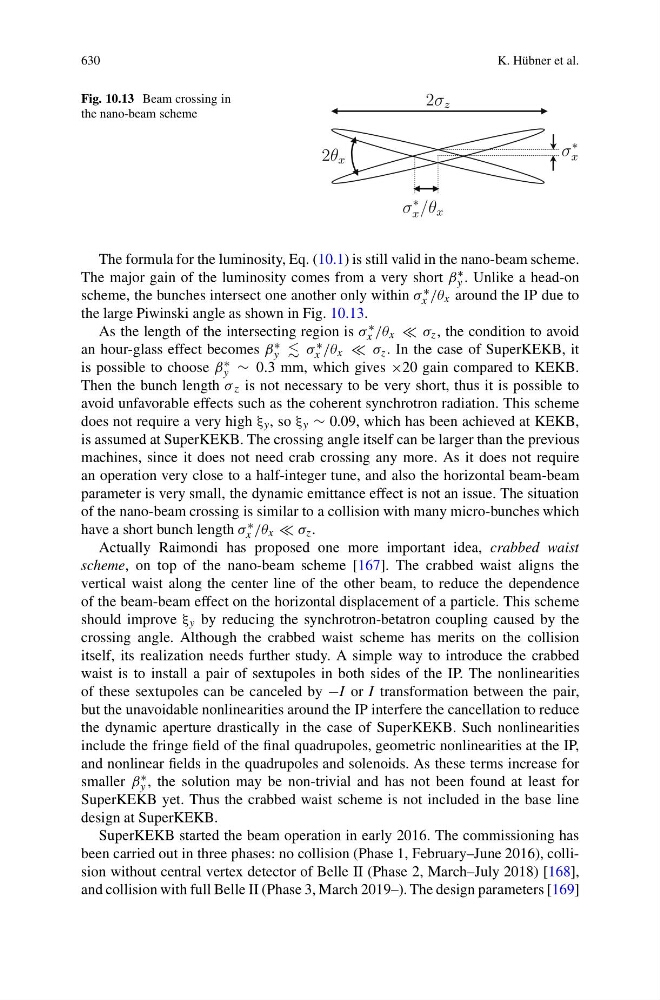
Fig. 10.13 Beam crossing in
the nano-beam scheme
The formula for the luminosity, Eq. (10.1) is still valid in the nano-beam scheme.
The major gain of the luminosity comes from a very short β ∗
y . Unlike a head-on
scheme, the bunches intersect one another only within σ ∗
x /θ x around the IP due to
the large Piwinski angle as shown in Fig. 10.13.
As the length of the intersecting region is σ ∗
x /θ x σ z , the condition to avoid
an hour-glass effect becomes β ∗
y σ ∗
x /θ x σ z . In the case of SuperKEKB, it
is possible to choose β ∗
y ∼ 0.3 mm, which gives ×20 gain compared to KEKB.
Then the bunch length σ z is not necessary to be very short, thus it is possible to
avoid unfavorable effects such as the coherent synchrotron radiation. This scheme
does not require a very high ξ y , so ξ y ∼ 0.09, which has been achieved at KEKB,
is assumed at SuperKEKB. The crossing angle itself can be larger than the previous
machines, since it does not need crab crossing any more. As it does not require
an operation very close to a half-integer tune, and also the horizontal beam-beam
parameter is very small, the dynamic emittance effect is not an issue. The situation
of the nano-beam crossing is similar to a collision with many micro-bunches which
have a short bunch length σ ∗
x /θ x σ z .
Actually Raimondi has proposed one more important idea, crabbed waist
scheme, on top of the nano-beam scheme [167]. The crabbed waist aligns the
vertical waist along the center line of the other beam, to reduce the dependence
of the beam-beam effect on the horizontal displacement of a particle. This scheme
should improve ξ y by reducing the synchrotron-betatron coupling caused by the
crossing angle. Although the crabbed waist scheme has merits on the collision
itself, its realization needs further study. A simple way to introduce the crabbed
waist is to install a pair of sextupoles in both sides of the IP. The nonlinearities
of these sextupoles can be canceled by −I or I transformation between the pair,
but the unavoidable nonlinearities around the IP interfere the cancellation to reduce
the dynamic aperture drastically in the case of SuperKEKB. Such nonlinearities
include the fringe field of the final quadrupoles, geometric nonlinearities at the IP,
and nonlinear fields in the quadrupoles and solenoids. As these terms increase for
smaller β ∗
y , the solution may be non-trivial and has not been found at least for
SuperKEKB yet. Thus the crabbed waist scheme is not included in the base line
design at SuperKEKB.
SuperKEKB started the beam operation in early 2016. The commissioning has
been carried out in three phases: no collision (Phase 1, February–June 2016), collision without central vertex detector of Belle II (Phase 2, March–July 2018) [168],
and collision with full Belle II (Phase 3, March 2019–). The design parameters [169]