

628
K. Hübner et al.
• In the case of the crossing angle at KEKB, the horizontal offset at the IP was
controlled by looking at the vertical beam size measured by the interferometer
[158].
• Tuning of the local coupling and dispersion at the IP by making offsets of orbits
at sextupoles near the IP [149].
• Dithering technique was used at PEP–II to maximize the luminosity against the
beam offsets [159].
• Skew sextupoles were introduced at KEKB to correct the local chromatic x-y
coupling terms at the IP [124].
The horizontal tunes were chosen as close to a half integer as possible, to
maximize the luminosity using the dynamic-β effect and expecting the reduction
of the degree-of-freedom of the beam-beam interaction [160]. In the case of KEKB,
the LER and the HER was operated at ν x ≈ 0.506 and ν x ≈ 0.510, respectively. Both
the optics correction and the tune feedback were necessary to maintain a collision
near the stop band.
10.4.10 Injector
The electron-positron injector must provide enough number of charges to the
collider rings. PEP–II could fully utilized the injection system for SLC, which
had more than enough performance for PEP–II, in the intensity, repetition, and the
emittance, especially with the damping rings for both beams. On the other hand, the
injector for KEKB was upgraded from that for TRISTAN, having only the minimum
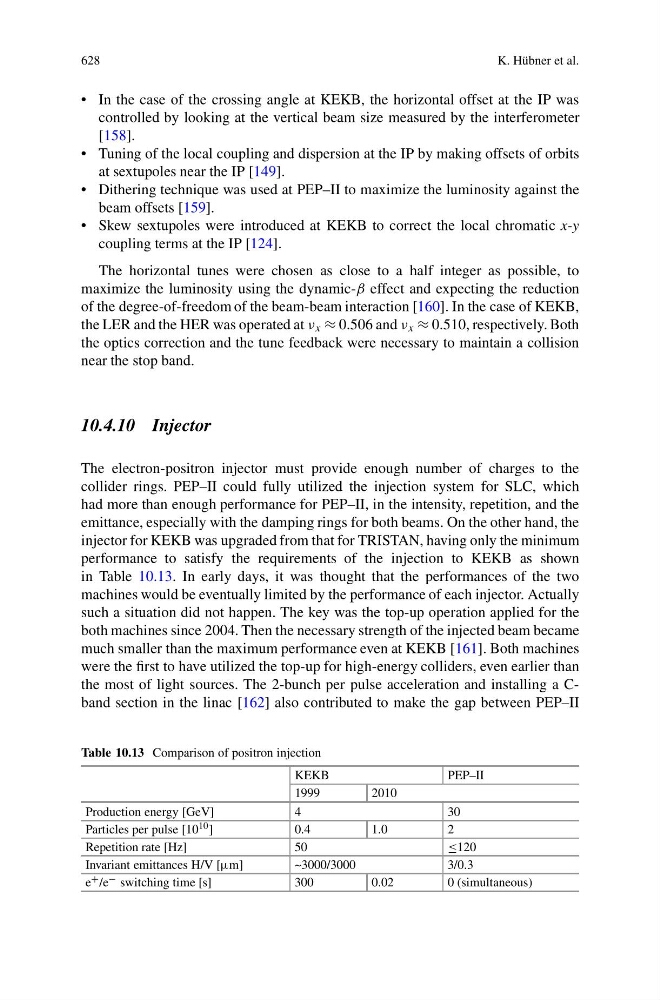
performance to satisfy the requirements of the injection to KEKB as shown
in Table 10.13. In early days, it was thought that the performances of the two
machines would be eventually limited by the performance of each injector. Actually
such a situation did not happen. The key was the top-up operation applied for the
both machines since 2004. Then the necessary strength of the injected beam became
much smaller than the maximum performance even at KEKB [161]. Both machines
were the first to have utilized the top-up for high-energy colliders, even earlier than
the most of light sources. The 2-bunch per pulse acceleration and installing a Cband section in the linac [162] also contributed to make the gap between PEP–II
Table 10.13 Comparison of positron injection
KEKB
PEP–II
1999
2010
Production energy [GeV]
4
30
Particles per pulse [10 10 ]
0.4
1.0
2
Repetition rate [Hz]
50
≤120
Invariant emittances H/V [μm]
~3000/3000
3/0.3
e + /e − switching time [s]
300
0.02
0 (simultaneous)