

624
K. Hübner et al.
beam-optical performance. Another issue of the magnetic separation was the nonnegligible effect due to the parasitic collision [130], which was never observed at
KEKB.
10.4.5 Storing High Current
As described above, the luminosity is proportional to the stored current. To achieve
the luminosity as high as 10 34 cm −2 s −1 , a stored current of near 3 A was required,
which was one order higher than any high energy electron storage rings at that time.
The first fundamental difficulty is to ensure the longitudinal stability of the beam.
The beam loading of the accelerating cavity is huge: a normal conducting cavity
at the RF frequency f RF = 500 MHz for the B-factories has a shunt impedance
R s ≈ 1.7 M. If the cavity is tuned at the harmonics, the 3 A beam generates 5.1 MV
decelerating voltage at the cavity, which is even higher than the accelerating voltage
V c of the cavity, typically 0.5 MV. Thus the detuning of the cavity is necessary and
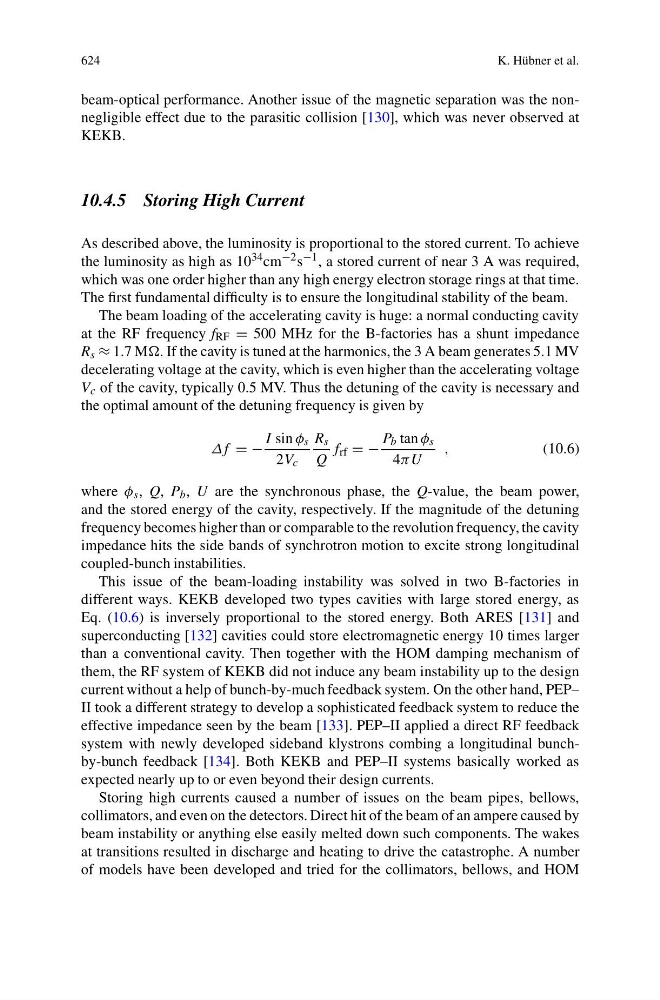
the optimal amount of the detuning frequency is given by
Δf = −
I sin φ s
2V c
R s
Q
f rf = −
P b tan φ s
4πU
,
(10.6)
where φ s , Q, P b , U are the synchronous phase, the Q-value, the beam power,
and the stored energy of the cavity, respectively. If the magnitude of the detuning
frequency becomes higher than or comparable to the revolution frequency, the cavity
impedance hits the side bands of synchrotron motion to excite strong longitudinal
coupled-bunch instabilities.
This issue of the beam-loading instability was solved in two B-factories in
different ways. KEKB developed two types cavities with large stored energy, as
Eq. (10.6) is inversely proportional to the stored energy. Both ARES [131] and
superconducting [132] cavities could store electromagnetic energy 10 times larger
than a conventional cavity. Then together with the HOM damping mechanism of
them, the RF system of KEKB did not induce any beam instability up to the design
current without a help of bunch-by-much feedback system. On the other hand, PEP–
II took a different strategy to develop a sophisticated feedback system to reduce the
effective impedance seen by the beam [133]. PEP–II applied a direct RF feedback
system with newly developed sideband klystrons combing a longitudinal bunchby-bunch feedback [134]. Both KEKB and PEP–II systems basically worked as
expected nearly up to or even beyond their design currents.
Storing high currents caused a number of issues on the beam pipes, bellows,
collimators, and even on the detectors. Direct hit of the beam of an ampere caused by
beam instability or anything else easily melted down such components. The wakes
at transitions resulted in discharge and heating to drive the catastrophe. A number
of models have been developed and tried for the collimators, bellows, and HOM