

10 The Largest Accelerators and Colliders of Their Time
621
focusing β ∗
y ∼ 100 μm to achieve the luminosity, then the bunch length must be as
short as β ∗
y to avoid the hour-glass effect. The bunch length itself can be obtained
by bunch compressors, but the associated energy spread degrades the effective
luminosity, since the width of the resonance ϒ(4S) is only 20 MeV (2 × 10 −4 ).
A huge damping ring would be necessary to realize such a short bunch length and a
small energy spread simultaneously. Thus linear collision schemes seemed difficult.
As for the double-ring collision, a question is the sizes of the rings. If one can
collide a large high energy ring (HER), for instance at 25 GeV, with a small low
energy ring (LER) at 1.2 GeV, the total cost will be saved, assuming an existing
tunnel for such a high energy ring. It was pointed out [120] that the collision of
rings with different circumferences has somewhat fundamental difficulty: if two
rings have the ratio of circumferences m : n(m > n), the periodicity of the system
becomes very long, i.e., LCM(m, n)/m times the revolution period of the larger ring.
Then both rings will have dense resonance lines in the tune space which reduces the
operable area, especially with a certain amount of the beam-beam tune shift. Thus
collision of rings with different circumferences seemed difficult. Therefore only the
double ring collider scheme with equal cicumferences remained.
Two projects of the asymmetric B-factories, PEP–II [121] at SLAC and KEKB
[122] at KEK, were approved and started the construction by 1994. Both projects
utilized the components and facilities of their previous generation colliders, PEP
and TRISTAN, and built the BaBar and Belle detectors, respectively. Both machines
started the collision experiments in 1999 and stopped the operation in April 2008
(PEP–II) and June 2010 (KEKB). Table 10.12 lists the main machine parameters
corresponding to their best records [123, 124]. Both colliders achieved higher performance than their designs, and experimentally verified the Kobayashi–Maskawa
model to bring the 2008 Nobel Prize in Physics.
10.4.3 Luminosity
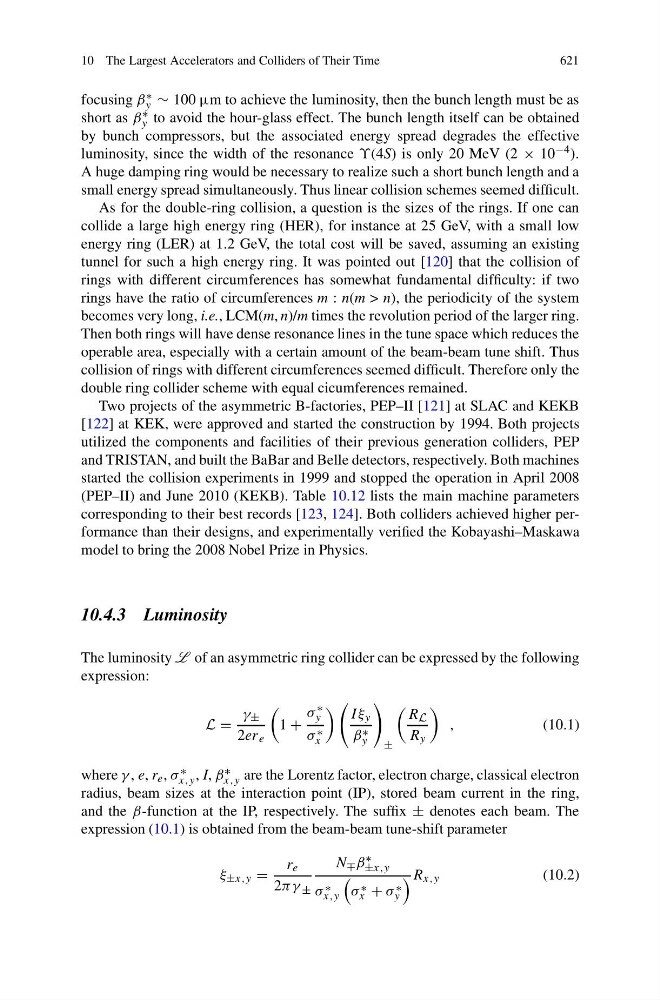
The luminosity L of an asymmetric ring collider can be expressed by the following
expression:
L =
γ ±
2er e
1 +
σ ∗
y
σ ∗
x
I ξ y
β ∗
y
±
R L
R y
,
(10.1)
where γ , e, r e , σ ∗
x,y , I, β ∗
x,y are the Lorentz factor, electron charge, classical electron
radius, beam sizes at the interaction point (IP), stored beam current in the ring,
and the β-function at the IP, respectively. The suffix ± denotes each beam. The
expression (10.1) is obtained from the beam-beam tune-shift parameter
ξ ±x,y =
r e
2πγ ±
N ∓ β ∗
±x,y
σ ∗
x,y
σ ∗
x + σ ∗
y
R x,y
(10.2)