

608
K. Hübner et al.
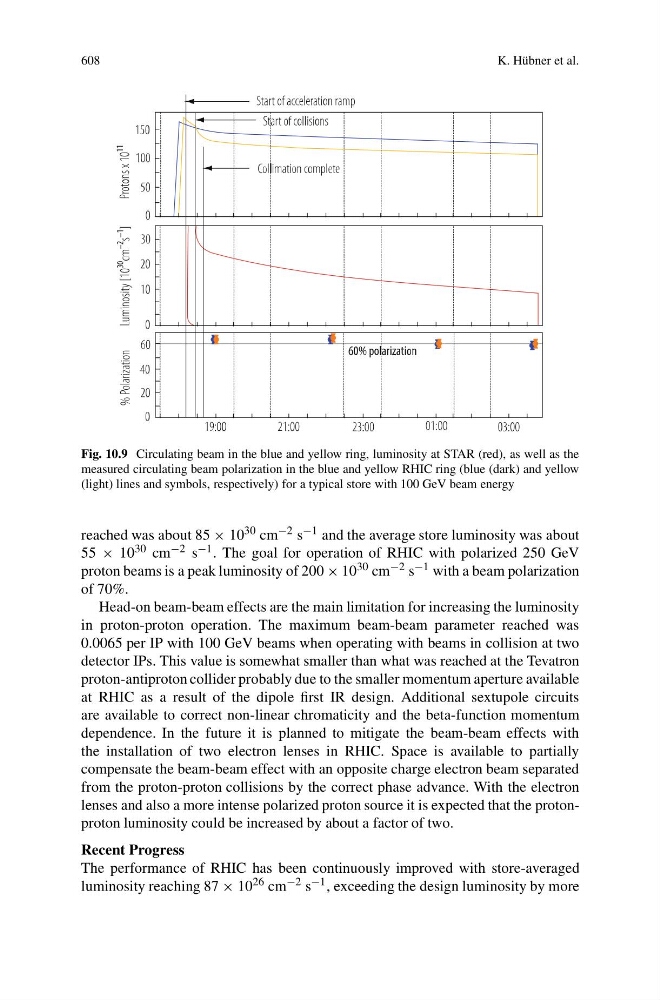
Fig. 10.9 Circulating beam in the blue and yellow ring, luminosity at STAR (red), as well as the
measured circulating beam polarization in the blue and yellow RHIC ring (blue (dark) and yellow
(light) lines and symbols, respectively) for a typical store with 100 GeV beam energy
reached was about 85 × 10 30 cm −2 s −1 and the average store luminosity was about
55 × 10 30 cm −2 s −1 . The goal for operation of RHIC with polarized 250 GeV
proton beams is a peak luminosity of 200 × 10 30 cm −2 s −1 with a beam polarization
of 70%.
Head-on beam-beam effects are the main limitation for increasing the luminosity
in proton-proton operation. The maximum beam-beam parameter reached was
0.0065 per IP with 100 GeV beams when operating with beams in collision at two
detector IPs. This value is somewhat smaller than what was reached at the Tevatron
proton-antiproton collider probably due to the smaller momentum aperture available
at RHIC as a result of the dipole first IR design. Additional sextupole circuits
are available to correct non-linear chromaticity and the beta-function momentum
dependence. In the future it is planned to mitigate the beam-beam effects with
the installation of two electron lenses in RHIC. Space is available to partially
compensate the beam-beam effect with an opposite charge electron beam separated
from the proton-proton collisions by the correct phase advance. With the electron
lenses and also a more intense polarized proton source it is expected that the protonproton luminosity could be increased by about a factor of two.
Recent Progress
The performance of RHIC has been continuously improved with store-averaged
luminosity reaching 87 × 10 26 cm −2 s −1 , exceeding the design luminosity by more