

604
K. Hübner et al.
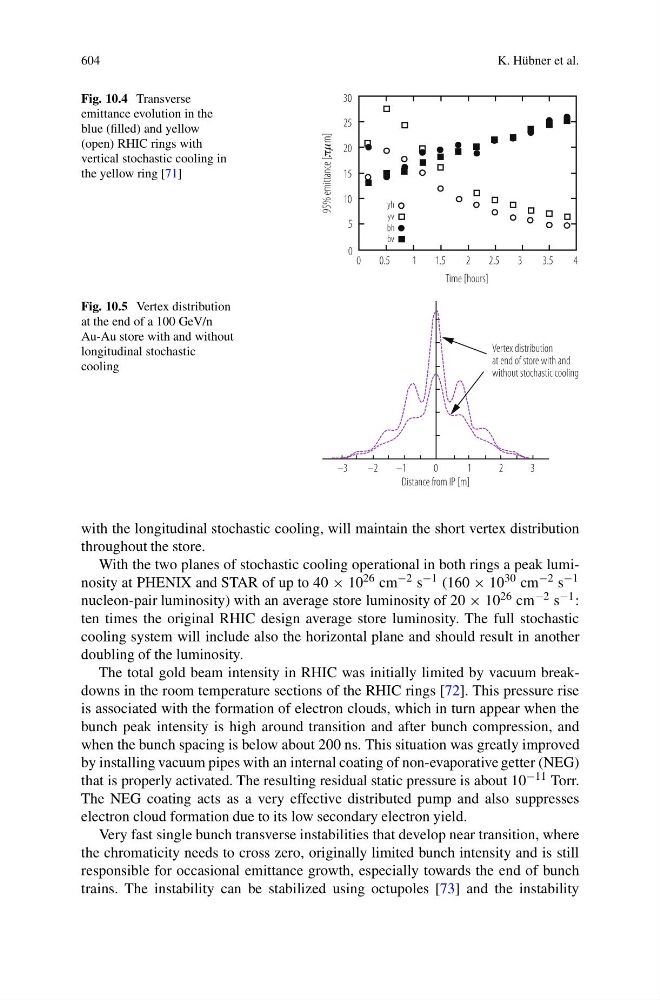
Fig. 10.4 Transverse
emittance evolution in the
blue (filled) and yellow
(open) RHIC rings with
vertical stochastic cooling in
the yellow ring [71]
Fig. 10.5 Vertex distribution
at the end of a 100 GeV/n
Au-Au store with and without
longitudinal stochastic
cooling
with the longitudinal stochastic cooling, will maintain the short vertex distribution
throughout the store.
With the two planes of stochastic cooling operational in both rings a peak luminosity at PHENIX and STAR of up to 40 × 10 26 cm −2 s −1 (160 × 10 30 cm −2 s −1
nucleon-pair luminosity) with an average store luminosity of 20 × 10 26 cm −2 s −1 :
ten times the original RHIC design average store luminosity. The full stochastic
cooling system will include also the horizontal plane and should result in another
doubling of the luminosity.
The total gold beam intensity in RHIC was initially limited by vacuum breakdowns in the room temperature sections of the RHIC rings [72]. This pressure rise
is associated with the formation of electron clouds, which in turn appear when the
bunch peak intensity is high around transition and after bunch compression, and
when the bunch spacing is below about 200 ns. This situation was greatly improved
by installing vacuum pipes with an internal coating of non-evaporative getter (NEG)
that is properly activated. The resulting residual static pressure is about 10 −11 Torr.
The NEG coating acts as a very effective distributed pump and also suppresses
electron cloud formation due to its low secondary electron yield.
Very fast single bunch transverse instabilities that develop near transition, where
the chromaticity needs to cross zero, originally limited bunch intensity and is still
responsible for occasional emittance growth, especially towards the end of bunch
trains. The instability can be stabilized using octupoles [73] and the instability