

578
M. Lamont et al.
9.9.8.3 Beam Current Monitors
Beam current monitors can be used to monitor transmission and lifetimes of beams.
If the beam transmission between two locations of the accelerator complex is too
low, implying beam loss, the obvious action is to stop operation and address the
problem. If the beam lifetime in a synchrotron or storage ring is too low, one
dumps the beam. The dangers of erroneous readings are fairly clear. Duplication
of monitors can provide some level of redundancy.
9.9.9 Machine Protection at the LHC
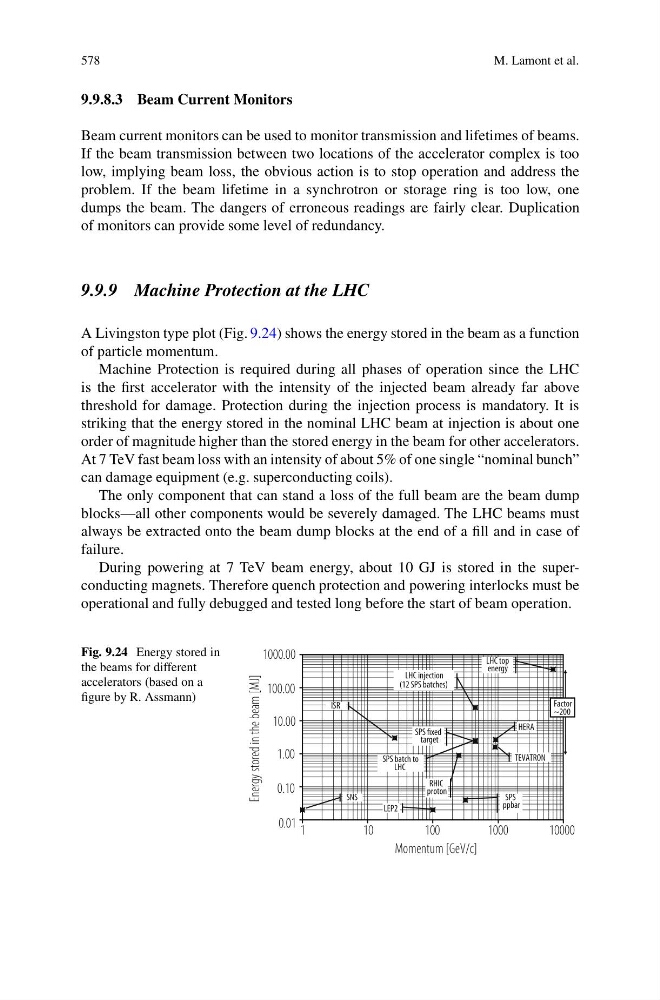
A Livingston type plot (Fig. 9.24) shows the energy stored in the beam as a function
of particle momentum.
Machine Protection is required during all phases of operation since the LHC
is the first accelerator with the intensity of the injected beam already far above
threshold for damage. Protection during the injection process is mandatory. It is
striking that the energy stored in the nominal LHC beam at injection is about one
order of magnitude higher than the stored energy in the beam for other accelerators.
At 7 TeV fast beam loss with an intensity of about 5% of one single “nominal bunch”
can damage equipment (e.g. superconducting coils).
The only component that can stand a loss of the full beam are the beam dump
blocks—all other components would be severely damaged. The LHC beams must
always be extracted onto the beam dump blocks at the end of a fill and in case of
failure.
During powering at 7 TeV beam energy, about 10 GJ is stored in the superconducting magnets. Therefore quench protection and powering interlocks must be
operational and fully debugged and tested long before the start of beam operation.
Fig. 9.24 Energy stored in
the beams for different
accelerators (based on a
figure by R. Assmann)
0.01
0.10
1.00
10.00
100.00
1000.00
1
10
100
1000
10000
Momentum [GeV/c]
Energy stored in the beam [MJ]
LHC top
energy
LHC injection
(12 SPS batches)
ISR
SNS
LEP2
target
HERA
TEVATRON
SPS
ppbar
SPS batch to
LHC
Factor
~200
RHIC
proton
M. Lamont et al.
9.9.8.3 Beam Current Monitors
Beam current monitors can be used to monitor transmission and lifetimes of beams.
If the beam transmission between two locations of the accelerator complex is too
low, implying beam loss, the obvious action is to stop operation and address the
problem. If the beam lifetime in a synchrotron or storage ring is too low, one
dumps the beam. The dangers of erroneous readings are fairly clear. Duplication
of monitors can provide some level of redundancy.
9.9.9 Machine Protection at the LHC
A Livingston type plot (Fig. 9.24) shows the energy stored in the beam as a function
of particle momentum.
Machine Protection is required during all phases of operation since the LHC
is the first accelerator with the intensity of the injected beam already far above
threshold for damage. Protection during the injection process is mandatory. It is
striking that the energy stored in the nominal LHC beam at injection is about one
order of magnitude higher than the stored energy in the beam for other accelerators.
At 7 TeV fast beam loss with an intensity of about 5% of one single “nominal bunch”
can damage equipment (e.g. superconducting coils).
The only component that can stand a loss of the full beam are the beam dump
blocks—all other components would be severely damaged. The LHC beams must
always be extracted onto the beam dump blocks at the end of a fill and in case of
failure.
During powering at 7 TeV beam energy, about 10 GJ is stored in the superconducting magnets. Therefore quench protection and powering interlocks must be
operational and fully debugged and tested long before the start of beam operation.
Fig. 9.24 Energy stored in
the beams for different
accelerators (based on a
figure by R. Assmann)
0.01
0.10
1.00
10.00
100.00
1000.00
1
10
100
1000
10000
Momentum [GeV/c]
Energy stored in the beam [MJ]
LHC top
energy
LHC injection
(12 SPS batches)
ISR
SNS
LEP2
target
HERA
TEVATRON
SPS
ppbar
SPS batch to
LHC
Factor
~200
RHIC
proton