

8 Accelerator Engineering and Technology: Accelerator Technology
499
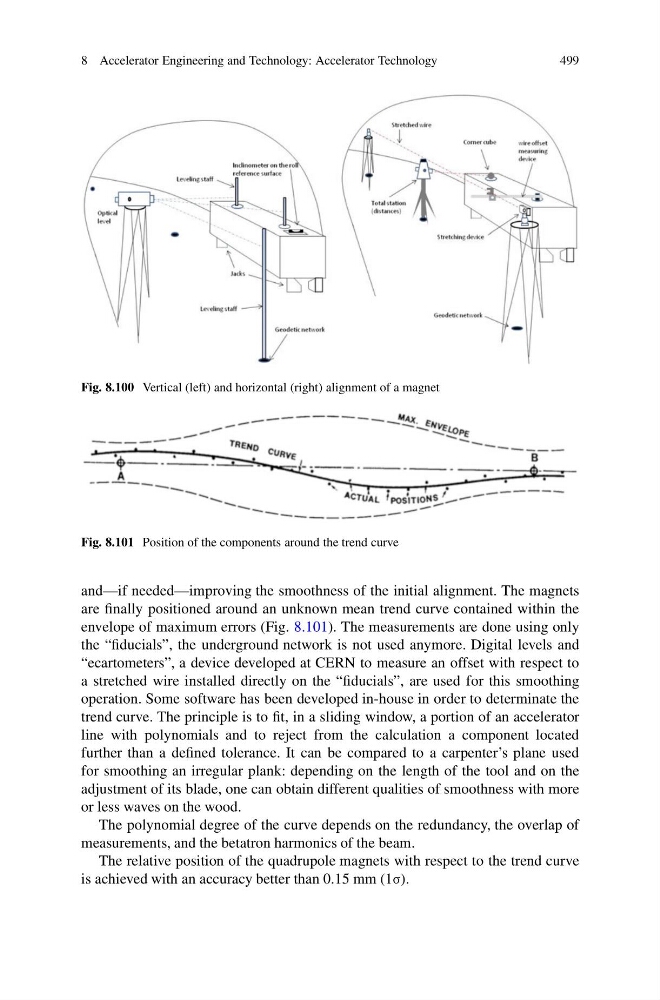
Fig. 8.100 Vertical (left) and horizontal (right) alignment of a magnet
Fig. 8.101 Position of the components around the trend curve
and—if needed—improving the smoothness of the initial alignment. The magnets
are finally positioned around an unknown mean trend curve contained within the
envelope of maximum errors (Fig. 8.101). The measurements are done using only
the “fiducials”, the underground network is not used anymore. Digital levels and
“ecartometers”, a device developed at CERN to measure an offset with respect to
a stretched wire installed directly on the “fiducials”, are used for this smoothing
operation. Some software has been developed in-house in order to determinate the
trend curve. The principle is to fit, in a sliding window, a portion of an accelerator
line with polynomials and to reject from the calculation a component located
further than a defined tolerance. It can be compared to a carpenter’s plane used
for smoothing an irregular plank: depending on the length of the tool and on the
adjustment of its blade, one can obtain different qualities of smoothness with more
or less waves on the wood.
The polynomial degree of the curve depends on the redundancy, the overlap of
measurements, and the betatron harmonics of the beam.
The relative position of the quadrupole magnets with respect to the trend curve
is achieved with an accuracy better than 0.15 mm (1σ).
499
Fig. 8.100 Vertical (left) and horizontal (right) alignment of a magnet
Fig. 8.101 Position of the components around the trend curve
and—if needed—improving the smoothness of the initial alignment. The magnets
are finally positioned around an unknown mean trend curve contained within the
envelope of maximum errors (Fig. 8.101). The measurements are done using only
the “fiducials”, the underground network is not used anymore. Digital levels and
“ecartometers”, a device developed at CERN to measure an offset with respect to
a stretched wire installed directly on the “fiducials”, are used for this smoothing
operation. Some software has been developed in-house in order to determinate the
trend curve. The principle is to fit, in a sliding window, a portion of an accelerator
line with polynomials and to reject from the calculation a component located
further than a defined tolerance. It can be compared to a carpenter’s plane used
for smoothing an irregular plank: depending on the length of the tool and on the
adjustment of its blade, one can obtain different qualities of smoothness with more
or less waves on the wood.
The polynomial degree of the curve depends on the redundancy, the overlap of
measurements, and the betatron harmonics of the beam.
The relative position of the quadrupole magnets with respect to the trend curve
is achieved with an accuracy better than 0.15 mm (1σ).