

40
E. Wilson and B. J. Holzer
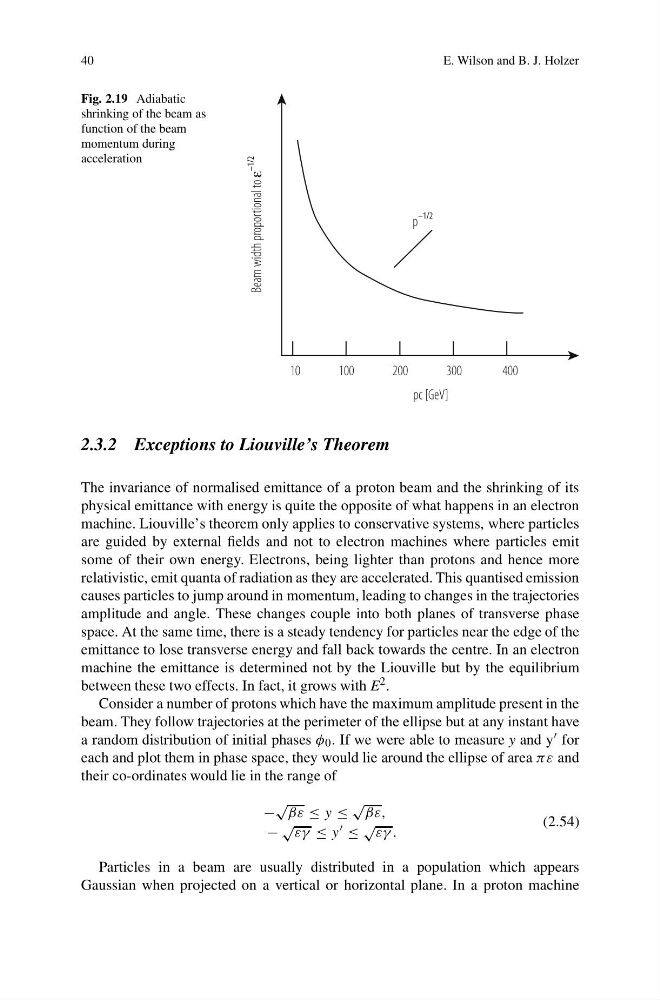
Fig. 2.19 Adiabatic
shrinking of the beam as
function of the beam
momentum during
acceleration
2.3.2 Exceptions to Liouville’s Theorem
The invariance of normalised emittance of a proton beam and the shrinking of its
physical emittance with energy is quite the opposite of what happens in an electron
machine. Liouville’s theorem only applies to conservative systems, where particles
are guided by external fields and not to electron machines where particles emit
some of their own energy. Electrons, being lighter than protons and hence more
relativistic, emit quanta of radiation as they are accelerated. This quantised emission
causes particles to jump around in momentum, leading to changes in the trajectories
amplitude and angle. These changes couple into both planes of transverse phase
space. At the same time, there is a steady tendency for particles near the edge of the
emittance to lose transverse energy and fall back towards the centre. In an electron
machine the emittance is determined not by the Liouville but by the equilibrium
between these two effects. In fact, it grows with E 2 .
Consider a number of protons which have the maximum amplitude present in the
beam. They follow trajectories at the perimeter of the ellipse but at any instant have
a random distribution of initial phases φ 0 . If we were able to measure y and y for
each and plot them in phase space, they would lie around the ellipse of area πε and
their co-ordinates would lie in the range of
−
√
βε ≤ y ≤
√
βε,
−
√ εγ ≤ y ≤
√
εγ .
(2.54)
Particles in a beam are usually distributed in a population which appears
Gaussian when projected on a vertical or horizontal plane. In a proton machine
E. Wilson and B. J. Holzer
Fig. 2.19 Adiabatic
shrinking of the beam as
function of the beam
momentum during
acceleration
2.3.2 Exceptions to Liouville’s Theorem
The invariance of normalised emittance of a proton beam and the shrinking of its
physical emittance with energy is quite the opposite of what happens in an electron
machine. Liouville’s theorem only applies to conservative systems, where particles
are guided by external fields and not to electron machines where particles emit
some of their own energy. Electrons, being lighter than protons and hence more
relativistic, emit quanta of radiation as they are accelerated. This quantised emission
causes particles to jump around in momentum, leading to changes in the trajectories
amplitude and angle. These changes couple into both planes of transverse phase
space. At the same time, there is a steady tendency for particles near the edge of the
emittance to lose transverse energy and fall back towards the centre. In an electron
machine the emittance is determined not by the Liouville but by the equilibrium
between these two effects. In fact, it grows with E 2 .
Consider a number of protons which have the maximum amplitude present in the
beam. They follow trajectories at the perimeter of the ellipse but at any instant have
a random distribution of initial phases φ 0 . If we were able to measure y and y for
each and plot them in phase space, they would lie around the ellipse of area πε and
their co-ordinates would lie in the range of
−
√
βε ≤ y ≤
√
βε,
−
√ εγ ≤ y ≤
√
εγ .
(2.54)
Particles in a beam are usually distributed in a population which appears
Gaussian when projected on a vertical or horizontal plane. In a proton machine