

490
F. Bordry et al.
Z
X
p
+
Y
1 m graphite block
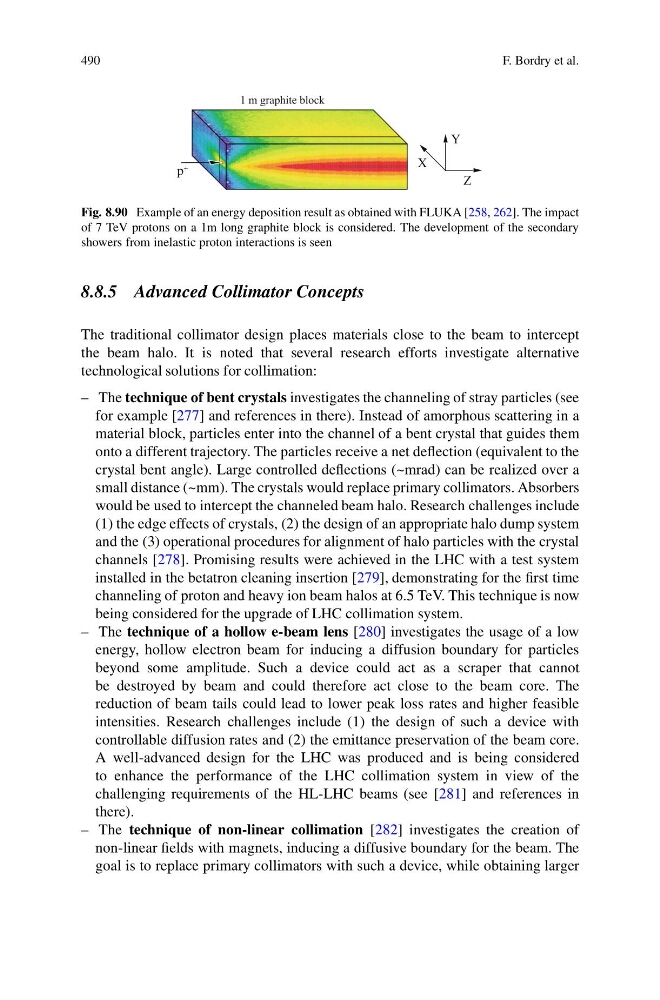
Fig. 8.90 Example of an energy deposition result as obtained with FLUKA [258, 262]. The impact
of 7 TeV protons on a 1m long graphite block is considered. The development of the secondary
showers from inelastic proton interactions is seen
8.8.5 Advanced Collimator Concepts
The traditional collimator design places materials close to the beam to intercept
the beam halo. It is noted that several research efforts investigate alternative
technological solutions for collimation:
– The technique of bent crystals investigates the channeling of stray particles (see
for example [277] and references in there). Instead of amorphous scattering in a
material block, particles enter into the channel of a bent crystal that guides them
onto a different trajectory. The particles receive a net deflection (equivalent to the
crystal bent angle). Large controlled deflections (~mrad) can be realized over a
small distance (~mm). The crystals would replace primary collimators. Absorbers
would be used to intercept the channeled beam halo. Research challenges include
(1) the edge effects of crystals, (2) the design of an appropriate halo dump system
and the (3) operational procedures for alignment of halo particles with the crystal
channels [278]. Promising results were achieved in the LHC with a test system
installed in the betatron cleaning insertion [279], demonstrating for the first time
channeling of proton and heavy ion beam halos at 6.5 TeV. This technique is now
being considered for the upgrade of LHC collimation system.
– The technique of a hollow e-beam lens [280] investigates the usage of a low
energy, hollow electron beam for inducing a diffusion boundary for particles
beyond some amplitude. Such a device could act as a scraper that cannot
be destroyed by beam and could therefore act close to the beam core. The
reduction of beam tails could lead to lower peak loss rates and higher feasible
intensities. Research challenges include (1) the design of such a device with
controllable diffusion rates and (2) the emittance preservation of the beam core.
A well-advanced design for the LHC was produced and is being considered
to enhance the performance of the LHC collimation system in view of the
challenging requirements of the HL-LHC beams (see [281] and references in
there).
– The technique of non-linear collimation [282] investigates the creation of
non-linear fields with magnets, inducing a diffusive boundary for the beam. The
goal is to replace primary collimators with such a device, while obtaining larger
F. Bordry et al.
Z
X
p
+
Y
1 m graphite block
Fig. 8.90 Example of an energy deposition result as obtained with FLUKA [258, 262]. The impact
of 7 TeV protons on a 1m long graphite block is considered. The development of the secondary
showers from inelastic proton interactions is seen
8.8.5 Advanced Collimator Concepts
The traditional collimator design places materials close to the beam to intercept
the beam halo. It is noted that several research efforts investigate alternative
technological solutions for collimation:
– The technique of bent crystals investigates the channeling of stray particles (see
for example [277] and references in there). Instead of amorphous scattering in a
material block, particles enter into the channel of a bent crystal that guides them
onto a different trajectory. The particles receive a net deflection (equivalent to the
crystal bent angle). Large controlled deflections (~mrad) can be realized over a
small distance (~mm). The crystals would replace primary collimators. Absorbers
would be used to intercept the channeled beam halo. Research challenges include
(1) the edge effects of crystals, (2) the design of an appropriate halo dump system
and the (3) operational procedures for alignment of halo particles with the crystal
channels [278]. Promising results were achieved in the LHC with a test system
installed in the betatron cleaning insertion [279], demonstrating for the first time
channeling of proton and heavy ion beam halos at 6.5 TeV. This technique is now
being considered for the upgrade of LHC collimation system.
– The technique of a hollow e-beam lens [280] investigates the usage of a low
energy, hollow electron beam for inducing a diffusion boundary for particles
beyond some amplitude. Such a device could act as a scraper that cannot
be destroyed by beam and could therefore act close to the beam core. The
reduction of beam tails could lead to lower peak loss rates and higher feasible
intensities. Research challenges include (1) the design of such a device with
controllable diffusion rates and (2) the emittance preservation of the beam core.
A well-advanced design for the LHC was produced and is being considered
to enhance the performance of the LHC collimation system in view of the
challenging requirements of the HL-LHC beams (see [281] and references in
there).
– The technique of non-linear collimation [282] investigates the creation of
non-linear fields with magnets, inducing a diffusive boundary for the beam. The
goal is to replace primary collimators with such a device, while obtaining larger