

484
F. Bordry et al.
of the assembly and allows matching to tight space requirements in a two-beam
pipe accelerator like the LHC. The second beam pipe can be passed besides the
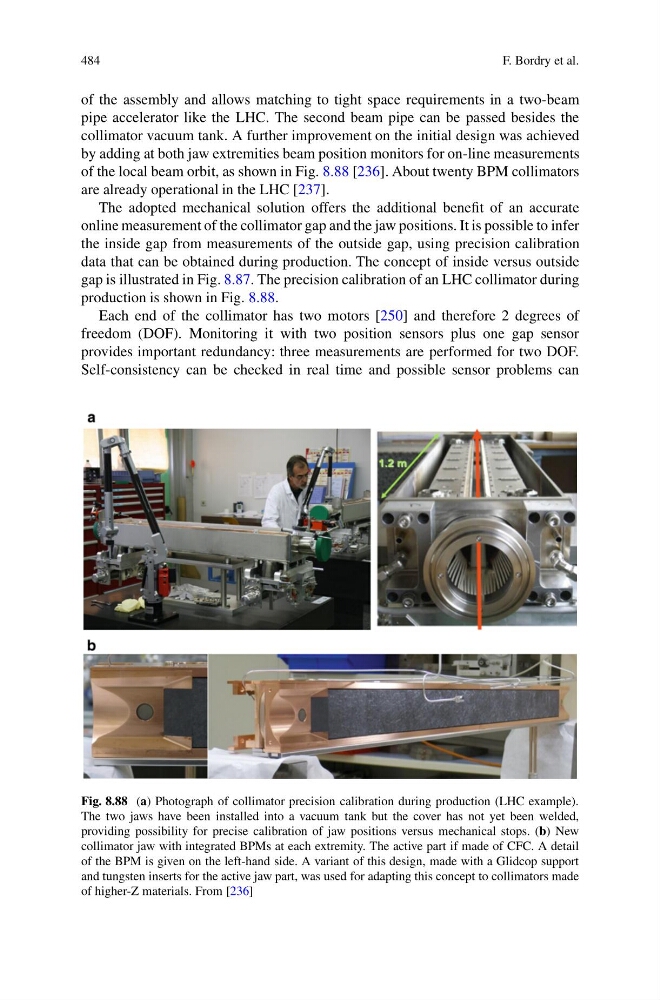
collimator vacuum tank. A further improvement on the initial design was achieved
by adding at both jaw extremities beam position monitors for on-line measurements
of the local beam orbit, as shown in Fig. 8.88 [236]. About twenty BPM collimators
are already operational in the LHC [237].
The adopted mechanical solution offers the additional benefit of an accurate
online measurement of the collimator gap and the jaw positions. It is possible to infer
the inside gap from measurements of the outside gap, using precision calibration
data that can be obtained during production. The concept of inside versus outside
gap is illustrated in Fig. 8.87. The precision calibration of an LHC collimator during
production is shown in Fig. 8.88.
Each end of the collimator has two motors [250] and therefore 2 degrees of
freedom (DOF). Monitoring it with two position sensors plus one gap sensor
provides important redundancy: three measurements are performed for two DOF.
Self-consistency can be checked in real time and possible sensor problems can
Fig. 8.88 (a) Photograph of collimator precision calibration during production (LHC example).
The two jaws have been installed into a vacuum tank but the cover has not yet been welded,
providing possibility for precise calibration of jaw positions versus mechanical stops. (b) New
collimator jaw with integrated BPMs at each extremity. The active part if made of CFC. A detail
of the BPM is given on the left-hand side. A variant of this design, made with a Glidcop support
and tungsten inserts for the active jaw part, was used for adapting this concept to collimators made
of higher-Z materials. From [236]
F. Bordry et al.
of the assembly and allows matching to tight space requirements in a two-beam
pipe accelerator like the LHC. The second beam pipe can be passed besides the
collimator vacuum tank. A further improvement on the initial design was achieved
by adding at both jaw extremities beam position monitors for on-line measurements
of the local beam orbit, as shown in Fig. 8.88 [236]. About twenty BPM collimators
are already operational in the LHC [237].
The adopted mechanical solution offers the additional benefit of an accurate
online measurement of the collimator gap and the jaw positions. It is possible to infer
the inside gap from measurements of the outside gap, using precision calibration
data that can be obtained during production. The concept of inside versus outside
gap is illustrated in Fig. 8.87. The precision calibration of an LHC collimator during
production is shown in Fig. 8.88.
Each end of the collimator has two motors [250] and therefore 2 degrees of
freedom (DOF). Monitoring it with two position sensors plus one gap sensor
provides important redundancy: three measurements are performed for two DOF.
Self-consistency can be checked in real time and possible sensor problems can
Fig. 8.88 (a) Photograph of collimator precision calibration during production (LHC example).
The two jaws have been installed into a vacuum tank but the cover has not yet been welded,
providing possibility for precise calibration of jaw positions versus mechanical stops. (b) New
collimator jaw with integrated BPMs at each extremity. The active part if made of CFC. A detail
of the BPM is given on the left-hand side. A variant of this design, made with a Glidcop support
and tungsten inserts for the active jaw part, was used for adapting this concept to collimators made
of higher-Z materials. From [236]