

38
E. Wilson and B. J. Holzer
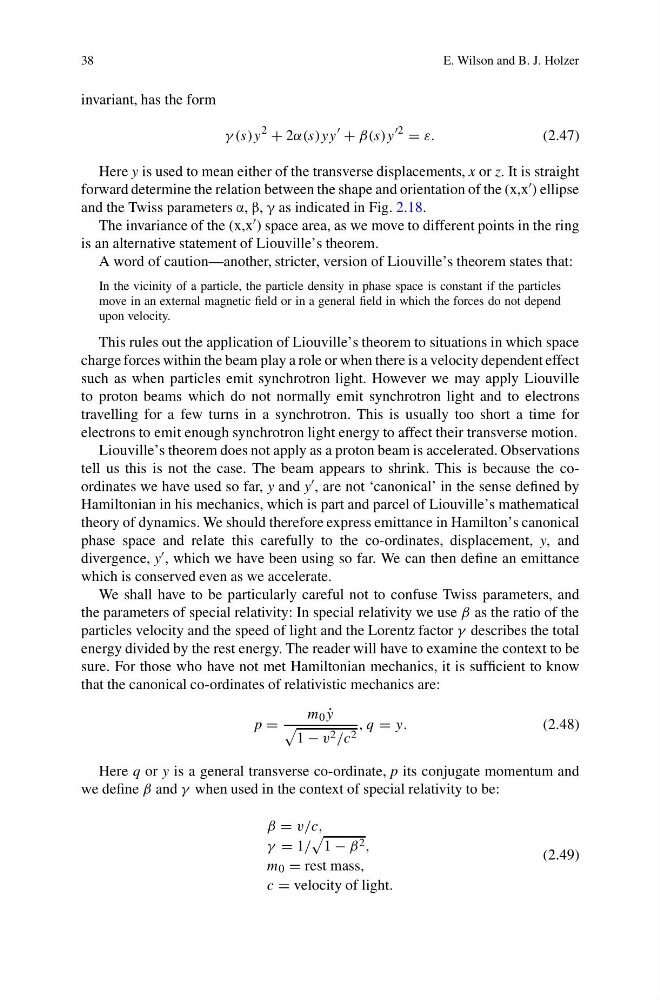
invariant, has the form
γ (s)y
2
+ 2α(s)yy
+ β(s)y
= ε.
(2.47)
Here y is used to mean either of the transverse displacements, x or z. It is straight
forward determine the relation between the shape and orientation of the (x,x ) ellipse
and the Twiss parameters α, β, γ as indicated in Fig. 2.18.
The invariance of the (x,x ) space area, as we move to different points in the ring
is an alternative statement of Liouville’s theorem.
A word of caution—another, stricter, version of Liouville’s theorem states that:
In the vicinity of a particle, the particle density in phase space is constant if the particles
move in an external magnetic field or in a general field in which the forces do not depend
upon velocity.
This rules out the application of Liouville’s theorem to situations in which space
charge forces within the beam play a role or when there is a velocity dependent effect
such as when particles emit synchrotron light. However we may apply Liouville
to proton beams which do not normally emit synchrotron light and to electrons
travelling for a few turns in a synchrotron. This is usually too short a time for
electrons to emit enough synchrotron light energy to affect their transverse motion.
Liouville’s theorem does not apply as a proton beam is accelerated. Observations
tell us this is not the case. The beam appears to shrink. This is because the coordinates we have used so far, y and y , are not ‘canonical’ in the sense defined by
Hamiltonian in his mechanics, which is part and parcel of Liouville’s mathematical
theory of dynamics. We should therefore express emittance in Hamilton’s canonical
phase space and relate this carefully to the co-ordinates, displacement, y, and
divergence, y , which we have been using so far. We can then define an emittance
which is conserved even as we accelerate.
We shall have to be particularly careful not to confuse Twiss parameters, and
the parameters of special relativity: In special relativity we use β as the ratio of the
particles velocity and the speed of light and the Lorentz factor γ describes the total
energy divided by the rest energy. The reader will have to examine the context to be
sure. For those who have not met Hamiltonian mechanics, it is sufficient to know
that the canonical co-ordinates of relativistic mechanics are:
p =
m 0 ˙
y
1 − v 2 /c 2
, q = y.
(2.48)
Here q or y is a general transverse co-ordinate, p its conjugate momentum and
we define β and γ when used in the context of special relativity to be:
β = v/c,
γ = 1/
1 − β 2 ,
m 0 = rest mass,
c = velocity of light.
(2.49)
E. Wilson and B. J. Holzer
invariant, has the form
γ (s)y
2
+ 2α(s)yy
+ β(s)y
= ε.
(2.47)
Here y is used to mean either of the transverse displacements, x or z. It is straight
forward determine the relation between the shape and orientation of the (x,x ) ellipse
and the Twiss parameters α, β, γ as indicated in Fig. 2.18.
The invariance of the (x,x ) space area, as we move to different points in the ring
is an alternative statement of Liouville’s theorem.
A word of caution—another, stricter, version of Liouville’s theorem states that:
In the vicinity of a particle, the particle density in phase space is constant if the particles
move in an external magnetic field or in a general field in which the forces do not depend
upon velocity.
This rules out the application of Liouville’s theorem to situations in which space
charge forces within the beam play a role or when there is a velocity dependent effect
such as when particles emit synchrotron light. However we may apply Liouville
to proton beams which do not normally emit synchrotron light and to electrons
travelling for a few turns in a synchrotron. This is usually too short a time for
electrons to emit enough synchrotron light energy to affect their transverse motion.
Liouville’s theorem does not apply as a proton beam is accelerated. Observations
tell us this is not the case. The beam appears to shrink. This is because the coordinates we have used so far, y and y , are not ‘canonical’ in the sense defined by
Hamiltonian in his mechanics, which is part and parcel of Liouville’s mathematical
theory of dynamics. We should therefore express emittance in Hamilton’s canonical
phase space and relate this carefully to the co-ordinates, displacement, y, and
divergence, y , which we have been using so far. We can then define an emittance
which is conserved even as we accelerate.
We shall have to be particularly careful not to confuse Twiss parameters, and
the parameters of special relativity: In special relativity we use β as the ratio of the
particles velocity and the speed of light and the Lorentz factor γ describes the total
energy divided by the rest energy. The reader will have to examine the context to be
sure. For those who have not met Hamiltonian mechanics, it is sufficient to know
that the canonical co-ordinates of relativistic mechanics are:
p =
m 0 ˙
y
1 − v 2 /c 2
, q = y.
(2.48)
Here q or y is a general transverse co-ordinate, p its conjugate momentum and
we define β and γ when used in the context of special relativity to be:
β = v/c,
γ = 1/
1 − β 2 ,
m 0 = rest mass,
c = velocity of light.
(2.49)