

464
F. Bordry et al.
current into the gates are important, to avoid excessive voltage across individual
GTOs which could lead to unwanted conduction of the whole stack (“erratic”) or
destruction of the power semiconductors. It is noteworthy that such assemblies
are often operated near or even beyond their normal specification limits; this is
to achieve suitable high current with adequately fast rise time. In areas with a
high background radiation (either from activated ambient materials or from beam
losses) the radiation effects can be cumulative, with relatively slow deterioration of
semiconductor performance, and/or sudden malfunction or failure [179]. Protection
against particle-triggered breakdowns can be important. For installations in which
the turn-on delay is critical, temperature stabilization of the semiconductors (usually
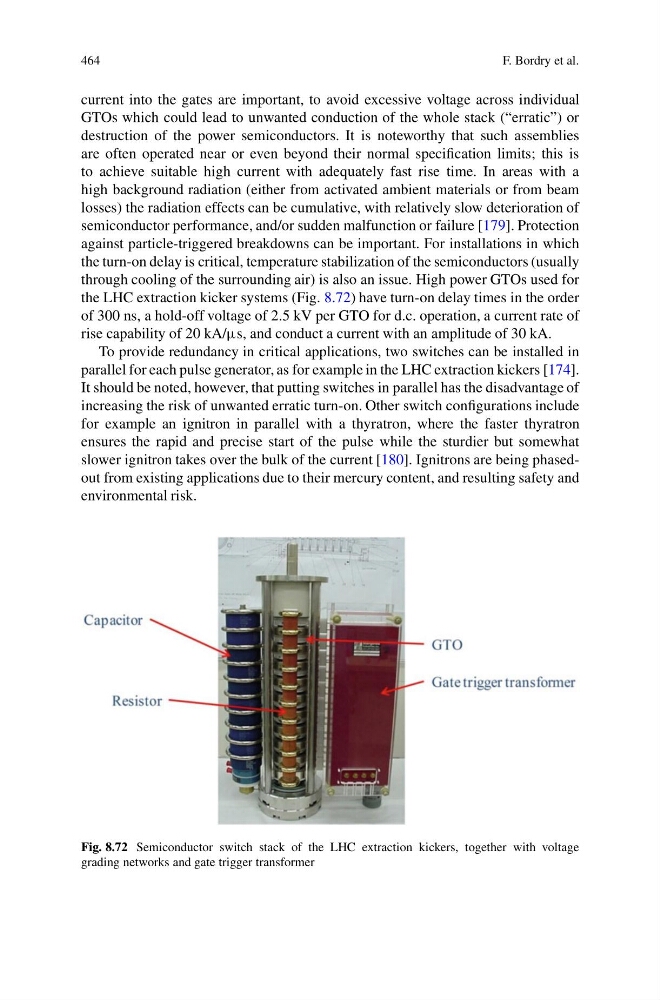
through cooling of the surrounding air) is also an issue. High power GTOs used for
the LHC extraction kicker systems (Fig. 8.72) have turn-on delay times in the order
of 300 ns, a hold-off voltage of 2.5 kV per GTO for d.c. operation, a current rate of
rise capability of 20 kA/μs, and conduct a current with an amplitude of 30 kA.
To provide redundancy in critical applications, two switches can be installed in
parallel for each pulse generator, as for example in the LHC extraction kickers [174].
It should be noted, however, that putting switches in parallel has the disadvantage of
increasing the risk of unwanted erratic turn-on. Other switch configurations include
for example an ignitron in parallel with a thyratron, where the faster thyratron
ensures the rapid and precise start of the pulse while the sturdier but somewhat
slower ignitron takes over the bulk of the current [180]. Ignitrons are being phasedout from existing applications due to their mercury content, and resulting safety and
environmental risk.
Fig. 8.72 Semiconductor switch stack of the LHC extraction kickers, together with voltage
grading networks and gate trigger transformer
F. Bordry et al.
current into the gates are important, to avoid excessive voltage across individual
GTOs which could lead to unwanted conduction of the whole stack (“erratic”) or
destruction of the power semiconductors. It is noteworthy that such assemblies
are often operated near or even beyond their normal specification limits; this is
to achieve suitable high current with adequately fast rise time. In areas with a
high background radiation (either from activated ambient materials or from beam
losses) the radiation effects can be cumulative, with relatively slow deterioration of
semiconductor performance, and/or sudden malfunction or failure [179]. Protection
against particle-triggered breakdowns can be important. For installations in which
the turn-on delay is critical, temperature stabilization of the semiconductors (usually
through cooling of the surrounding air) is also an issue. High power GTOs used for
the LHC extraction kicker systems (Fig. 8.72) have turn-on delay times in the order
of 300 ns, a hold-off voltage of 2.5 kV per GTO for d.c. operation, a current rate of
rise capability of 20 kA/μs, and conduct a current with an amplitude of 30 kA.
To provide redundancy in critical applications, two switches can be installed in
parallel for each pulse generator, as for example in the LHC extraction kickers [174].
It should be noted, however, that putting switches in parallel has the disadvantage of
increasing the risk of unwanted erratic turn-on. Other switch configurations include
for example an ignitron in parallel with a thyratron, where the faster thyratron
ensures the rapid and precise start of the pulse while the sturdier but somewhat
slower ignitron takes over the bulk of the current [180]. Ignitrons are being phasedout from existing applications due to their mercury content, and resulting safety and
environmental risk.
Fig. 8.72 Semiconductor switch stack of the LHC extraction kickers, together with voltage
grading networks and gate trigger transformer