

8 Accelerator Engineering and Technology: Accelerator Technology
447
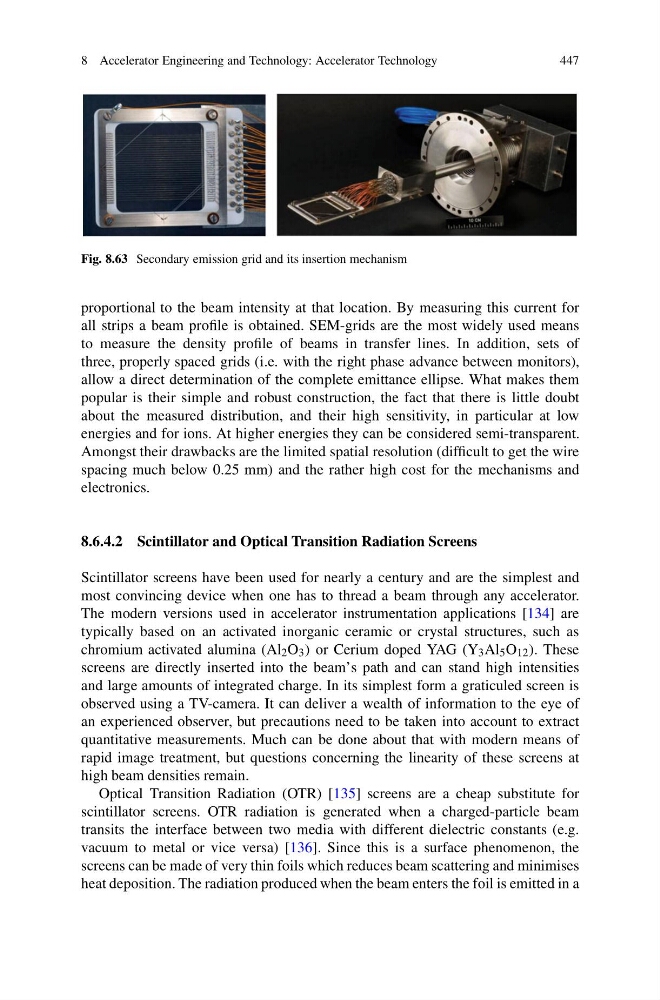
Fig. 8.63 Secondary emission grid and its insertion mechanism
proportional to the beam intensity at that location. By measuring this current for
all strips a beam profile is obtained. SEM-grids are the most widely used means
to measure the density profile of beams in transfer lines. In addition, sets of
three, properly spaced grids (i.e. with the right phase advance between monitors),
allow a direct determination of the complete emittance ellipse. What makes them
popular is their simple and robust construction, the fact that there is little doubt
about the measured distribution, and their high sensitivity, in particular at low
energies and for ions. At higher energies they can be considered semi-transparent.
Amongst their drawbacks are the limited spatial resolution (difficult to get the wire
spacing much below 0.25 mm) and the rather high cost for the mechanisms and
electronics.
8.6.4.2 Scintillator and Optical Transition Radiation Screens
Scintillator screens have been used for nearly a century and are the simplest and
most convincing device when one has to thread a beam through any accelerator.
The modern versions used in accelerator instrumentation applications [134] are
typically based on an activated inorganic ceramic or crystal structures, such as
chromium activated alumina (Al 2 O 3 ) or Cerium doped YAG (Y 3 Al 5 O 12 ). These
screens are directly inserted into the beam’s path and can stand high intensities
and large amounts of integrated charge. In its simplest form a graticuled screen is
observed using a TV-camera. It can deliver a wealth of information to the eye of
an experienced observer, but precautions need to be taken into account to extract
quantitative measurements. Much can be done about that with modern means of
rapid image treatment, but questions concerning the linearity of these screens at
high beam densities remain.
Optical Transition Radiation (OTR) [135] screens are a cheap substitute for
scintillator screens. OTR radiation is generated when a charged-particle beam
transits the interface between two media with different dielectric constants (e.g.
vacuum to metal or vice versa) [136]. Since this is a surface phenomenon, the
screens can be made of very thin foils which reduces beam scattering and minimises
heat deposition. The radiation produced when the beam enters the foil is emitted in a
447
Fig. 8.63 Secondary emission grid and its insertion mechanism
proportional to the beam intensity at that location. By measuring this current for
all strips a beam profile is obtained. SEM-grids are the most widely used means
to measure the density profile of beams in transfer lines. In addition, sets of
three, properly spaced grids (i.e. with the right phase advance between monitors),
allow a direct determination of the complete emittance ellipse. What makes them
popular is their simple and robust construction, the fact that there is little doubt
about the measured distribution, and their high sensitivity, in particular at low
energies and for ions. At higher energies they can be considered semi-transparent.
Amongst their drawbacks are the limited spatial resolution (difficult to get the wire
spacing much below 0.25 mm) and the rather high cost for the mechanisms and
electronics.
8.6.4.2 Scintillator and Optical Transition Radiation Screens
Scintillator screens have been used for nearly a century and are the simplest and
most convincing device when one has to thread a beam through any accelerator.
The modern versions used in accelerator instrumentation applications [134] are
typically based on an activated inorganic ceramic or crystal structures, such as
chromium activated alumina (Al 2 O 3 ) or Cerium doped YAG (Y 3 Al 5 O 12 ). These
screens are directly inserted into the beam’s path and can stand high intensities
and large amounts of integrated charge. In its simplest form a graticuled screen is
observed using a TV-camera. It can deliver a wealth of information to the eye of
an experienced observer, but precautions need to be taken into account to extract
quantitative measurements. Much can be done about that with modern means of
rapid image treatment, but questions concerning the linearity of these screens at
high beam densities remain.
Optical Transition Radiation (OTR) [135] screens are a cheap substitute for
scintillator screens. OTR radiation is generated when a charged-particle beam
transits the interface between two media with different dielectric constants (e.g.
vacuum to metal or vice versa) [136]. Since this is a surface phenomenon, the
screens can be made of very thin foils which reduces beam scattering and minimises
heat deposition. The radiation produced when the beam enters the foil is emitted in a