

444
F. Bordry et al.
8.6.3.1 Tune Measurement
All betatron tune measurements are based on measuring the characteristic frequency
of the transverse motion of the beam. In the simplest case the beam is given a
single kick using a powerful stripline or magnetic kicker and allowed to oscillate
freely. A position pick-up is then used to measure the resulting beam motion, with
the betatron tune being the frequency which has the highest amplitude response
in the power density spectrum obtained using Fourier Transform techniques. If the
detection technique is sufficiently sensitive (see e.g. [129, 130]) and there is enough
external excitation from other sources such as ground motion then the method also
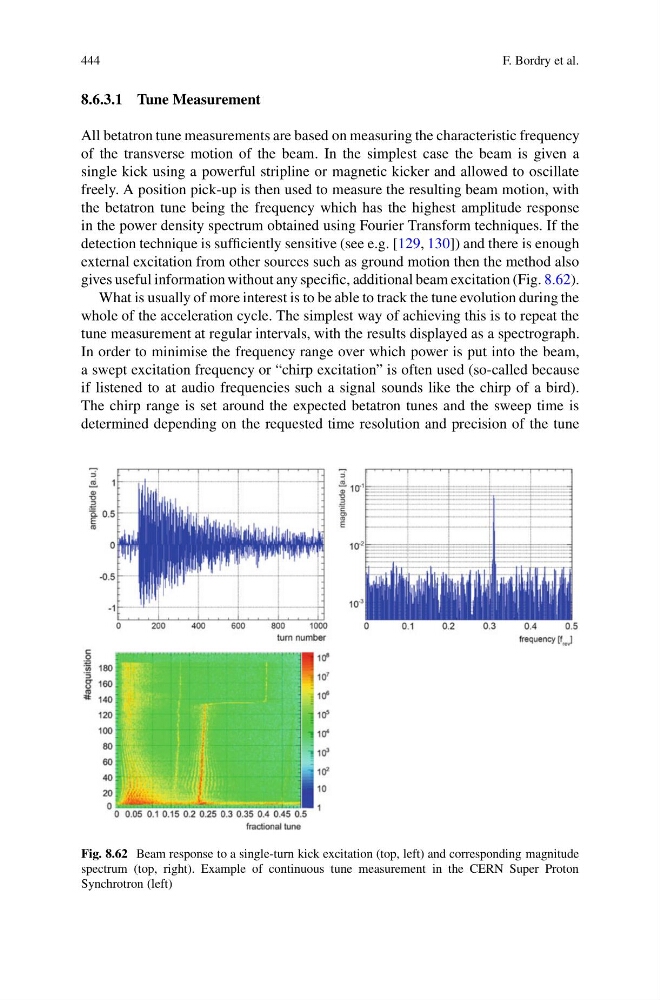
gives useful information without any specific, additional beam excitation (Fig. 8.62).
What is usually of more interest is to be able to track the tune evolution during the
whole of the acceleration cycle. The simplest way of achieving this is to repeat the
tune measurement at regular intervals, with the results displayed as a spectrograph.
In order to minimise the frequency range over which power is put into the beam,
a swept excitation frequency or “chirp excitation” is often used (so-called because
if listened to at audio frequencies such a signal sounds like the chirp of a bird).
The chirp range is set around the expected betatron tunes and the sweep time is
determined depending on the requested time resolution and precision of the tune
Fig. 8.62 Beam response to a single-turn kick excitation (top, left) and corresponding magnitude
spectrum (top, right). Example of continuous tune measurement in the CERN Super Proton
Synchrotron (left)
F. Bordry et al.
8.6.3.1 Tune Measurement
All betatron tune measurements are based on measuring the characteristic frequency
of the transverse motion of the beam. In the simplest case the beam is given a
single kick using a powerful stripline or magnetic kicker and allowed to oscillate
freely. A position pick-up is then used to measure the resulting beam motion, with
the betatron tune being the frequency which has the highest amplitude response
in the power density spectrum obtained using Fourier Transform techniques. If the
detection technique is sufficiently sensitive (see e.g. [129, 130]) and there is enough
external excitation from other sources such as ground motion then the method also
gives useful information without any specific, additional beam excitation (Fig. 8.62).
What is usually of more interest is to be able to track the tune evolution during the
whole of the acceleration cycle. The simplest way of achieving this is to repeat the
tune measurement at regular intervals, with the results displayed as a spectrograph.
In order to minimise the frequency range over which power is put into the beam,
a swept excitation frequency or “chirp excitation” is often used (so-called because
if listened to at audio frequencies such a signal sounds like the chirp of a bird).
The chirp range is set around the expected betatron tunes and the sweep time is
determined depending on the requested time resolution and precision of the tune
Fig. 8.62 Beam response to a single-turn kick excitation (top, left) and corresponding magnitude
spectrum (top, right). Example of continuous tune measurement in the CERN Super Proton
Synchrotron (left)