

8 Accelerator Engineering and Technology: Accelerator Technology
439
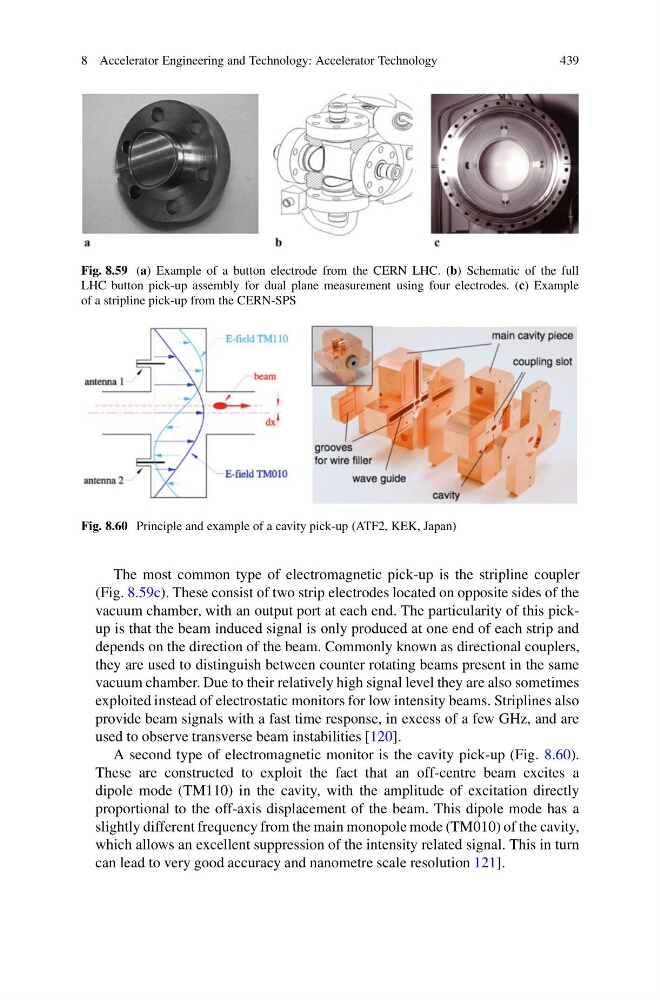
Fig. 8.59 (a) Example of a button electrode from the CERN LHC. (b) Schematic of the full
LHC button pick-up assembly for dual plane measurement using four electrodes. (c) Example
of a stripline pick-up from the CERN-SPS
Fig. 8.60 Principle and example of a cavity pick-up (ATF2, KEK, Japan)
The most common type of electromagnetic pick-up is the stripline coupler
(Fig. 8.59c). These consist of two strip electrodes located on opposite sides of the
vacuum chamber, with an output port at each end. The particularity of this pickup is that the beam induced signal is only produced at one end of each strip and
depends on the direction of the beam. Commonly known as directional couplers,
they are used to distinguish between counter rotating beams present in the same
vacuum chamber. Due to their relatively high signal level they are also sometimes
exploited instead of electrostatic monitors for low intensity beams. Striplines also
provide beam signals with a fast time response, in excess of a few GHz, and are
used to observe transverse beam instabilities [120].
A second type of electromagnetic monitor is the cavity pick-up (Fig. 8.60).
These are constructed to exploit the fact that an off-centre beam excites a
dipole mode (TM110) in the cavity, with the amplitude of excitation directly
proportional to the off-axis displacement of the beam. This dipole mode has a
slightly different frequency from the main monopole mode (TM010) of the cavity,
which allows an excellent suppression of the intensity related signal. This in turn
can lead to very good accuracy and nanometre scale resolution 121].
439
Fig. 8.59 (a) Example of a button electrode from the CERN LHC. (b) Schematic of the full
LHC button pick-up assembly for dual plane measurement using four electrodes. (c) Example
of a stripline pick-up from the CERN-SPS
Fig. 8.60 Principle and example of a cavity pick-up (ATF2, KEK, Japan)
The most common type of electromagnetic pick-up is the stripline coupler
(Fig. 8.59c). These consist of two strip electrodes located on opposite sides of the
vacuum chamber, with an output port at each end. The particularity of this pickup is that the beam induced signal is only produced at one end of each strip and
depends on the direction of the beam. Commonly known as directional couplers,
they are used to distinguish between counter rotating beams present in the same
vacuum chamber. Due to their relatively high signal level they are also sometimes
exploited instead of electrostatic monitors for low intensity beams. Striplines also
provide beam signals with a fast time response, in excess of a few GHz, and are
used to observe transverse beam instabilities [120].
A second type of electromagnetic monitor is the cavity pick-up (Fig. 8.60).
These are constructed to exploit the fact that an off-centre beam excites a
dipole mode (TM110) in the cavity, with the amplitude of excitation directly
proportional to the off-axis displacement of the beam. This dipole mode has a
slightly different frequency from the main monopole mode (TM010) of the cavity,
which allows an excellent suppression of the intensity related signal. This in turn
can lead to very good accuracy and nanometre scale resolution 121].