

2 Beam Dynamics
33
2.2.2 Qualitative Treatment of Coupling
In our treatment the theory is deliberately simplified to reveal the physical mechanisms at work. We assume that the coupling is driven by a single skew quadrupole at
the centre of one of the existing lattice machine quadrupoles where β is maximum
and its derivative zero. We ignore the changes in betatron phase of one plane with
respect to the other within a single turn.
The skew quadrupole gradient is normalized:
k =
1
(Bρ)
∂B x
∂x
z=0
,
l = length of the quadrupole.
(2.41)
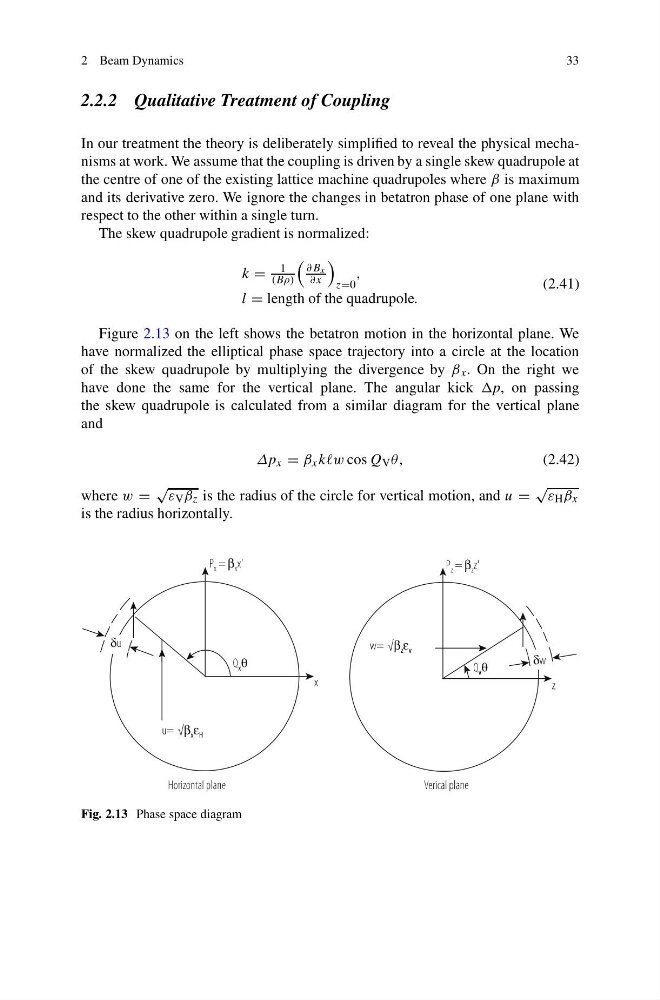
Figure 2.13 on the left shows the betatron motion in the horizontal plane. We
have normalized the elliptical phase space trajectory into a circle at the location
of the skew quadrupole by multiplying the divergence by β x . On the right we
have done the same for the vertical plane. The angular kick on passing
the skew quadrupole is calculated from a similar diagram for the vertical plane
and
Δp x = β x kkw cos Q V θ,
(2.42)
where w =
√
ε V β z is the radius of the circle for vertical motion, and u =
√
ε H β x
is the radius horizontally.
Fig. 2.13 Phase space diagram
33
2.2.2 Qualitative Treatment of Coupling
In our treatment the theory is deliberately simplified to reveal the physical mechanisms at work. We assume that the coupling is driven by a single skew quadrupole at
the centre of one of the existing lattice machine quadrupoles where β is maximum
and its derivative zero. We ignore the changes in betatron phase of one plane with
respect to the other within a single turn.
The skew quadrupole gradient is normalized:
k =
1
(Bρ)
∂B x
∂x
z=0
,
l = length of the quadrupole.
(2.41)
Figure 2.13 on the left shows the betatron motion in the horizontal plane. We
have normalized the elliptical phase space trajectory into a circle at the location
of the skew quadrupole by multiplying the divergence by β x . On the right we
have done the same for the vertical plane. The angular kick on passing
the skew quadrupole is calculated from a similar diagram for the vertical plane
and
Δp x = β x kkw cos Q V θ,
(2.42)
where w =
√
ε V β z is the radius of the circle for vertical motion, and u =
√
ε H β x
is the radius horizontally.
Fig. 2.13 Phase space diagram