

8 Accelerator Engineering and Technology: Accelerator Technology
351
Table 8.4 Characteristics of the four major superconducting hadron accelerators
Tevatron [7] HERA [8] RHIC [9]
LHC [10]
Maximum beam energy [GeV] 980
820 a
250 b 100/n c
7000
Injection energy
[GeV] 151
45
12
450
Ring length
[km] 6.3
6.3
3.8
26.7
Dipole field induction
[T]
4.3
4.7
3.5
8.3
Aperture
[mm] 76
75
80
56
Configuration
[mm] Single bore Single bore Single boreTwo rings Twin bore
Operating temperature [K]
4.2
4.5
4.3–4.6
1.9
First beam
7–1983
4–1991
6–2000
9–2008
a Energy of the proton beam, colliding with the 27.5 GeV electron beam
b Particle energy for proton beams
c Particle energy per nucleon, for ion beams (Au)
superconducting material can carry large currents with no loss, and ampere-turns
become cheap, thus opening the way to magnetic fields much above saturation
of ferromagnetic materials. Very schematically, superconducting magnets for large
scale accelerators consist of a coil wound with highly compacted cables, tightly
packed around the bore that delimits a vacuum chamber hosting the beam. The
coil shape is optimized to maximize the bore field and achieve acceptable field
quality, as described later. The large forces that are experienced by the coil (several
tens to hundreds of tons/m) cannot be reacted on the winding alone, that has
the characteristic shape of a slender racetrack. The force is hence transferred to
a structure that guarantees mechanical stability and rigidity. The iron yoke that
surrounds this assembly closes the magnetic circuit, yields to a marginal gain of
magnetic field in the bore, and shields the surrounding from stray fields. Finally, the
magnet is enclosed in a cryostat that provides the thermal barrier features necessary
to cool the magnet to the operating temperature, which is in the cryogenic range
(1.9 to 4.5 K for accelerators built to date). Various implementations of this basic
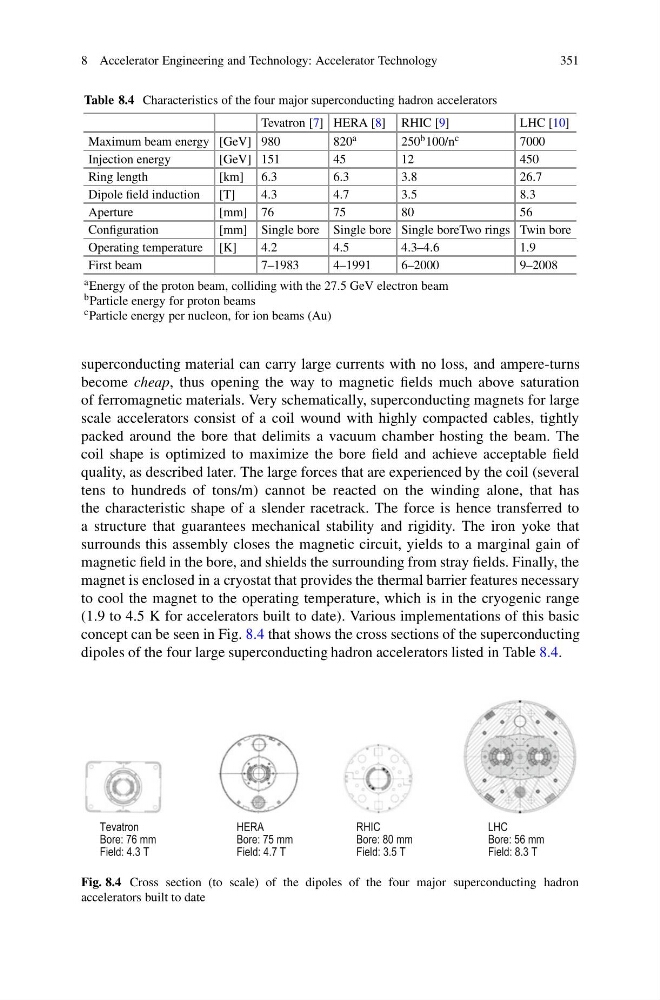
concept can be seen in Fig. 8.4 that shows the cross sections of the superconducting
dipoles of the four large superconducting hadron accelerators listed in Table 8.4.
Tevatron
Bore: 76 mm
Field: 4.3 T
HERA
Bore: 75 mm
Field: 4.7 T
RHIC
Bore: 80 mm
Field: 3.5 T
LHC
Bore: 56 mm
Field: 8.3 T
Fig. 8.4 Cross section (to scale) of the dipoles of the four major superconducting hadron
accelerators built to date
351
Table 8.4 Characteristics of the four major superconducting hadron accelerators
Tevatron [7] HERA [8] RHIC [9]
LHC [10]
Maximum beam energy [GeV] 980
820 a
250 b 100/n c
7000
Injection energy
[GeV] 151
45
12
450
Ring length
[km] 6.3
6.3
3.8
26.7
Dipole field induction
[T]
4.3
4.7
3.5
8.3
Aperture
[mm] 76
75
80
56
Configuration
[mm] Single bore Single bore Single boreTwo rings Twin bore
Operating temperature [K]
4.2
4.5
4.3–4.6
1.9
First beam
7–1983
4–1991
6–2000
9–2008
a Energy of the proton beam, colliding with the 27.5 GeV electron beam
b Particle energy for proton beams
c Particle energy per nucleon, for ion beams (Au)
superconducting material can carry large currents with no loss, and ampere-turns
become cheap, thus opening the way to magnetic fields much above saturation
of ferromagnetic materials. Very schematically, superconducting magnets for large
scale accelerators consist of a coil wound with highly compacted cables, tightly
packed around the bore that delimits a vacuum chamber hosting the beam. The
coil shape is optimized to maximize the bore field and achieve acceptable field
quality, as described later. The large forces that are experienced by the coil (several
tens to hundreds of tons/m) cannot be reacted on the winding alone, that has
the characteristic shape of a slender racetrack. The force is hence transferred to
a structure that guarantees mechanical stability and rigidity. The iron yoke that
surrounds this assembly closes the magnetic circuit, yields to a marginal gain of
magnetic field in the bore, and shields the surrounding from stray fields. Finally, the
magnet is enclosed in a cryostat that provides the thermal barrier features necessary
to cool the magnet to the operating temperature, which is in the cryogenic range
(1.9 to 4.5 K for accelerators built to date). Various implementations of this basic
concept can be seen in Fig. 8.4 that shows the cross sections of the superconducting
dipoles of the four large superconducting hadron accelerators listed in Table 8.4.
Tevatron
Bore: 76 mm
Field: 4.3 T
HERA
Bore: 75 mm
Field: 4.7 T
RHIC
Bore: 80 mm
Field: 3.5 T
LHC
Bore: 56 mm
Field: 8.3 T
Fig. 8.4 Cross section (to scale) of the dipoles of the four major superconducting hadron
accelerators built to date