

2 Beam Dynamics
25
The transport matrix M 21 has a rather simple form for each focusing quadrupole
that the particle encounters and for the drift length between quadrupoles and it
is easy to compute the four elements numerically once we define the length and
focusing strength. We can trace particles by simply forming the product of these
elementary matrices. But there is also a general relation between the elements a, b,
c, d and the amplitude and phase of transverse motion between any two points. Each
term in M 21 can be expressed as a function of β(s) and φ(s). The functions of β(s)
and φ(s) may be calculated by comparing the numerical result of multiplying the
individual matrices for quadrupoles and drift lengths with what we know must be
the general form of each element.
As a first step, we derive the general form of a periodic transport matrix.
To simplify the notation we drop the explicit dependence of β and φ on s from the
expressions—we will just have to remember that they vary with s. We also introduce
a new quantity:
w =
β.
(2.20)
just to avoid too many terms in what follows.
In this new notation we can write the solution of the Hill Equation:
y = ε
1/2 w cos (ϕ + φ 0 ) .
(2.21)
Taking the derivative and substituting ϕ = 1/β = 1/w 2 we have:
y
= ε
1/2 w
cos (ϕ + φ 0 ) −
ε
1
2
w
sin (ϕ + φ 0 ) .
(2.22)
Next we substitute these explicit expressions for y and y in both sides of the
matrix equation. We do this first with the initial condition ϕ 0 = 0, this is the so-called
‘cosine’ solution, and then we do it again for the ‘sine’ solution with ϕ 0 = π/2. This
is exactly equivalent to tracing the paraxial and central rays through an optical lens.
We write φ 2 − φ 1 = φ for each case. Each of the two solutions give us two equations
for y and y and thus we obtain four simultaneous equations which can be solved for
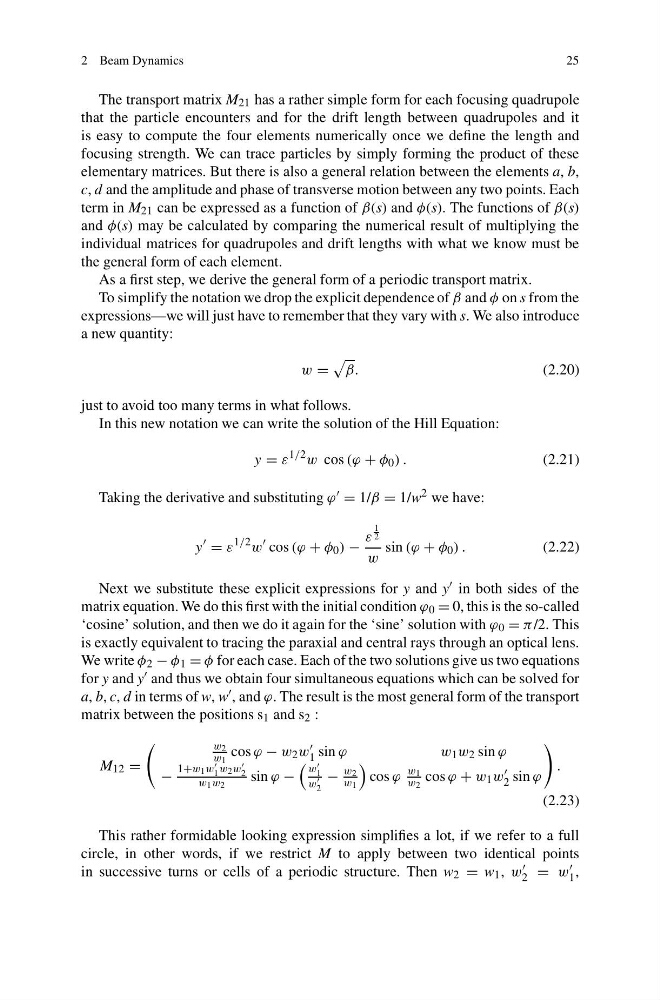
a, b, c, d in terms of w, w , and ϕ. The result is the most general form of the transport
matrix between the positions s 1 and s 2 :
M 12 =
w 2
w 1
cos ϕ − w 2 w
1 sin ϕ
w 1 w 2 sin ϕ
−
1+w 1 w
1 w 2 w
2
w 1 w 2
sin ϕ −
w
1
w
2
−
w 2
w 1
cos ϕ
w 1
w 2
cos ϕ + w 1 w
2 sin ϕ
.
(2.23)
This rather formidable looking expression simplifies a lot, if we refer to a full
circle, in other words, if we restrict M to apply between two identical points
in successive turns or cells of a periodic structure. Then w 2 = w 1 , w
2 = w
1 ,
25
The transport matrix M 21 has a rather simple form for each focusing quadrupole
that the particle encounters and for the drift length between quadrupoles and it
is easy to compute the four elements numerically once we define the length and
focusing strength. We can trace particles by simply forming the product of these
elementary matrices. But there is also a general relation between the elements a, b,
c, d and the amplitude and phase of transverse motion between any two points. Each
term in M 21 can be expressed as a function of β(s) and φ(s). The functions of β(s)
and φ(s) may be calculated by comparing the numerical result of multiplying the
individual matrices for quadrupoles and drift lengths with what we know must be
the general form of each element.
As a first step, we derive the general form of a periodic transport matrix.
To simplify the notation we drop the explicit dependence of β and φ on s from the
expressions—we will just have to remember that they vary with s. We also introduce
a new quantity:
w =
β.
(2.20)
just to avoid too many terms in what follows.
In this new notation we can write the solution of the Hill Equation:
y = ε
1/2 w cos (ϕ + φ 0 ) .
(2.21)
Taking the derivative and substituting ϕ = 1/β = 1/w 2 we have:
y
= ε
1/2 w
cos (ϕ + φ 0 ) −
ε
1
2
w
sin (ϕ + φ 0 ) .
(2.22)
Next we substitute these explicit expressions for y and y in both sides of the
matrix equation. We do this first with the initial condition ϕ 0 = 0, this is the so-called
‘cosine’ solution, and then we do it again for the ‘sine’ solution with ϕ 0 = π/2. This
is exactly equivalent to tracing the paraxial and central rays through an optical lens.
We write φ 2 − φ 1 = φ for each case. Each of the two solutions give us two equations
for y and y and thus we obtain four simultaneous equations which can be solved for
a, b, c, d in terms of w, w , and ϕ. The result is the most general form of the transport
matrix between the positions s 1 and s 2 :
M 12 =
w 2
w 1
cos ϕ − w 2 w
1 sin ϕ
w 1 w 2 sin ϕ
−
1+w 1 w
1 w 2 w
2
w 1 w 2
sin ϕ −
w
1
w
2
−
w 2
w 1
cos ϕ
w 1
w 2
cos ϕ + w 1 w
2 sin ϕ
.
(2.23)
This rather formidable looking expression simplifies a lot, if we refer to a full
circle, in other words, if we restrict M to apply between two identical points
in successive turns or cells of a periodic structure. Then w 2 = w 1 , w
2 = w
1 ,