

300
J. Seeman et al.
The first factor N/σ x is a measure of the beamstrahlung, the second σ y depends
strongly on the beam quality and the efficiency η of transforming the wall plug
power P wall into beam power is dominated by the RF to beam transfer efficiency of
the main linac.
The beamstrahlung can conveniently be described with the beamstrahlung
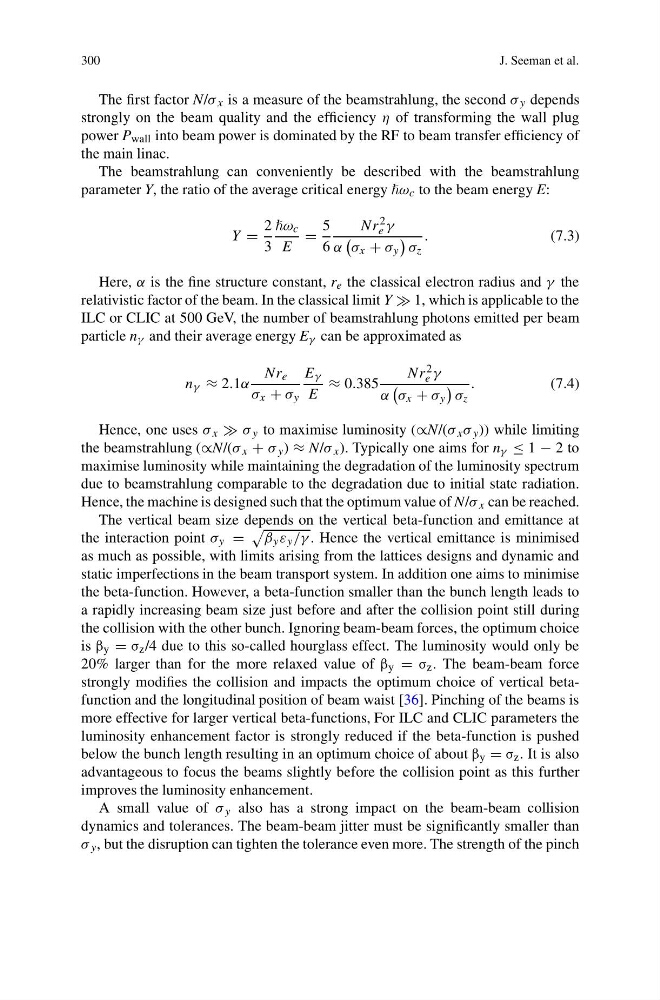
parameter Y, the ratio of the average critical energy c to the beam energy E:
Y =
2
3
c
E
=
5
6
Nr 2
e γ
α
σ x + σ y
σ z
.
(7.3)
Here, α is the fine structure constant, r e the classical electron radius and γ the
relativistic factor of the beam. In the classical limit Y 1, which is applicable to the
ILC or CLIC at 500 GeV, the number of beamstrahlung photons emitted per beam
particle n γ and their average energy E γ can be approximated as
n γ ≈ 2.1α
Nr e
σ x + σ y
E γ
E
≈ 0.385
Nr 2
e γ
α
σ x + σ y
σ z
.
(7.4)
Hence, one uses σ x σ y to maximise luminosity (∝N/(σ x σ y )) while limiting
the beamstrahlung (∝N/(σ x + σ y ) ≈ N/σ x ). Typically one aims for n γ ≤ 1 − 2 to
maximise luminosity while maintaining the degradation of the luminosity spectrum
due to beamstrahlung comparable to the degradation due to initial state radiation.
Hence, the machine is designed such that the optimum value of N/σ x can be reached.
The vertical beam size depends on the vertical beta-function and emittance at
the interaction point σ y =
β y ε y /γ . Hence the vertical emittance is minimised
as much as possible, with limits arising from the lattices designs and dynamic and
static imperfections in the beam transport system. In addition one aims to minimise
the beta-function. However, a beta-function smaller than the bunch length leads to
a rapidly increasing beam size just before and after the collision point still during
the collision with the other bunch. Ignoring beam-beam forces, the optimum choice
is β y = σ z /4 due to this so-called hourglass effect. The luminosity would only be
20% larger than for the more relaxed value of β y = σ z . The beam-beam force
strongly modifies the collision and impacts the optimum choice of vertical betafunction and the longitudinal position of beam waist [36]. Pinching of the beams is
more effective for larger vertical beta-functions, For ILC and CLIC parameters the
luminosity enhancement factor is strongly reduced if the beta-function is pushed
below the bunch length resulting in an optimum choice of about β y = σ z . It is also
advantageous to focus the beams slightly before the collision point as this further
improves the luminosity enhancement.
A small value of σ y also has a strong impact on the beam-beam collision
dynamics and tolerances. The beam-beam jitter must be significantly smaller than
σ y , but the disruption can tighten the tolerance even more. The strength of the pinch
J. Seeman et al.
The first factor N/σ x is a measure of the beamstrahlung, the second σ y depends
strongly on the beam quality and the efficiency η of transforming the wall plug
power P wall into beam power is dominated by the RF to beam transfer efficiency of
the main linac.
The beamstrahlung can conveniently be described with the beamstrahlung
parameter Y, the ratio of the average critical energy c to the beam energy E:
Y =
2
3
c
E
=
5
6
Nr 2
e γ
α
σ x + σ y
σ z
.
(7.3)
Here, α is the fine structure constant, r e the classical electron radius and γ the
relativistic factor of the beam. In the classical limit Y 1, which is applicable to the
ILC or CLIC at 500 GeV, the number of beamstrahlung photons emitted per beam
particle n γ and their average energy E γ can be approximated as
n γ ≈ 2.1α
Nr e
σ x + σ y
E γ
E
≈ 0.385
Nr 2
e γ
α
σ x + σ y
σ z
.
(7.4)
Hence, one uses σ x σ y to maximise luminosity (∝N/(σ x σ y )) while limiting
the beamstrahlung (∝N/(σ x + σ y ) ≈ N/σ x ). Typically one aims for n γ ≤ 1 − 2 to
maximise luminosity while maintaining the degradation of the luminosity spectrum
due to beamstrahlung comparable to the degradation due to initial state radiation.
Hence, the machine is designed such that the optimum value of N/σ x can be reached.
The vertical beam size depends on the vertical beta-function and emittance at
the interaction point σ y =
β y ε y /γ . Hence the vertical emittance is minimised
as much as possible, with limits arising from the lattices designs and dynamic and
static imperfections in the beam transport system. In addition one aims to minimise
the beta-function. However, a beta-function smaller than the bunch length leads to
a rapidly increasing beam size just before and after the collision point still during
the collision with the other bunch. Ignoring beam-beam forces, the optimum choice
is β y = σ z /4 due to this so-called hourglass effect. The luminosity would only be
20% larger than for the more relaxed value of β y = σ z . The beam-beam force
strongly modifies the collision and impacts the optimum choice of vertical betafunction and the longitudinal position of beam waist [36]. Pinching of the beams is
more effective for larger vertical beta-functions, For ILC and CLIC parameters the
luminosity enhancement factor is strongly reduced if the beta-function is pushed
below the bunch length resulting in an optimum choice of about β y = σ z . It is also
advantageous to focus the beams slightly before the collision point as this further
improves the luminosity enhancement.
A small value of σ y also has a strong impact on the beam-beam collision
dynamics and tolerances. The beam-beam jitter must be significantly smaller than
σ y , but the disruption can tighten the tolerance even more. The strength of the pinch