

286
B. J. Holzer et al.
Some (like stochastic cooling) are more difficult others (e.g. laser cooling) are much
more powerful in the traps.
There are however several techniques which are especially adapted to or even
working only in the environment of particles confined in a trap which is frequently
cryogenically cooled. A gross classification is to divide them into lossy and lossless
methods in terms of conservation of number of particles. A lossy technique (which
in the strict definition of [100] would not be classified as “phase density cooling”)
is evaporative cooling. In this case, just as in the evaporation of water, the more
energetic molecules leave the trap and the temperature of the condensate is thereby
strongly reduced. Experiments at the forefront of physics making Bose-Einstein
condensates at a temperature of a tiny fraction of a degree have thus become possible
[194].
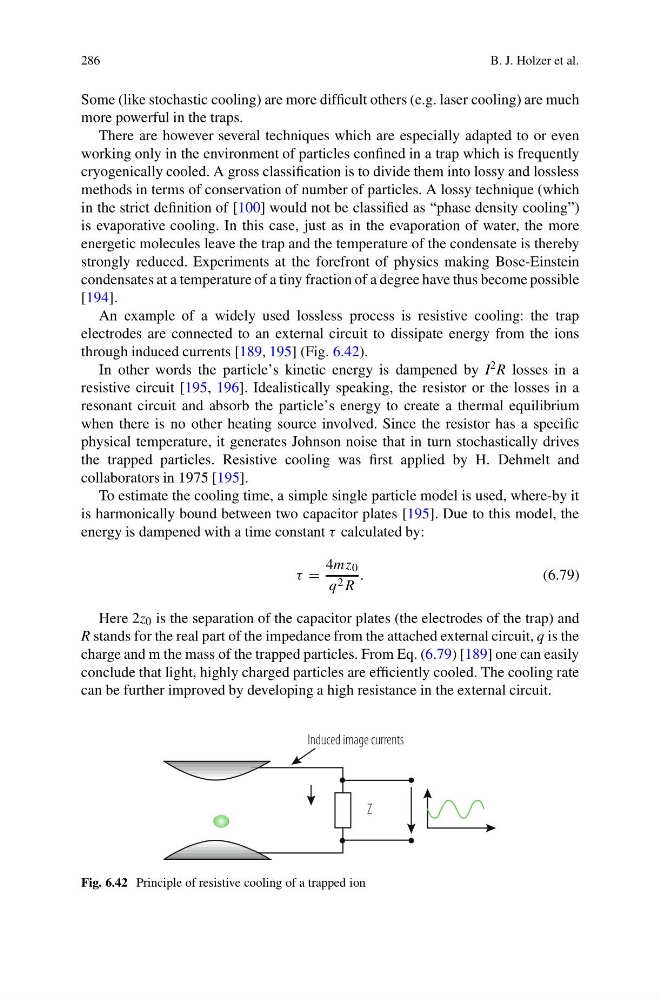
An example of a widely used lossless process is resistive cooling: the trap
electrodes are connected to an external circuit to dissipate energy from the ions
through induced currents [189, 195] (Fig. 6.42).
In other words the particle’s kinetic energy is dampened by I 2 R losses in a
resistive circuit [195, 196]. Idealistically speaking, the resistor or the losses in a
resonant circuit and absorb the particle’s energy to create a thermal equilibrium
when there is no other heating source involved. Since the resistor has a specific
physical temperature, it generates Johnson noise that in turn stochastically drives
the trapped particles. Resistive cooling was first applied by H. Dehmelt and
collaborators in 1975 [195].
To estimate the cooling time, a simple single particle model is used, where-by it
is harmonically bound between two capacitor plates [195]. Due to this model, the
energy is dampened with a time constant τ calculated by:
τ =
4mz 0
q 2 R
.
(6.79)
Here 2z 0 is the separation of the capacitor plates (the electrodes of the trap) and
R stands for the real part of the impedance from the attached external circuit, q is the
charge and m the mass of the trapped particles. From Eq. (6.79) [189] one can easily
conclude that light, highly charged particles are efficiently cooled. The cooling rate
can be further improved by developing a high resistance in the external circuit.
Fig. 6.42 Principle of resistive cooling of a trapped ion
B. J. Holzer et al.
Some (like stochastic cooling) are more difficult others (e.g. laser cooling) are much
more powerful in the traps.
There are however several techniques which are especially adapted to or even
working only in the environment of particles confined in a trap which is frequently
cryogenically cooled. A gross classification is to divide them into lossy and lossless
methods in terms of conservation of number of particles. A lossy technique (which
in the strict definition of [100] would not be classified as “phase density cooling”)
is evaporative cooling. In this case, just as in the evaporation of water, the more
energetic molecules leave the trap and the temperature of the condensate is thereby
strongly reduced. Experiments at the forefront of physics making Bose-Einstein
condensates at a temperature of a tiny fraction of a degree have thus become possible
[194].
An example of a widely used lossless process is resistive cooling: the trap
electrodes are connected to an external circuit to dissipate energy from the ions
through induced currents [189, 195] (Fig. 6.42).
In other words the particle’s kinetic energy is dampened by I 2 R losses in a
resistive circuit [195, 196]. Idealistically speaking, the resistor or the losses in a
resonant circuit and absorb the particle’s energy to create a thermal equilibrium
when there is no other heating source involved. Since the resistor has a specific
physical temperature, it generates Johnson noise that in turn stochastically drives
the trapped particles. Resistive cooling was first applied by H. Dehmelt and
collaborators in 1975 [195].
To estimate the cooling time, a simple single particle model is used, where-by it
is harmonically bound between two capacitor plates [195]. Due to this model, the
energy is dampened with a time constant τ calculated by:
τ =
4mz 0
q 2 R
.
(6.79)
Here 2z 0 is the separation of the capacitor plates (the electrodes of the trap) and
R stands for the real part of the impedance from the attached external circuit, q is the
charge and m the mass of the trapped particles. From Eq. (6.79) [189] one can easily
conclude that light, highly charged particles are efficiently cooled. The cooling rate
can be further improved by developing a high resistance in the external circuit.
Fig. 6.42 Principle of resistive cooling of a trapped ion