

6 Design and Principles of Synchrotrons and Circular Colliders
277
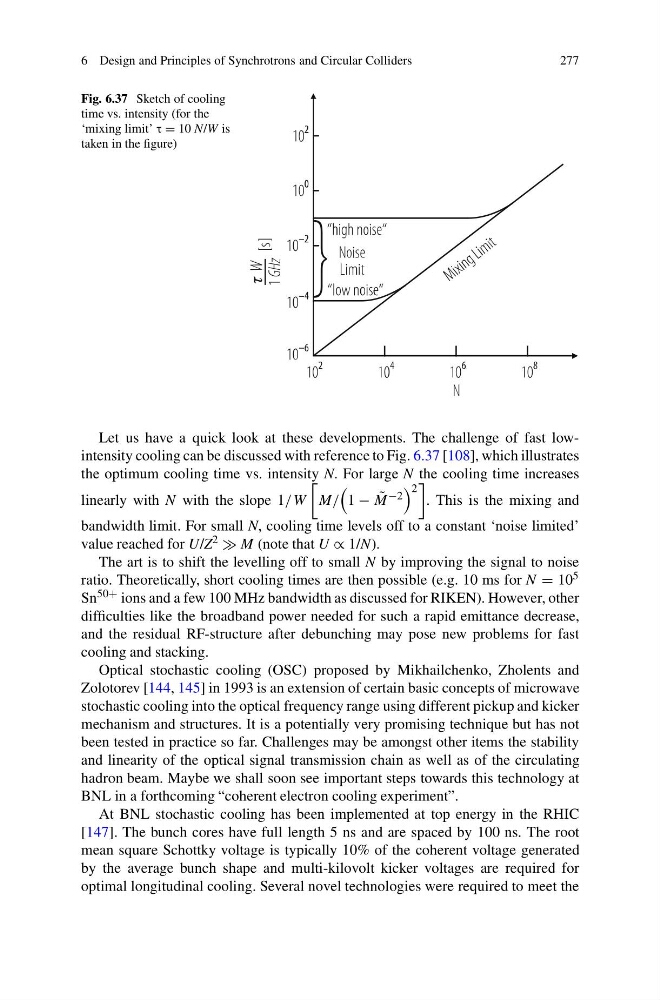
Fig. 6.37 Sketch of cooling
time vs. intensity (for the
‘mixing limit’ τ = 10 N/W is
taken in the figure)
Let us have a quick look at these developments. The challenge of fast lowintensity cooling can be discussed with reference to Fig. 6.37 [108], which illustrates
the optimum cooling time vs. intensity N. For large N the cooling time increases
linearly with N with the slope 1/W
M/
1 − ˜
M −2
2
. This is the mixing and
bandwidth limit. For small N, cooling time levels off to a constant ‘noise limited’
value reached for U/Z 2 M (note that U ∝ 1/N).
The art is to shift the levelling off to small N by improving the signal to noise
ratio. Theoretically, short cooling times are then possible (e.g. 10 ms for N = 10 5
Sn 50+ ions and a few 100 MHz bandwidth as discussed for RIKEN). However, other
difficulties like the broadband power needed for such a rapid emittance decrease,
and the residual RF-structure after debunching may pose new problems for fast
cooling and stacking.
Optical stochastic cooling (OSC) proposed by Mikhailchenko, Zholents and
Zolotorev [144, 145] in 1993 is an extension of certain basic concepts of microwave
stochastic cooling into the optical frequency range using different pickup and kicker
mechanism and structures. It is a potentially very promising technique but has not
been tested in practice so far. Challenges may be amongst other items the stability
and linearity of the optical signal transmission chain as well as of the circulating
hadron beam. Maybe we shall soon see important steps towards this technology at
BNL in a forthcoming “coherent electron cooling experiment”.
At BNL stochastic cooling has been implemented at top energy in the RHIC
[147]. The bunch cores have full length 5 ns and are spaced by 100 ns. The root
mean square Schottky voltage is typically 10% of the coherent voltage generated
by the average bunch shape and multi-kilovolt kicker voltages are required for
optimal longitudinal cooling. Several novel technologies were required to meet the
277
Fig. 6.37 Sketch of cooling
time vs. intensity (for the
‘mixing limit’ τ = 10 N/W is
taken in the figure)
Let us have a quick look at these developments. The challenge of fast lowintensity cooling can be discussed with reference to Fig. 6.37 [108], which illustrates
the optimum cooling time vs. intensity N. For large N the cooling time increases
linearly with N with the slope 1/W
M/
1 − ˜
M −2
2
. This is the mixing and
bandwidth limit. For small N, cooling time levels off to a constant ‘noise limited’
value reached for U/Z 2 M (note that U ∝ 1/N).
The art is to shift the levelling off to small N by improving the signal to noise
ratio. Theoretically, short cooling times are then possible (e.g. 10 ms for N = 10 5
Sn 50+ ions and a few 100 MHz bandwidth as discussed for RIKEN). However, other
difficulties like the broadband power needed for such a rapid emittance decrease,
and the residual RF-structure after debunching may pose new problems for fast
cooling and stacking.
Optical stochastic cooling (OSC) proposed by Mikhailchenko, Zholents and
Zolotorev [144, 145] in 1993 is an extension of certain basic concepts of microwave
stochastic cooling into the optical frequency range using different pickup and kicker
mechanism and structures. It is a potentially very promising technique but has not
been tested in practice so far. Challenges may be amongst other items the stability
and linearity of the optical signal transmission chain as well as of the circulating
hadron beam. Maybe we shall soon see important steps towards this technology at
BNL in a forthcoming “coherent electron cooling experiment”.
At BNL stochastic cooling has been implemented at top energy in the RHIC
[147]. The bunch cores have full length 5 ns and are spaced by 100 ns. The root
mean square Schottky voltage is typically 10% of the coherent voltage generated
by the average bunch shape and multi-kilovolt kicker voltages are required for
optimal longitudinal cooling. Several novel technologies were required to meet the