

272
B. J. Holzer et al.
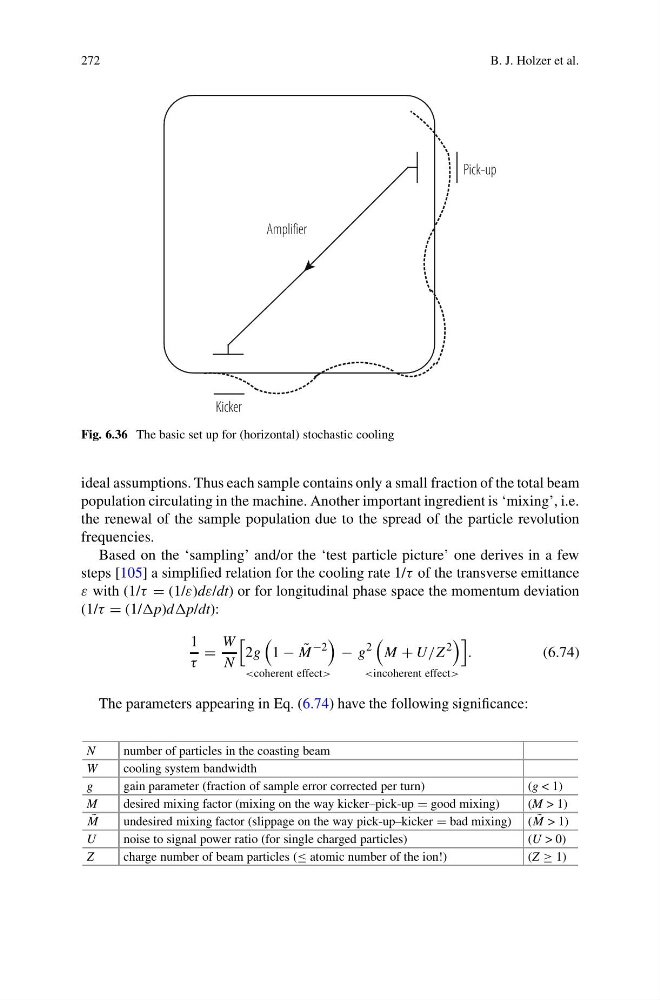
Fig. 6.36 The basic set up for (horizontal) stochastic cooling
ideal assumptions. Thus each sample contains only a small fraction of the total beam
population circulating in the machine. Another important ingredient is ‘mixing’, i.e.
the renewal of the sample population due to the spread of the particle revolution
frequencies.
Based on the ‘sampling’ and/or the ‘test particle picture’ one derives in a few
steps [105] a simplified relation for the cooling rate 1/τ of the transverse emittance
ε with (1/τ = (1/ε)dε/dt) or for longitudinal phase space the momentum deviation
(1/τ = (1/
1
τ
=
W
N
2g
1 − ˜
M
−2
− g
2
M + U/Z
2
.
(6.74)
The parameters appearing in Eq. (6.74) have the following significance:
N
number of particles in the coasting beam
W
cooling system bandwidth
g
gain parameter (fraction of sample error corrected per turn)
(g < 1)
M
desired mixing factor (mixing on the way kicker–pick-up = good mixing)
(M > 1)
˜
M
undesired mixing factor (slippage on the way pick-up–kicker = bad mixing) ( ˜
M > 1)
U
noise to signal power ratio (for single charged particles)
(U > 0)
Z
charge number of beam particles (≤ atomic number of the ion!)
(Z ≥ 1)
B. J. Holzer et al.
Fig. 6.36 The basic set up for (horizontal) stochastic cooling
ideal assumptions. Thus each sample contains only a small fraction of the total beam
population circulating in the machine. Another important ingredient is ‘mixing’, i.e.
the renewal of the sample population due to the spread of the particle revolution
frequencies.
Based on the ‘sampling’ and/or the ‘test particle picture’ one derives in a few
steps [105] a simplified relation for the cooling rate 1/τ of the transverse emittance
ε with (1/τ = (1/ε)dε/dt) or for longitudinal phase space the momentum deviation
(1/τ = (1/
1
τ
=
W
N
2g
1 − ˜
M
−2
− g
2
M + U/Z
2
.
(6.74)
The parameters appearing in Eq. (6.74) have the following significance:
N
number of particles in the coasting beam
W
cooling system bandwidth
g
gain parameter (fraction of sample error corrected per turn)
(g < 1)
M
desired mixing factor (mixing on the way kicker–pick-up = good mixing)
(M > 1)
˜
M
undesired mixing factor (slippage on the way pick-up–kicker = bad mixing) ( ˜
M > 1)
U
noise to signal power ratio (for single charged particles)
(U > 0)
Z
charge number of beam particles (≤ atomic number of the ion!)
(Z ≥ 1)