

270
B. J. Holzer et al.
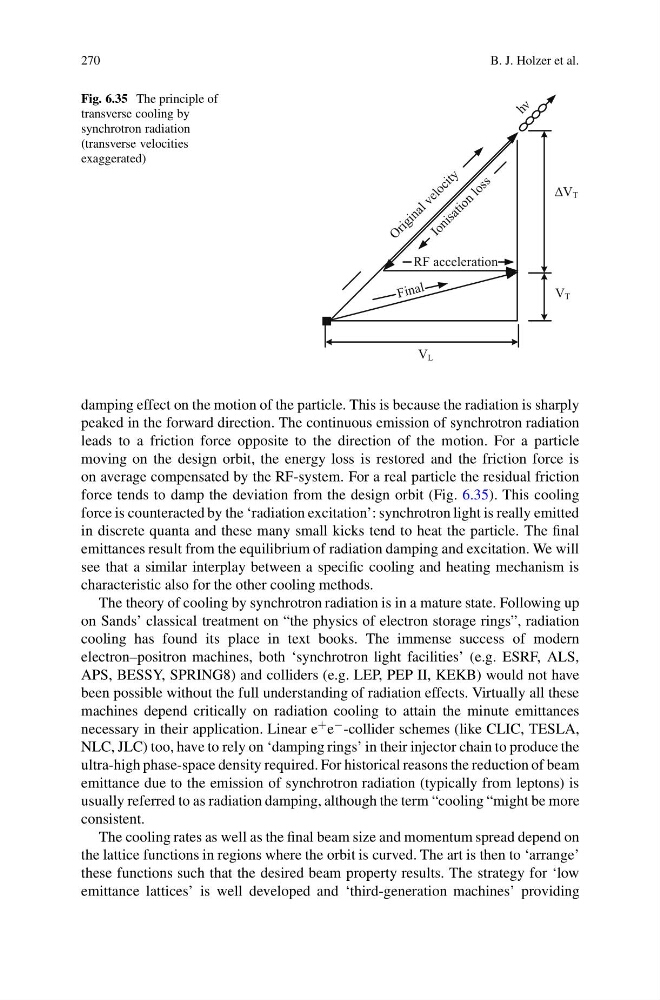
Fig. 6.35 The principle of
transverse cooling by
synchrotron radiation
(transverse velocities
exaggerated)
ΔV T
V T
V L
F in a l
O
r i g i n a l v e l o c i t y
RF acceleration
I o n i s a t i o n
l o s s
h ν
damping effect on the motion of the particle. This is because the radiation is sharply
peaked in the forward direction. The continuous emission of synchrotron radiation
leads to a friction force opposite to the direction of the motion. For a particle
moving on the design orbit, the energy loss is restored and the friction force is
on average compensated by the RF-system. For a real particle the residual friction
force tends to damp the deviation from the design orbit (Fig. 6.35). This cooling
force is counteracted by the ‘radiation excitation’: synchrotron light is really emitted
in discrete quanta and these many small kicks tend to heat the particle. The final
emittances result from the equilibrium of radiation damping and excitation. We will
see that a similar interplay between a specific cooling and heating mechanism is
characteristic also for the other cooling methods.
The theory of cooling by synchrotron radiation is in a mature state. Following up
on Sands’ classical treatment on “the physics of electron storage rings”, radiation
cooling has found its place in text books. The immense success of modern
electron–positron machines, both ‘synchrotron light facilities’ (e.g. ESRF, ALS,
APS, BESSY, SPRING8) and colliders (e.g. LEP, PEP II, KEKB) would not have
been possible without the full understanding of radiation effects. Virtually all these
machines depend critically on radiation cooling to attain the minute emittances
necessary in their application. Linear e + e − -collider schemes (like CLIC, TESLA,
NLC, JLC) too, have to rely on ‘damping rings’ in their injector chain to produce the
ultra-high phase-space density required. For historical reasons the reduction of beam
emittance due to the emission of synchrotron radiation (typically from leptons) is
usually referred to as radiation damping, although the term “cooling “might be more
consistent.
The cooling rates as well as the final beam size and momentum spread depend on
the lattice functions in regions where the orbit is curved. The art is then to ‘arrange’
these functions such that the desired beam property results. The strategy for ‘low
emittance lattices’ is well developed and ‘third-generation machines’ providing
B. J. Holzer et al.
Fig. 6.35 The principle of
transverse cooling by
synchrotron radiation
(transverse velocities
exaggerated)
ΔV T
V T
V L
F in a l
O
r i g i n a l v e l o c i t y
RF acceleration
I o n i s a t i o n
l o s s
h ν
damping effect on the motion of the particle. This is because the radiation is sharply
peaked in the forward direction. The continuous emission of synchrotron radiation
leads to a friction force opposite to the direction of the motion. For a particle
moving on the design orbit, the energy loss is restored and the friction force is
on average compensated by the RF-system. For a real particle the residual friction
force tends to damp the deviation from the design orbit (Fig. 6.35). This cooling
force is counteracted by the ‘radiation excitation’: synchrotron light is really emitted
in discrete quanta and these many small kicks tend to heat the particle. The final
emittances result from the equilibrium of radiation damping and excitation. We will
see that a similar interplay between a specific cooling and heating mechanism is
characteristic also for the other cooling methods.
The theory of cooling by synchrotron radiation is in a mature state. Following up
on Sands’ classical treatment on “the physics of electron storage rings”, radiation
cooling has found its place in text books. The immense success of modern
electron–positron machines, both ‘synchrotron light facilities’ (e.g. ESRF, ALS,
APS, BESSY, SPRING8) and colliders (e.g. LEP, PEP II, KEKB) would not have
been possible without the full understanding of radiation effects. Virtually all these
machines depend critically on radiation cooling to attain the minute emittances
necessary in their application. Linear e + e − -collider schemes (like CLIC, TESLA,
NLC, JLC) too, have to rely on ‘damping rings’ in their injector chain to produce the
ultra-high phase-space density required. For historical reasons the reduction of beam
emittance due to the emission of synchrotron radiation (typically from leptons) is
usually referred to as radiation damping, although the term “cooling “might be more
consistent.
The cooling rates as well as the final beam size and momentum spread depend on
the lattice functions in regions where the orbit is curved. The art is then to ‘arrange’
these functions such that the desired beam property results. The strategy for ‘low
emittance lattices’ is well developed and ‘third-generation machines’ providing